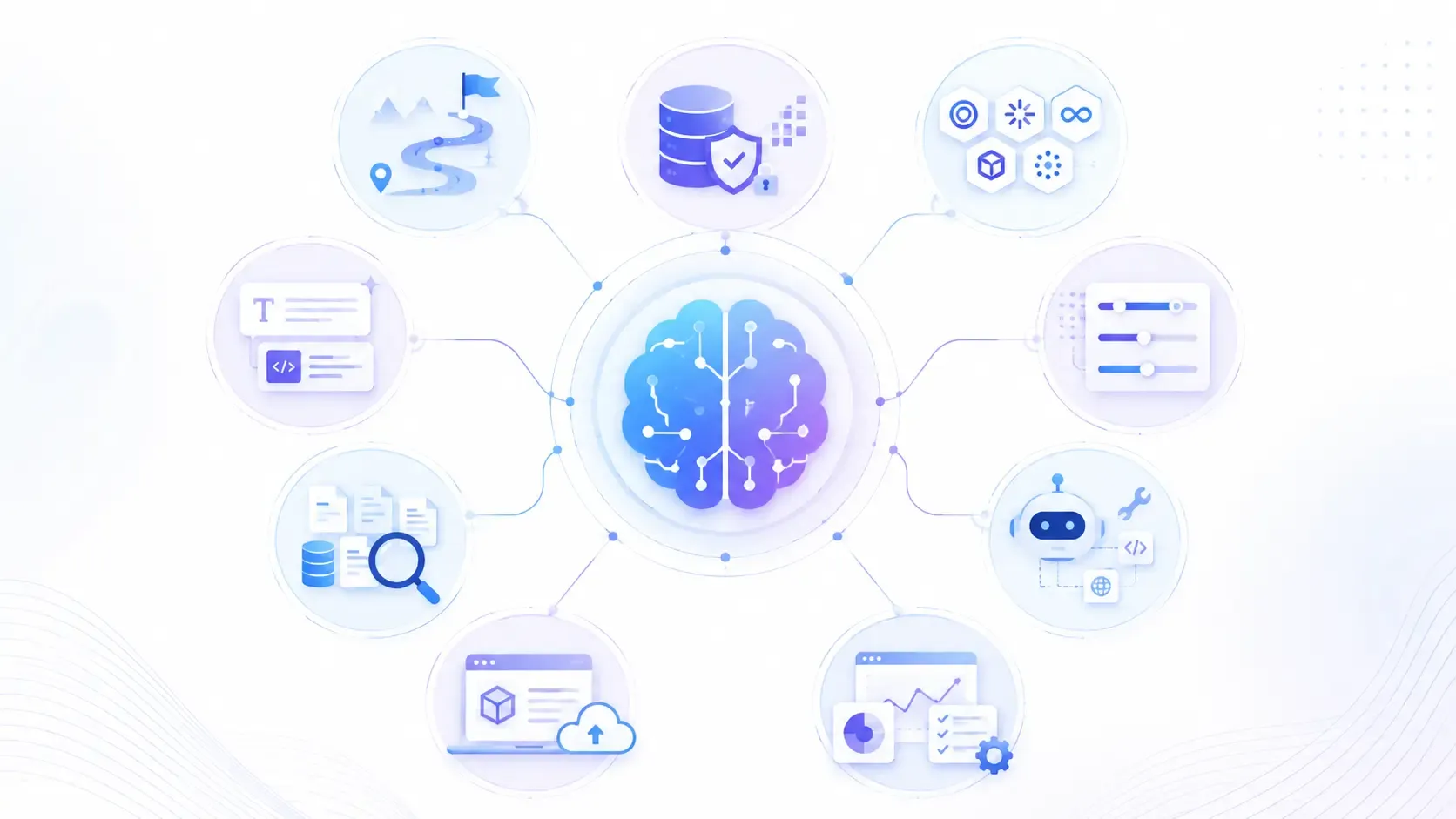
What does a generative AI development company do? In simple terms, it helps businesses plan, build, integrate, and maintain applications powered by generative AI. This can involve everything from choosing the right AI model and preparing business data to building RAG systems, AI agents, custom applications, and production-ready integrations.
The services Gen AI development companies offer vary depending on the problem being solved and the stage of the project. Some businesses may only need strategy or prompt engineering, while others require data preparation, fine-tuning, deployment, evaluation, and ongoing LLMOps support. This guide breaks down each core service, what it involves, and when it is typically needed.
- Gen AI development companies usually support the full lifecycle, from use-case selection and data preparation to RAG, fine-tuning, AI agents, deployment, evaluation, LLMOps, and ongoing maintenance.
- The right service depends on the problem: use RAG when knowledge changes frequently, fine-tuning when model behaviour needs to change, and AI agents when the system must reason across tools or multi-step workflows.
- More complexity does not always mean a better solution. Many use cases can be solved with strong prompting, retrieval, or simple integrations before fine-tuning or agentic architecture is necessary.
- Production readiness depends less on the model alone and more on data quality, evaluation, guardrails, latency, cost, and how reliably the system integrates with existing workflows.
- Early-stage projects should focus on validating the use case and technical fit; later-stage projects need stronger deployment, monitoring, security, and maintenance to keep the system reliable at scale.
What Services Do Gen AI Development Companies Offer?
The services that Gen AI development companies provide usually span the full AI development lifecycle. Below are the core services and what each one is typically used for.
1. AI Strategy Consulting
AI strategy consulting helps businesses decide where generative AI is worth using and what should be built first. Providers typically assess use cases against factors such as data availability, expected business impact, implementation complexity, privacy requirements, model cost, and integration effort.
The result is more than a list of AI ideas. It is usually a prioritized roadmap that separates viable use cases from those that add unnecessary AI complexity, then identifies whether each one needs RAG, fine-tuning, agents, or a simpler integration.
2. Data Preparation and Governance
Data preparation and governance make sure the information used by a Gen AI system is accurate, usable, and appropriately controlled. This can include cleaning duplicate or outdated records, structuring unorganized data, removing sensitive information, setting access permissions, and deciding which data the model is allowed to retrieve or process.
For RAG and enterprise AI systems, this step directly affects answer quality. Duplicate, outdated, or conflicting sources can weaken retrieval even when the underlying model performs well. Governance therefore needs to cover not only access controls, but also who owns the data, how it is updated, and which source takes priority when information conflicts.
3. AI Model Selection
AI model selection is the process of choosing the foundation model that best fits the use case, rather than defaulting to the most capable model available. The decision usually comes down to output quality, latency, context window, pricing, hosting requirements, privacy, and how much control the business needs over the model.
A proprietary model may be the faster option for teams that want managed infrastructure and quick deployment, while an open-source model can make more sense when customization, data control, or self-hosting matters. The model with the best benchmark or test results is not always the best production choice if its latency, inference cost, or infrastructure requirements make it difficult to scale.
4. Fine-Tuning Services
Fine-tuning services adapt an existing AI model using a business's own examples or task-specific datasets. Gen AI development companies typically handle dataset preparation, training, model evaluation, and testing to improve how consistently the model performs a particular task.
This service is most useful when prompt engineering alone cannot produce reliable output across repeated use cases, such as maintaining a specific response format, terminology, or domain behaviour. Fine-tuning should not be used simply to keep a model updated with new business information; when knowledge changes frequently, RAG is usually the better fit because the source data can be refreshed without retraining.
5. Prompt Engineering
Prompt engineering services focus on improving how a generative AI system interprets instructions and produces consistent outputs without changing the underlying model. Providers typically design system prompts, few-shot examples, output formats, and fallback instructions, then test them across different inputs to identify where responses become inconsistent or unreliable.
This service is often used before fine-tuning because it is faster to iterate and easier to maintain. It works well when the model already has the required knowledge but needs clearer instructions, better structure, or tighter control over how it responds.
6. RAG Implementation Services
RAG implementation services connect a generative AI system to external knowledge sources so responses can be grounded in current, business-specific information. Providers typically handle document ingestion, chunking, embeddings, vector search, retrieval logic, access controls, and evaluation of how well the system finds the right context.

Walk away with actionable insights on AI adoption.
Limited seats available!

This service is useful when the model needs to answer from private or frequently updated data, such as internal documents, policies, product information, or knowledge bases. Unlike fine-tuning, RAG can refresh what the model references without retraining it. However, adding more documents does not automatically improve answers; poor chunking, weak retrieval, or conflicting source content can reduce quality even when the underlying model is strong.
7. AI Agent Development
AI agent development services build systems that can go beyond generating responses and carry out multi-step tasks using tools, APIs, and connected business systems. Providers typically design the agent workflow, define which tools it can access, set decision rules, add memory where needed, and put guardrails around what the agent is allowed to do.
This service is useful for workflows that involve several actions, such as retrieving information, updating a CRM, creating a ticket, or triggering another system. If those steps always follow the same predictable sequence, normal workflow automation may be simpler than an AI agent.
Agents become more useful when the system needs to choose tools, reason between steps, or adapt its next action based on what happens earlier in the workflow.
8. Custom Generative AI Development
The complexity of the data, models, integrations, and infrastructure also has a major impact on generative AI app development cost. Providers build tailored applications around specific workflows, data sources, user roles, integrations, and output requirements rather than forcing the business into a generic AI setup.
This can include internal copilots, document intelligence tools, content systems, domain-specific assistants, or AI features built directly into an existing product. The focus is usually on designing the full application around the model, not necessarily training a foundation model from scratch.
9. Generative AI Integration and Deployment
Generative AI integration and deployment services connect the AI system with the applications and infrastructure where it will actually be used. Providers typically handle API integration, authentication, cloud or on-premises deployment, database connections, latency optimization, scaling, and production monitoring.
This stage is what moves a working prototype into a usable product. It also involves making sure the system can handle real traffic, maintain reliable response times, control inference costs, and work securely with existing business systems.
10. AI Evaluation, Testing, and Guardrails
AI evaluation should measure the failure modes that matter for the actual application, not just whether responses sound good. Depending on the system, this can include answer faithfulness, retrieval quality, task completion, hallucination rates, safety violations, latency, and regressions after prompt or model changes.
This service becomes especially important in production, where a model can sound confident even when the answer is wrong. Guardrails may include access controls, content filters, fallback responses, human review, and limits on what an AI agent is allowed to do.
11. MLOps and LLMOps
MLOps and LLMOps services keep generative AI systems stable after deployment. Gen AI development companies use them to monitor model performance, track prompt and model versions, measure latency and token usage, detect quality drift, and manage updates without disrupting the live application.
For LLM-based systems, this also includes monitoring retrieval quality, failed responses, evaluation scores, and changes after model or prompt updates. Cost and quality need to be tracked together; reducing token usage or switching models only helps if response quality and task success remain acceptable.
12. Ongoing Support and Maintenance
Ongoing support and maintenance services cover the work needed to keep a generative AI system reliable after launch. Providers typically handle bug fixes, prompt and model updates, security patches, retraining where required, performance tuning, and changes to integrations as the surrounding systems evolve.
This service is especially important for production AI because models, APIs, data sources, and user behaviour change over time. Regular maintenance helps prevent response quality from declining, keeps costs under control, and ensures the system continues to work as expected after deployment.
Prompt Engineering vs RAG vs Fine-Tuning vs AI Agents
These approaches are often grouped together, but they solve different problems. The main difference is whether you need to improve instructions, add knowledge, change model behaviour, or enable the system to take actions.
| Approach | What it changes | Best suited for | Key limitation |
Prompt Engineering | How the model is instructed | Improving response format, consistency, and task execution | Cannot give the model reliable access to missing or current knowledge |
RAG | The information available at query time | Private, frequently updated, or source-backed knowledge | Quality depends heavily on retrieval and source data |
Fine-Tuning | The model's learned behaviour | Consistent domain-specific outputs, formats, or task behaviour | Requires quality training data and retraining when behaviour needs to change |
What the AI can do | Multi-step workflows involving tools, APIs, and business systems | More moving parts increase the need for testing, permissions, and guardrails |
In practice, these are not always alternatives. A single AI application can use prompt engineering for instructions, RAG for knowledge, fine-tuning for specialized behaviour, and an agent layer when it needs to perform actions.
How Do Gen AI Development Services Work Together?
Gen AI development services usually work as connected stages rather than isolated tasks. Strategy defines the use case, data preparation makes the right information available, and model selection determines the technical foundation.
Walk away with actionable insights on AI adoption.
Limited seats available!
From there, prompt engineering, RAG, fine-tuning, or agent development are chosen based on what the system needs to do. Evaluation and guardrails are added before production, followed by integration, deployment, and LLMOps to keep the system reliable over time.
Typical flow: Strategy → Data Preparation → Model Selection → Build or Customize → Evaluate → Integrate → Deploy → Monitor and Improve
How to Match Gen AI Services to Your Project Stage
The list of services Gen AI development companies offer will not be equally relevant at every stage. A team validating an idea needs a very different mix of support from one already running Gen AI in production.
| Project stage | Main focus | Services typically needed | Common mistake |
Exploration | Validate feasibility | Strategy, data assessment, model selection | Choosing models before validating the use case |
Prototype | Test whether it works | Prompting, RAG/fine-tuning, evaluation | Over-engineering too early |
Development | Build the system | Custom development, agents, integrations | Adding agent autonomy before workflows are stable |
Production | Launch reliably | Deployment, testing, LLMOps | Launching without evaluation baselines |
Optimization | Improve quality and cost | Monitoring, updates, maintenance | Optimizing cost without tracking quality |
Not every project needs to move through every service. The right combination depends on what has already been validated, where the main technical gaps are, and how close the system is to production.
Frequently Asked Questions
What services do generative AI development companies provide?
Generative AI development companies provide services such as AI strategy, data preparation, model selection, prompt engineering, RAG, fine-tuning, AI agent development, integration, deployment, evaluation, LLMOps, and ongoing maintenance.
What is the role of a generative AI development company?
A generative AI development company helps turn an AI use case into a working system. This can include selecting models, connecting business data, building AI workflows, integrating existing software, testing outputs, and maintaining the system after launch.
When should a business use RAG instead of fine-tuning?
RAG is usually better when the system needs access to private or frequently changing information. Fine-tuning is better when the main requirement is changing how consistently the model behaves, responds, or follows a specific output pattern.
Do all Gen AI projects need fine-tuning?
No. Many projects work well with prompt engineering, RAG, or standard model APIs. Fine-tuning becomes useful when repeated testing shows that prompting alone cannot deliver the required consistency or specialized behaviour.
Can RAG, fine-tuning, and AI agents be used together?
Yes. They solve different problems and can be combined. RAG supplies knowledge, fine-tuning adjusts model behaviour, and AI agents allow the system to use tools and complete multi-step actions.
When should you hire a generative AI development company?
You can hire a generative AI development company for anything from validating an AI idea to building and operating a production system, particularly when the project requires custom data, integrations, evaluation, security, or ongoing monitoring

Walk away with actionable insights on AI adoption.
Limited seats available!