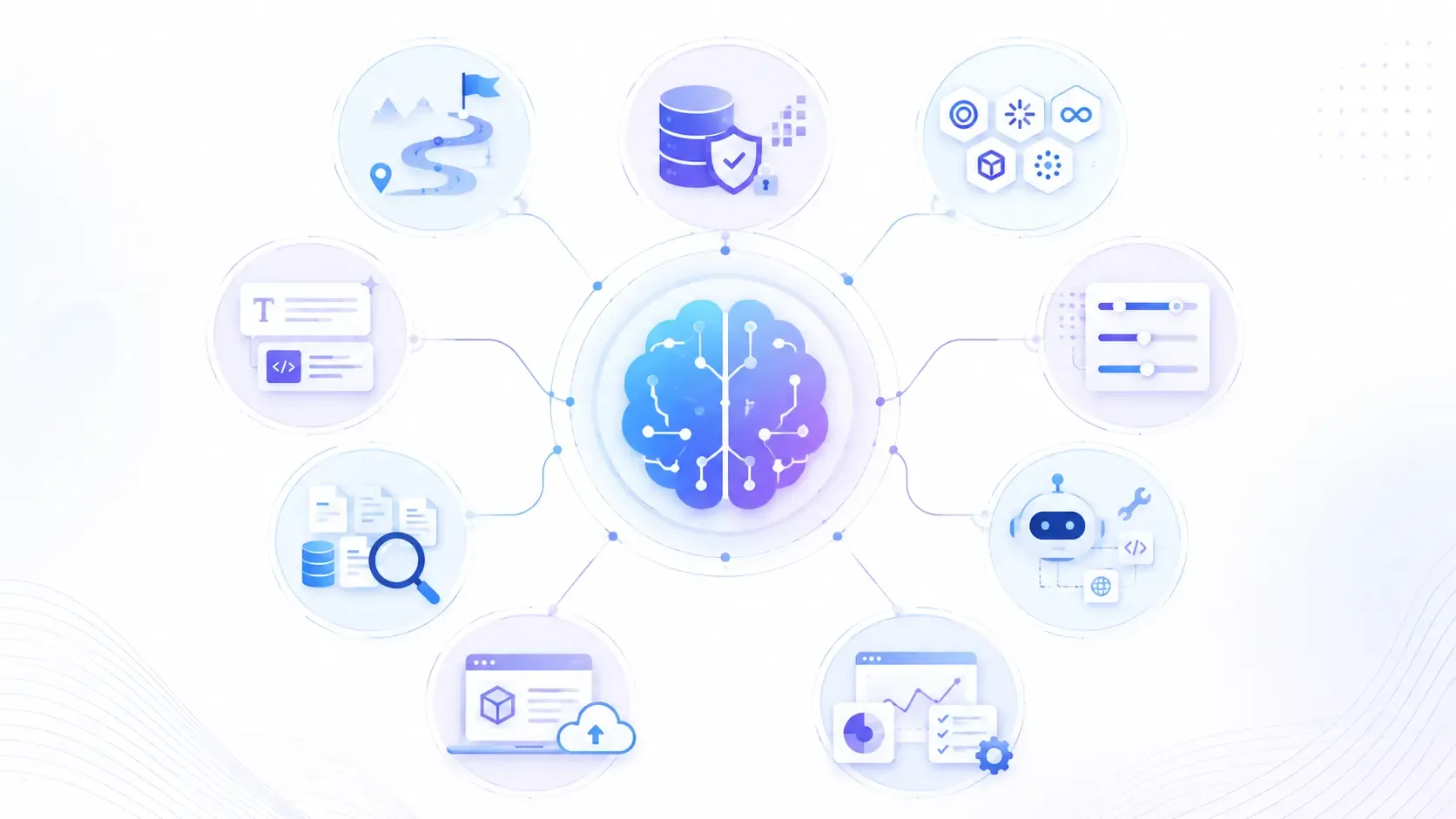
- Generative AI apps cost $20K–$60K (basic chatbots/automation), $60K–$150K+ (RAG/integrations), $150K–$300K+ (enterprise/custom models).
- Cost is driven by data readiness, model strategy, integrations, and scale, not feature count.
- Ongoing costs (token usage, infra, monitoring, retraining) typically run 15–30% of the initial build cost per year — this isn't a one-time expense.
- Estimate with: Total Cost = Development + Data + Infrastructure + Ongoing, rather than picking a number off a generic range.
- Choosing the right dev partner affects cost as much as scope does; look for real production AI experience, not just demos.
Generative AI app development cost in 2026 typically ranges from $20,000 for basic tools to $300,000+ for enterprise-grade systems. The challenge isn’t the range; it’s understanding what actually drives that cost.
If you’ve been trying to estimate the cost of building a generative AI app, you’ve likely come across numbers without context. That’s where most guides fall short.
This guide breaks down generative AI app development cost in a practical way, by use case, complexity, components, and real cost drivers like model choice, data readiness, and infrastructure.
How Much Does Generative AI App Development Cost in 2026?
Generative AI app development cost in 2026 typically ranges from $20,000 for basic applications to $300,000+ for enterprise-grade systems.
- Basic apps (chatbots, simple automation): $20K – $60K
- Mid-level apps (RAG, integrations): $60K – $150K+
- Advanced systems (enterprise, custom models): $150K – $300K+
The difference in cost comes from how the system is built, especially how it handles data, connects with other systems, and performs under real usage, not just the number of features.
What Most Generative AI Cost Estimates Get Wrong
Most generative AI cost estimates focus on features, chatbots, copilots, and automation tools. But features are only a small part of the total cost.
What actually drives cost is how the system works behind the scenes: how data is processed, how models are used, and how the system scales with usage.
That’s why two apps with similar features can have completely different costs. One may rely on simple API calls, while the other requires complex data pipelines, retrieval systems, and infrastructure to handle real-world usage.
Understanding this difference is key to estimating generative AI costs accurately.
Generative AI App Cost at a Glance
| App Type | Typical Cost Range | Timeline | Best For |
Basic AI Tools | $20K – $60K | 1–3 months | Chatbots, simple automation, internal tools |
Mid-Level AI Apps | $60K – $150K+ | 3–6 months | RAG systems, copilots, workflow automation |
Advanced AI Systems | $150K – $300K+ | 6–12+ months | Enterprise apps, multi-model systems |
Generative AI app cost increases based on how much data the system handles and how reliably it needs to perform as usage grows.
Not all generative AI apps are built for the same purpose. Let’s look at how different use cases impact cost.
Generative AI App Cost by Use Case
Not all generative AI apps are built for the same purpose. The cost varies significantly based on what the system is designed to do and the level of complexity involved.
| Use Case | Typical Cost Range | What Drives Cost |
AI Chatbots (Support, FAQ) | $20K – $80K | Prompt design, integrations, conversation flows |
AI Copilots (Internal tools) | $50K – $150K+ | Data access, workflow logic, accuracy requirements |
Content Generation Tools | $40K – $120K | Output quality, customization, moderation layers |
RAG-Based Applications | $60K – $180K+ | Data pipelines, retrieval accuracy, indexing |
AI Automation Systems | $80K – $200K+ | Workflow complexity, integrations, orchestration |
Enterprise AI Platforms | $150K – $300K+ | Security, scale, multi-system integrations |
Cost increases are driven by how the system operates behind the scenes, not just what it appears to do.
Even within the same use case, the level of complexity can significantly change the overall cost.
Generative AI App Cost by Complexity
Not all generative AI apps are built the same. Even within the same use case, the level of complexity can significantly change the cost.
At a basic level, you’re working with pre-built models and minimal logic. As complexity increases, you start dealing with data pipelines, retrieval systems, integrations, and eventually large-scale infrastructure.
Here’s how that translates into cost:
| Complexity Level | Typical Cost Range | What It Includes |
Basic | $20K – $60K | API-based apps, single workflow, minimal integrations |
Moderate | $60K – $150K+ | RAG systems, multiple workflows, integrations, and structured data handling |
Advanced | $150K – $300K+ | Enterprise systems, multi-model setup, high concurrency, scalable architecture |
As you move from basic to advanced systems, the cost is no longer driven by features alone. It’s driven by how much data the system handles, how reliably it needs to perform, and how well it scales with usage.
This is why two apps with similar features can have completely different costs, because the underlying complexity is different.
Key Factors That Influence Generative AI App Development Cost
Generative AI app development cost is driven less by features and more by a few core decisions made early in the project. These factors directly impact both build cost and long-term expenses.
- Model StrategyUsing hosted APIs (like GPT or Claude) lowers initial cost but adds ongoing usage cost. Custom or fine-tuned models increase upfront cost but offer more control.
- Data ReadinessClean, structured data reduces effort. Poor or scattered data increases time spent on cleaning, labeling, and validation, often a major cost driver.
- Use Case ComplexitySimple assistants are cheaper to build. Systems that involve reasoning, personalization, or multiple workflows require more development effort.
- IntegrationsConnecting with CRMs, ERPs, or internal tools adds complexity through authentication, APIs, and data synchronization.
- Infrastructure and UsageCosts scale with token usage, number of users, and response complexity. Without optimization, usage costs can grow quickly after launch.
- Security and ComplianceHandling sensitive data requires additional layers like encryption, access control, and audit logs, increasing development effort.
- Scalability RequirementsApps designed for high traffic, low latency, and reliability require stronger architecture and higher infrastructure investment.
These factors matter more than the number of features because they determine how the system behaves, scales, and performs in real-world usage.
To understand where most of your budget goes, it helps to break the system into its core components.
Generative AI Cost Breakdown by Components
Once you move past estimates, the cost of a generative AI app comes down to a few core components. Each one represents a real part of the system that needs to be built, connected, and maintained.
| Component | Typical Cost Range | What It Covers |
Model & AI Logic | $10K – $100K+ | API integration, fine-tuning, prompt design, evaluation |
Data Engineering | $10K – $80K | Data collection, cleaning, structuring, pipelines |
Backend & APIs | $15K – $100K | Application logic, integrations, authentication |
Infrastructure & Compute | $5K – $50K+ | Model hosting, token usage, scaling, caching |
UX/UI | $5K – $40K | Interface design, interaction flows, usability |
Testing & Security | $5K – $25K | QA, performance testing, security layers |
MLOps & Monitoring | $10K – $40K | Logging, evaluation, model monitoring |
Maintenance & Updates | 15–30% yearly | Retraining, improvements, infrastructure upkeep |
The distribution varies by project, but in most cases, data work and model-related decisions account for the largest share of the total cost.

Walk away with actionable insights on AI adoption.
Limited seats available!

Generative AI development isn’t a single step; it happens across multiple stages, each contributing to the total cost.
Generative AI Cost Breakdown by Stages
Building a generative AI app isn’t a single step, it’s a sequence of stages, each contributing to the total cost. Understanding this helps you see where most of your budget actually goes.
| Stage | Typical Cost Share | What It Includes |
Discovery & Planning | 5–10% | Use case definition, feasibility, architecture decisions |
Design (UX/UI) | 10–15% | User flows, interaction design, prompt UX |
Data Preparation | 15–30% | Data collection, cleaning, structuring, compliance |
Model Development | 20–30% | Model integration, fine-tuning, prompt engineering |
Backend & Integration | 15–25% | APIs, workflows, system integrations |
Testing & QA | 10–15% | Functional testing, performance, security validation |
Deployment & Monitoring | 5–10% | Infrastructure setup, logging, performance tracking |
In most generative AI projects, data preparation and model development take the largest share, while early planning helps reduce costly rework later.
Hidden and Ongoing Costs of Generative AI Apps
The initial build cost is only part of the investment. Generative AI apps continue to incur costs after launch, often in ways that are underestimated during planning.
- Model Usage (Token Costs)
API-based models charge per request. As usage grows, token consumption becomes a major recurring cost.
- Infrastructure & Compute
Hosting, scaling, caching, and storage costs increase with traffic and data volume.
- Model Monitoring & MLOps
Ongoing tracking of performance, errors, and drift requires tools and engineering effort.
- Retraining & Updates
Models need periodic updates to stay accurate as data and user behavior change.
- Data Maintenance
Keeping data pipelines clean, updated, and compliant adds continuous effort.
- Security & Compliance
Regular audits, access control updates, and data protection measures increase operational cost.
- Feature Improvements & Iterations
Enhancements, optimizations, and new use cases add to long-term development spend.
- RAG Re-indexing Costs (usage-independent)
If your app uses retrieval (RAG), every time source documents change, they need to be re-embedded and re-indexed, a cost driven by how much your data changes, not how many users you have. Teams that budget only for token usage per query are often blindsided by this, since it scales with content volume even at zero traffic.
In most cases, these ongoing costs account for 15–30% of the initial development cost per year, making them a critical part of total investment planning.
What Increases Generative AI App Cost the Most
While many factors influence cost, some have a significantly higher impact on your total budget than others.
| Cost Driver | Why It Increases Cost |
Data Complexity | Requires cleaning, labeling, structuring, and compliance handling |
Model Choice | Fine-tuned or custom models increase development and infrastructure effort |
RAG & Data Pipelines | Needs indexing, retrieval logic, and continuous data updates |
High Usage / Scale | Increases token usage, infrastructure, and performance requirements |
Integrations | Adds API complexity, authentication, and data synchronization effort |
Security & Compliance | Requires encryption, access control, audits, and governance layers |
Scalability Requirements | Demands robust architecture, monitoring, and reliability systems |
Cost increases are driven more by system complexity and scale than by the number of features.
How to Reduce Generative AI Development Cost
Generative AI projects become expensive not because of what you build, but how you build it. The biggest savings come from making the right decisions early.
| Strategy | How It Reduces Cost |
Start with an MVP | Focus on one use case, avoid building unnecessary features |
Use API-Based Models First | Avoids the high upfront cost of custom model development |
Optimize Token Usage | Reduces ongoing API and compute costs at scale |
Use High-Quality Data | Cuts down rework and improves model accuracy faster |
Limit Early Integrations | Keeps initial development simpler and faster |
Choose Scalable Architecture | Prevents expensive rework as usage grows |
Build in Phases | Validates ROI before committing to full-scale investment |
Instead of trying to optimize everything at once, focus on controlling complexity early. Most cost overruns happen when teams scale too fast without validating what actually works.
Instead of relying on rough ranges, you can estimate cost more accurately by breaking it into components.
Generative AI Cost Estimation Formula
Estimating generative AI cost becomes much clearer when you break it into core components instead of guessing a total number.
A simple way to estimate your budget:
Total Cost = Development Cost + Data Cost + Infrastructure Cost + Ongoing Cost
| Component | What It Includes |
Development Cost | Model integration, backend, APIs, UI, and overall build |
Data Cost | Data collection, cleaning, labelling, and pipeline setup |
Infrastructure Cost | Model hosting, token usage, storage, and scaling |
Ongoing Cost | Monitoring, retraining, updates, and maintenance |
How to Use This
Start by estimating each component separately based on your use case and complexity level. Then combine them to get a realistic total instead of relying on generic ranges.
For most projects:
- Development forms the initial bulk of the cost
- Data and infrastructure vary based on usage
- Ongoing cost typically adds 15–30% annually
The biggest mistake in AI cost estimation is treating it as a one-time expense. Generative AI apps are ongoing systems, and your budget should reflect both build and long-term operation.
Beyond cost, the choice of development partner can significantly impact both budget and outcomes.
How to Choose the Right Generative AI Development Partner
Choosing the right generative AI development partner has a direct impact on both cost and outcome. The difference isn’t just delivery; it’s how efficiently the system is built and scaled.
- Experience with Production AI Systems
Look for teams that have built real-world AI applications, not just prototypes or demos.
- Clarity on Model Strategy
Walk away with actionable insights on AI adoption.
Limited seats available!
They should guide you on when to use APIs, fine-tuning, or custom models, not default to one approach.
- Strong Data Handling Capabilities
Data pipelines, cleaning, and structuring should be a core strength, not an afterthought.
- Understanding of Cost vs Performance Trade-offs
The right partner helps you balance accuracy, speed, and cost, not just maximize output.
- Integration Expertise
Ability to connect AI systems with your existing tools (CRM, ERP, internal systems) without adding unnecessary complexity.
- Focus on Scalability and MLOps
They should plan for monitoring, updates, and long-term performance from the start.
- Transparent Cost Structure
Clear breakdown of development, infrastructure, and ongoing costs, no hidden assumptions.
- Collaborative Approach
Willingness to work closely with your team, iterate, and adapt as requirements evolve.
A strong partner doesn’t just build your AI system, they help you avoid unnecessary cost, reduce rework, and scale efficiently over time.
Conclusion
The generative AI app development cost in 2026 isn’t a fixed number; it’s a function of decisions. Model choice, data readiness, system complexity, and scale have far more impact than feature count alone.
What matters is not estimating a perfect number upfront, but understanding where your budget goes and how it evolves as the system grows. Teams that approach AI development with clarity, starting small, validating early, and scaling based on real usage, consistently control costs better.
If you’re planning a generative AI app, focus on building a system that works reliably for your core use case first. Everything else can follow once the value is proven.
Frequently Asked Questions
How much does generative AI app development cost in 2026?
It typically ranges from $20,000 to $300,000+, depending on use case, model choice, data complexity, and scale.
What affects the generative AI app development cost the most?
Data complexity, model strategy, integrations, and system scale have the biggest impact on overall cost.
Are API-based AI apps cheaper than custom models?
Yes. API-based apps have lower upfront cost but higher ongoing usage costs, while custom models require higher initial investment.
How long does it take to build a generative AI app?
It usually takes 1–3 months for basic apps and 3–12+ months for more complex or enterprise systems.
What are the hidden costs of generative AI apps?
Token usage, infrastructure, monitoring, retraining, and ongoing maintenance costs are often underestimated.
Can I reduce generative AI development cost?
Yes. Starting with an MVP, using API-based models, optimizing token usage, and limiting early complexity can significantly reduce costs.
Is generative AI development a one-time cost?
No. It involves ongoing costs such as infrastructure, updates, and monitoring, typically 15–30% of the initial cost annually.
Do I need a custom model to build a generative AI app?
Not always. Most apps start with pre-built models and move to custom or fine-tuned models as requirements grow.

Walk away with actionable insights on AI adoption.
Limited seats available!