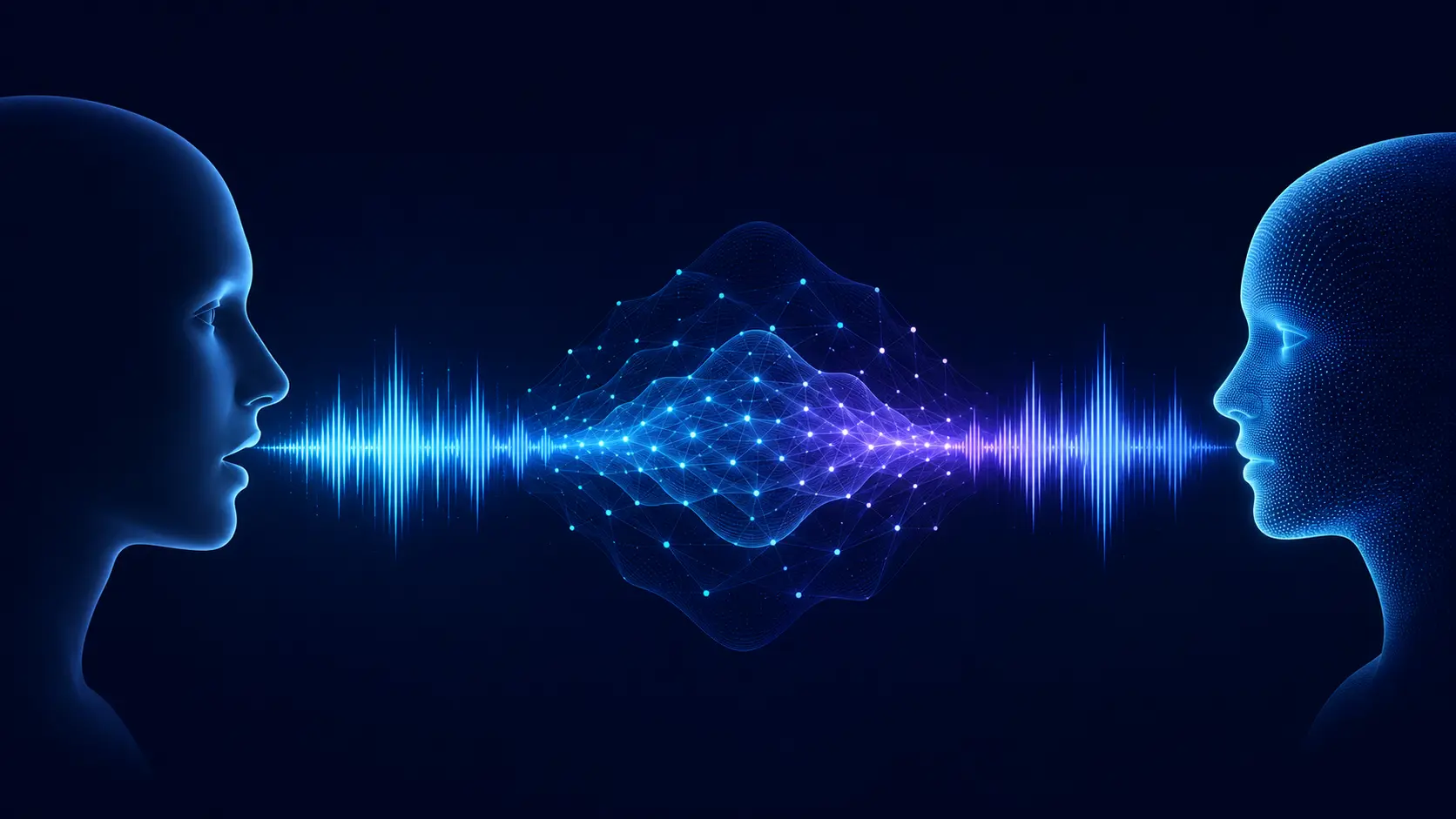
- Voice cloning creates synthetic speech that resembles a specific person.
- Some systems can produce a basic clone from a short recording, while higher-quality models may require longer and more varied audio.
- Voice cloning differs from ordinary text-to-speech because it attempts to preserve the identity and speaking characteristics of a particular speaker.
- Common applications include narration, voice bots, games, accessibility, localisation, and personalised assistants.
- Hosted platforms provide the fastest way to experiment, while open-source models offer more control over deployment and data.
- A voice should not be cloned without clear permission from the person it represents.
- Voice cloning systems need safeguards against impersonation, fraud, unauthorised distribution, and misuse.
AI voice cloning uses artificial intelligence to create a digital version of a person’s voice. Once created, the voice clone can speak new words and scripts without requiring the original speaker to record every line.
The technology addresses a practical problem: producing speech at scale. Traditionally, a creator, educator, voice artist, or product team had to record every new message separately. With voice cloning, text can be converted into speech that reflects the original speaker’s tone, accent, rhythm, and vocal character.
Voice cloning is already used in narration, content production, accessibility tools, games, and conversational AI. However, the same ability to reproduce a recognisable voice also introduces risks involving consent, fraud, impersonation, and ownership.
This guide explains what voice cloning is, how it works, where it is useful, and how developers can experiment with it through a hosted platform or an open-source model.
What Is AI Voice Cloning?
AI voice cloning is the process of capturing the vocal characteristics of a speaker and applying them to newly generated speech.
A traditional text-to-speech system uses a predefined voice. Voice cloning adds another capability: it conditions the generated speech on a reference recording of a particular speaker.
For example, someone could provide a recording of their voice and then enter a new product announcement as text. The system would generate that announcement in a voice resembling the reference speaker, even though the speaker never recorded those exact words.
The result is synthetic speech, not a rearrangement of previously recorded sentences. The model generates a new waveform based on the input text and the characteristics it learned or extracted from the voice sample.
Voice cloning quality varies considerably. A short sample may capture the broad identity of a voice, but it may struggle with emotion, unusual pronunciations, long-form consistency, or a speaking style that was not represented in the recording.
How Does AI Voice Cloning Work?
Although implementations differ, voice cloning generally involves four stages.
1. Capture a Reference Recording
The system first receives a sample of the target voice. The recording should contain clear speech with minimal background noise, echo, music, or overlapping speakers.
Audio quality often matters more than simply increasing duration. A clean recording helps the system focus on the speaker instead of learning microphone noise or room acoustics.
The amount of audio required depends on the platform and cloning method. Some rapid systems can work from a few seconds, while professional fine-tuned models may need considerably more material.
2. Represent the Speaker’s Voice
Many voice cloning systems convert the reference recording into a numerical representation commonly called a speaker embedding.
This representation captures voice-related patterns such as timbre, pitch range, accent, cadence, and pronunciation. It is not an audio recording that the system simply plays back. It is a compact profile used to condition the speech-generation process.
Not every modern model follows this exact design. Some newer systems condition directly on reference audio instead of producing a separate, reusable speaker embedding. The underlying objective remains the same: preserve the identity of the reference speaker while generating new content.
3. Interpret the Input Text
The model processes the requested text and determines how it should be spoken. This includes pronunciation, pauses, sentence rhythm, syllable duration, stress, and intonation.
This stage explains why punctuation and sentence construction influence the result. The same voice may sound natural with a conversational script but unnatural when given a long, poorly punctuated paragraph.
4. Generate the Audio
The system combines the linguistic information with the voice characteristics extracted from the sample. It then generates a new audio waveform that speaks the requested text in the cloned voice.
The output may still require adjustments to pacing, expressiveness, pronunciation, or stability. A convincing voice identity does not automatically guarantee a natural performance.
Technologies Behind Voice Cloning
Voice cloning systems may use several specialised components, although modern end-to-end models sometimes combine their responsibilities.

Walk away with actionable insights on AI adoption.
Limited seats available!

A speaker encoder identifies the vocal characteristics associated with a speaker. A text-to-speech model determines what the text should sound like, including its pronunciation and rhythm. A vocoder converts an intermediate acoustic representation into the final waveform that listeners hear.
Models such as Tacotron 2 helped establish neural text-to-speech generation, while VITS combined more of the pipeline into an end-to-end architecture. Neural vocoders such as WaveNet and HiFi-GAN significantly improved speech quality compared with older signal-processing methods.
These names are useful for understanding the development of voice synthesis, but developers using a hosted API usually do not interact with each component separately. The platform handles the complete pipeline and returns generated audio.
3 Types of AI Voice Cloning
1. Zero-Shot or Instant Voice Cloning
Zero-shot systems generate a voice clone from reference audio without training a separate model for that individual. They are fast and useful for prototypes, personalised experiences, and applications that need to support many speakers.
The trade-off is consistency. A short sample may not capture how the person speaks across different emotions, languages, or sentence structures.
2. Fine-Tuned Voice Cloning
Fine-tuned systems train or adapt a model using a larger collection of recordings from one speaker. They can provide stronger identity preservation and more consistent long-form speech.
This approach requires more audio, preparation, training time, and quality control. It is better suited to audiobooks, professional narration, licensed voice products, or recurring brand content.
3. Real-Time Voice Cloning
Real-time systems generate speech with sufficiently low latency for conversations, calls, games, and voice agents.
Real-time performance involves more than fast audio generation. The complete application must also account for speech recognition, model response time, audio streaming, interruptions, and network latency.
Where Is Voice Cloning Used?
Voice cloning is valuable when teams need repeated or personalised speech without arranging a new recording session for every change.
Content creators can update podcast segments, videos, and narration in a consistent voice. Audiobook and learning platforms can produce additional material without repeatedly bringing the speaker back into the studio.
Conversational AI systems can use an approved brand or character voice across customer interactions. Games can generate character dialogue dynamically, while localisation teams can reproduce a speaker’s vocal identity in supported languages.
One of its most meaningful applications is accessibility. People who expect to lose their natural speech may record their voices in advance, while restoration systems can help some users communicate through a voice that better reflects their identity.
Voice cloning can also support:
- AI interview and recruitment platforms
- Customer-support voice agents
- Personalised assistants
- Product demonstrations
- Training and educational material
- Game characters and interactive stories
Benefits of Voice Cloning
The main benefit is scalability. Once an approved voice has been created, teams can generate new speech without recording every sentence manually.
It can also shorten production cycles. Script corrections that once required another studio session may be generated more quickly, making it easier to update announcements, tutorials, and product content.
Voice cloning enables personalisation as well. A product can offer different approved voices based on user preferences, language, audience, or context.
These benefits do not eliminate the need for human direction. Pronunciation, emotional delivery, pacing, and context still need review, especially when the audio represents a real person or brand.
How to Create an AI Voice Clone
There are two practical ways to experiment with voice cloning: use a hosted platform or run an open-source model locally.
Option 1: Use an Existing Platform
Platforms such as Cartesia and ElevenLabs provide interfaces and APIs for creating and using custom voices. The exact process varies, but it generally involves:
- Recording or uploading an authorised voice sample.
- Creating a voice profile.
- Providing the text to be spoken.
- Generating and reviewing the output.
I used Cartesia to create a clone of my own voice. You can listen to the generated sample here.
When evaluating the result, do not judge only whether it “sounds similar.” Listen for pronunciation, pacing, emotional consistency, background artefacts, and whether the voice remains stable across longer scripts.
Platform rules also differ. For example, ElevenLabs requires users to confirm that they have the right and consent to create an instant clone. Its Professional Voice Cloning product only allows users to clone their own verified voice.
Option 2: Run LuxTTS Locally
Developers who want more control can experiment with LuxTTS, an Apache 2.0-licensed, open-source voice-cloning model.
Walk away with actionable insights on AI adoption.
Limited seats available!
Clone and install the project:
git clone https://github.com/ysharma3501/LuxTTS.git
cd LuxTTS
pip install -r requirements.txt
Run basic inference:
import soundfile as sf
from zipvoice.luxvoice import LuxTTS
# Use "cuda" for a GPU, "cpu" for a CPU,
# or "mps" for an Apple Silicon Mac.
lux_tts = LuxTTS("YatharthS/LuxTTS", device="cuda")
text = "Hey, what's up? I'm feeling really great if you ask me honestly!"
prompt_audio = "audio_file.wav"
encoded_prompt = lux_tts.encode_prompt(prompt_audio, rms=0.01)
final_wav = lux_tts.generate_speech(
    text,
    encoded_prompt,
    num_steps=4,
)
sf.write(
    "output.wav",
    final_wav.numpy().squeeze(),
    48000,
)
For CPU execution:
lux_tts = LuxTTS(
    "YatharthS/LuxTTS",
    device="cpu",
    threads=2,
)
For Apple Silicon:
lux_tts = LuxTTS(
    "YatharthS/LuxTTS",
    device="mps",
)
The LuxTTS repository recommends a reference clip of at least three seconds and writes the generated output at 48 kHz. A longer, clean recording may still produce a more stable representation than a noisy minimum-length sample.
Risks and Ethical Concerns
The most important requirement is consent. A voice is closely connected to a person’s identity, reputation, relationships, and livelihood. Publicly available audio should not be treated as automatic permission to create a clone.
Voice cloning can also make impersonation scams more convincing. Fraudsters may imitate relatives, executives, public figures, or service providers to request money or sensitive information. The US Federal Trade Commission has specifically warned that voice cloning can strengthen family-emergency and impersonation scams.
Voice-based authentication creates another concern. A recognisable voice should not be treated as sufficient proof of identity when synthetic speech can imitate vocal characteristics.
Responsible systems should obtain documented permission, restrict who can access a clone, maintain audit records, disclose synthetic audio where appropriate, and provide a way to delete or revoke the voice. Watermarking, provenance signals, liveness checks, and abuse monitoring can add protection, but no single safeguard is perfect.
Legal requirements vary by location and use case. Teams should review applicable privacy, publicity, biometric-data, copyright, contract, consumer-protection, and impersonation rules before releasing a voice-cloning product.
Conclusion
AI voice cloning allows new speech to be generated in a voice that resembles a reference speaker. It can reduce repeated recording work, enable personalised audio, and support applications ranging from narration and games to accessibility and conversational AI.
The technology is also easy to misuse. A successful implementation therefore requires more than natural-sounding output. Teams must consider consent, access control, disclosure, security, and what happens to the voice data after it is uploaded.
For developers, hosted platforms offer the fastest way to test the experience, while open-source models such as LuxTTS provide greater control. Whichever approach you choose, evaluate both sides of the system: how convincingly it generates speech and how responsibly it protects the person behind the voice.
Frequently Asked Questions
How much audio is required for voice cloning?
Requirements vary by model. Some systems accept a few seconds for basic cloning, while higher-quality or fine-tuned voices may require several minutes or more of clean, varied recordings.
Is voice cloning the same as text-to-speech?
Not exactly. Text-to-speech generates spoken audio from text, while voice cloning conditions that speech on the characteristics of a particular speaker captured from reference recordings.
Can voice cloning work in real time?
Yes, some models generate audio fast enough for calls and assistants. The perceived delay also depends on speech recognition, response generation, streaming, network performance, and playback.
Is it legal to clone someone’s voice?
The answer depends on jurisdiction and intended use. Obtain explicit permission and review applicable privacy, publicity, biometric-data, impersonation, consumer-protection, copyright, and contractual requirements before using someone’s voice.
Can AI clone any voice?
Not reliably. Results depend on recording quality, available speech, language support, accent coverage, model capability, and vocal characteristics. Some voices and speaking styles are more difficult to reproduce consistently.
What is the biggest challenge in voice cloning?
The challenge is balancing identity similarity with natural pronunciation, emotion, and long-form consistency while preventing unauthorised cloning, impersonation, fraud, and misuse of the resulting digital voice.

Rabbani Shaik
AI enthusiast who loves building cool stuff by leveraging AI. I explore new tools, experiment with ideas, and share what I learn along the way. Always curious, always building!
Walk away with actionable insights on AI adoption.
Limited seats available!