- AI agents are autonomous systems that perceive, reason, act, evaluate results, and adapt until a goal is completed.
- Their core components include perception, memory, reasoning, tool use, and action execution.
- The five main types are reflex, model-based, goal-based, utility-based, and learning agents.
- Unlike chatbots, agents can complete multi-step workflows and interact with external systems.
- Multi-agent systems divide complex tasks among specialized agents coordinated in parallel or sequence.
- Popular frameworks include LangGraph, CrewAI, AutoGen, LangChain, and MCP.
- Responsible deployment requires privacy controls, explainability, human oversight, and regular auditing.
AI agents are reshaping how software operates, moving from tools that respond to tools that act. From autonomous customer support to self-directing research assistants, AI agents are no longer experimental.
By 2026, 40% of enterprise applications are projected to include task-specific agents, up from less than 5% just a year ago. This guide covers everything: what an AI agent is, how it works, its types, components, and where it is headed.
What Is an AI Agent?
An AI agent is an autonomous software system that perceives its environment, reasons about it, and takes actions to achieve a defined goal, without requiring human input at every step.
Unlike a traditional chatbot that responds to one message at a time, an AI agent operates in a continuous loop: it observes, plans, acts, evaluates the result, and adapts, repeating until the task is complete. According to IBM, AI agents are capable of designing their own workflows and utilising available tools to accomplish complex objectives.
In simple terms, a chatbot answers your question. An AI agent books your flight, checks your calendar, sends the confirmation, and follows up if there is a conflict.
How Do AI Agents Work?

Every AI agent operates on a continuous perception-reasoning-action loop:
- Perceive — the agent takes in input from its environment: user queries, API responses, file contents, sensor data, or web searches
- Reason — using an LLM or other model, it interprets the input, evaluates its goal, and decides what to do next
- Act — it executes an action: calling an API, running code, searching the web, writing a file, or sending a message
- Observe — it evaluates the result of the action
- Iterate — it loops back, adjusting its plan based on what it learned, until the goal is achieved
This loop is what separates AI agents from traditional software. A fixed program follows instructions. An AI agent pursues outcomes.
Core Components of AI Agents
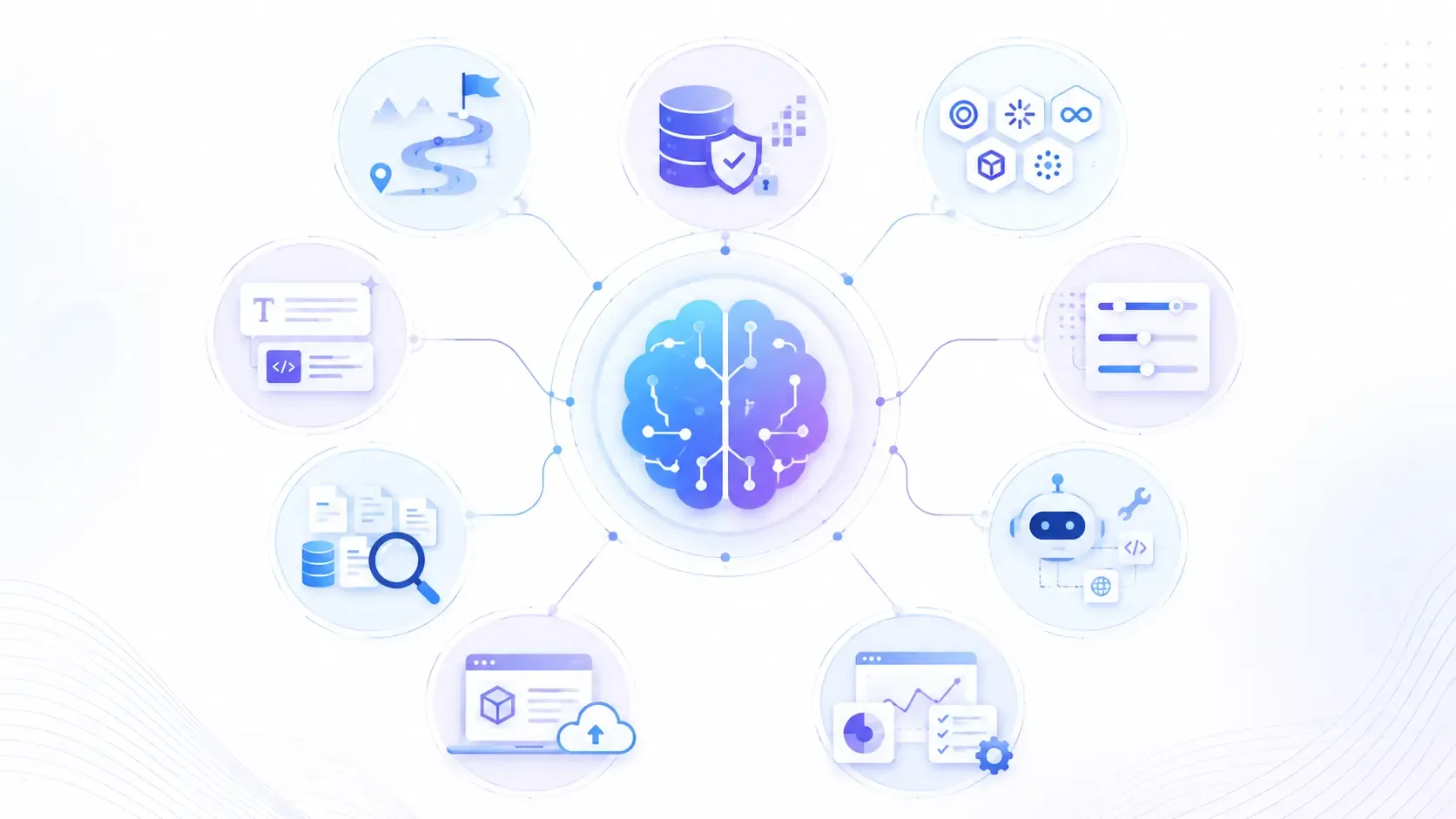
According to Google Cloud, every AI agent is built from five core components:
Perception — the ability to receive and interpret inputs from the environment. This includes text, images, structured data, tool outputs, and real-time signals.
Memory — agents maintain two types of memory:
- Short-term (context window) — the active conversation and task state
- Long-term (external storage) — persistent memory stored in vector databases or files, retrieved as needed
Reasoning & Planning — the agent's "brain," typically powered by an LLM. It decomposes goals into sub-tasks, selects strategies, and handles ambiguity.
Tool Use — agents extend their capabilities by calling external tools: web search, code execution, API calls, database queries, calendar access, and more.
Action Execution — the ability to take real-world actions — not just generate text, but write files, trigger workflows, send messages, and interact with external systems.
5 Types of AI Agents
AI agents are classified by how they make decisions and how much environmental context they use.

1. Simple Reflex Agents
Respond to current input using predefined condition-action rules. No memory, no planning. Fast but limited, only effective in fully observable environments. Example: a thermostat that turns heating on when temperature drops below a threshold.
2. Model-Based Reflex Agents
Maintain an internal model of the world, allowing them to handle partially observable environments. They track state over time and make decisions based on both current input and historical context.

Walk away with actionable insights on AI adoption.
Limited seats available!

3. Goal-Based Agents
Extend model-based agents with explicit objectives. They evaluate multiple possible action sequences and choose the one most likely to achieve the goal. This requires search and planning, making them proactive rather than reactive.
4. Utility-Based Agents
Add a utility function on top of goal-based reasoning. When multiple paths lead to the goal, the agent picks the one that maximises a defined measure of success, balancing speed, accuracy, cost, or any other metric.
5. Learning Agents
Improve performance over time through feedback. A learning agent has four components: a learning element that updates behaviour, a critic that evaluates performance, a performance element that executes actions, and a problem generator that explores new strategies. Modern LLM-based agents are largely learning agents.
Agentic AI vs AI Agents
These terms are related but distinct:
| Term | Meaning |
| AI Agent | A specific autonomous system built to complete a task |
| Agentic AI | A design philosophy — building AI systems that act autonomously over multi-step workflows |
Agentic AI is the broader paradigm. An AI agent is the implementation. When companies say they are "going agentic," they mean they are designing systems where AI makes decisions and takes actions across a workflow, not just answering individual prompts.
Multi-Agent Systems
A single AI agent handles one task. A multi-agent system splits a complex workflow across multiple specialized agents working in parallel or sequence.
For example, a research workflow might use:
- A search agent to gather information
- A summarization agent to condense it
- A fact-checking agent to verify claims
- An orchestrator agent to coordinate all three
Queries for multi-agent systems surged 1,445% in 2025, reflecting rapid enterprise adoption. Organizations deploying multi-agent workflows report an average 35% productivity gain and 30% cost reduction.
How agents communicate in multi-agent systems:
- Hierarchical — an orchestrator delegates to sub-agents
- Collaborative — agents share state and pass outputs peer-to-peer
- Competitive — agents propose solutions independently; the best one wins
For teams moving from prototypes to production, Databricks provides the Databricks Data + AI Platform for building AI agents grounded in enterprise data. Its Agent Bricks multi-harness agent development platform lets teams build and deploy agents with any combination of models, frameworks, harnesses, and data sources, with no vendor lock-in. Omnigent, a meta-harness for multi-agent workflows, lets teams combine and share agents across projects, while Unity Catalog provides unified governance for data, models, tools, and agents.
AI Agent Frameworks in 2026
These are the most widely used frameworks for building AI agents in production:
LangGraph — builds agents as stateful graphs, making complex multi-step and multi-agent workflows explicit and controllable. Best for production systems where reliability matters.
CrewAI — role-based multi-agent framework where each agent has a defined role, goal, and toolset. Strong for collaborative agent pipelines.
AutoGen (Microsoft) — conversation-driven multi-agent framework optimized for code generation and tool-heavy tasks.
LangChain — the most widely adopted agent framework overall. Flexible, extensive tooling ecosystem, large community.
Model Context Protocol (MCP) — an open standard introduced by Anthropic that simplifies AI integration by giving agents a unified interface to external tools and data sources.
Real-World Applications
Customer Support — AI agents handle multi-turn conversations, access order history, process refunds, and escalate to humans only when needed. Companies like Zendesk and Intercom deploy agents that resolve the majority of support tickets autonomously.
Healthcare — Virtual health agents check symptoms, manage appointment scheduling, send medication reminders, and flag clinical risks to practitioners. They operate 24/7 without clinician involvement for routine tasks.
Software Engineering — Coding agents write code, run tests, interpret errors, and iterate on fixes autonomously. Tools like GitHub Copilot Workspace and Cursor are shifting developers from writing code to reviewing agent-generated code.
Finance — Agents monitor transactions for fraud patterns, generate financial reports, and execute rule-based trading decisions in real time.
Robotics and Automation — Manufacturing robots use AI agents to adapt to production line changes, perform quality inspection, and optimize throughput without manual reprogramming.
Gaming — NPC behavior, dynamic difficulty adjustment, and procedural content generation are all driven by AI agents that adapt to player behavior in real time.
Walk away with actionable insights on AI adoption.
Limited seats available!
Ethical and Security Considerations
As AI agents gain autonomy, three risk areas require active governance:
Privacy — Agents operating on user data must adhere to data minimisation principles. The more autonomous the agent, the more data it typically accesses — raising questions about consent, storage, and third-party exposure.
Bias — Agents trained on biased datasets perpetuate those biases at scale and at speed. Amazon's scrapped AI recruiting tool, which systematically disadvantaged women because it was trained on historically male-dominated hiring data, is the textbook example of what unchecked bias in an autonomous system looks like.
Accountability — When an AI agent makes a consequential decision, accountability frameworks must be clear. Who is responsible when an agent makes a mistake? The developer, the deployer, or the organization using it? This is an unsolved regulatory problem in most jurisdictions.
Responsible deployment requires explainability (being able to trace why an agent took an action), human-in-the-loop escalation paths, and regular auditing for drift and bias.
The Future of AI Agents
Longer-horizon autonomy — agents in 2026 can handle multi-step tasks over hours. Future systems will handle multi-day or multi-week workflows with minimal check-ins.
Improved memory — better long-term memory architectures will allow agents to build persistent, personalized context across sessions rather than starting fresh each time.
Cross-agent collaboration — standardized protocols like MCP are enabling agents from different providers to work together on shared tasks, the beginning of true agent interoperability.
Embedded in everyday infrastructure — smart cities, personalized education, autonomous logistics, and elder care will increasingly rely on AI agents operating in the background, invisible, persistent, and continuously optimizing.
Frequently Asked Questions
What is an AI agent in simple terms?
An AI agent is an autonomous software system that perceives its environment, makes decisions, and takes actions to achieve a defined goal, without requiring human approval at every step.
What are the main types of AI agents?
The five main types are simple reflex agents, model-based agents, goal-based agents, utility-based agents, and learning agents, each progressively more capable of handling complex, uncertain environments.
How do AI agents differ from traditional software?
Traditional software executes fixed instructions. AI agents pursue outcomes, they plan, adapt, and iterate based on feedback until a goal is achieved.
What is the difference between an AI agent and a chatbot?
A chatbot handles single-turn or short-context conversations. An AI agent operates over multi-step workflows, uses external tools, maintains memory across a task, and acts autonomously to complete objectives.
What are AI agents used for in real life?
AI agents power customer support automation, healthcare virtual assistants, software engineering copilots, financial monitoring systems, autonomous robots, and gaming NPCs.
Are AI agents the same as AGI?
No. AI agents are task-specific autonomous systems. Artificial General Intelligence (AGI) refers to a system with broad, human-level intelligence across all domains, a capability that does not yet exist.

Walk away with actionable insights on AI adoption.
Limited seats available!