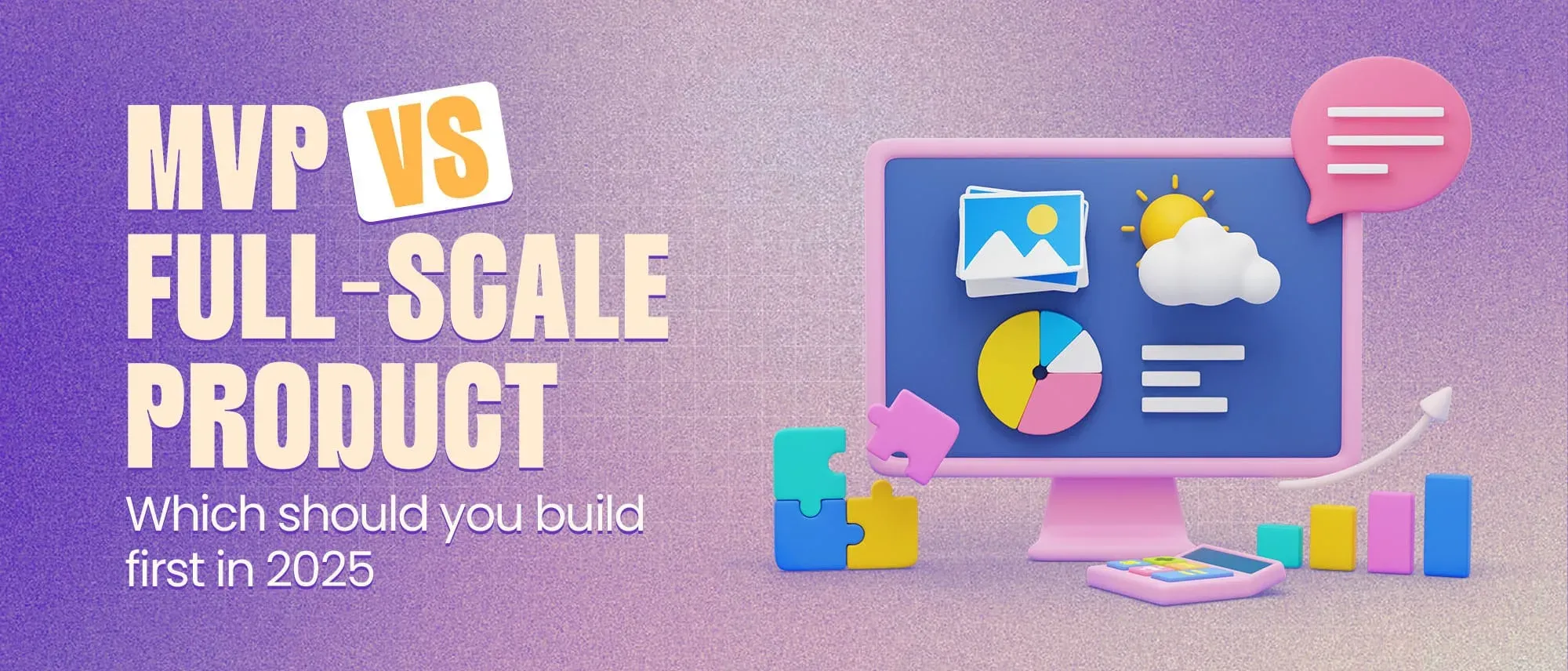
MVP vs Full-Scale Product: Which Should You Build First in 2026?
Every founder reaches the same fork: build lean and validate fast, or commit fully and launch with everything.
This is not a philosophical question. It directly determines your burn rate, your time to market, and whether you learn from real users before the market gives you an answer you did not want. 42% of startups fail because they built something nobody wanted. In most of those cases, the failure was not the idea. It was the sequence.
This guide breaks down the MVP vs full scale product decision using real outcomes, clear signals, and a decision framework you can apply to your specific situation in 2026.
What an MVP Actually Is (And What It Is Not)
An MVP is the smallest version of your product that still proves real user demand. Not the most polished version. Not a prototype. A functional, testable product that delivers core value to a defined audience and generates evidence about whether the larger bet is worth making.
Airbnb's 2008 MVP was a basic website offering air mattresses during a conference. No global infrastructure, no trust systems, no fancy design. Just enough to answer one question: will strangers pay to stay in someone else's space? They did. That answer funded everything that followed.
Dropbox validated its MVP with a two-minute video explaining a product that did not yet exist. 75,000 people signed up overnight. The video cost almost nothing. The signal it produced was worth millions.
McKinsey's data shows MVPs reduce time-to-market by 30% and costs by 25%. 74% of tech unicorns started with one. An MVP is not a compromise. It is a deliberate strategy for sequencing risk correctly.
What a Full-Scale Product Offers
A full-scale product is a complete, feature-rich build designed for a broad audience. It prioritizes depth, polish, and production quality over speed and learning. It is the right choice in specific circumstances, but it requires that demand already be validated before you build.
The risk is significant. Building a full-scale product based on unvalidated assumptions means spending 6 to 18 months and significant capital before you receive any real market feedback. If the assumptions were wrong, you have no runway left to course-correct.
Juicero spent $120 million building a premium connected juicer that users found they could replicate by hand. The product worked. The demand did not exist at that price point. A lean test could have revealed this in weeks.
MVP vs Full-Scale Product: Direct Comparison
| Factor | MVP | Full-Scale Product |
| Build cost | $20,000 to $60,000 typically | $150,000+ |
| Time to market | 6 to 12 weeks | 6 to 18 months |
| Risk level | Low: test before committing | High: commit before testing |
| Learning speed | Fast: real user feedback in weeks | Slow: feedback comes post-launch only |
| Best for | Unvalidated ideas, new markets | Validated demand, funded teams |
| Iteration flexibility | High: change before scaling | Low: expensive to change post-build |
| Investor signal | Strong with traction data | Strong with proven market fit |
| First impression | Functional, not polished | Polished, complete |

When to Build an MVP First
Build an MVP first when any of these conditions apply. You are testing a new idea with no confirmed demand. You are a first-time founder without a proven track record in the category. Your budget is limited and burning runway on unvalidated assumptions is not an option. You are entering a new or unclear market where user behavior is genuinely unknown.
Build Lean. Learn Fast.
Launch an MVP that saves money while proving your concept works.
The MVP vs full product decision is clearest here: if you cannot confidently say that users will pay for this, at this price point, you need validation before you build. An MVP is how you get that confirmation cheaply. See how MVP design and customer advocacy principles shape the kind of MVP that generates real signal rather than just early adopter enthusiasm.
When a Full-Scale Product Makes Sense?
Full-scale development makes sense when demand is already validated and the market expects completeness. Regulated industries like fintech, healthcare, and enterprise software often require a certain level of polish and reliability before users will trust the product with real data or real money.
If you have raised a seed or Series A round specifically on the basis of a proven market, your investors are expecting a product that can acquire and retain users at scale, not just validate an assumption. In these circumstances, building full-scale from the start may be the appropriate choice.
Even here, many teams run a constrained MVP phase internally before the full public build, using it to stress-test core flows before committing to the complete feature set.
Signals That Your MVP Is Ready to Scale
The MVP vs full scale product question does not end at launch. It continues throughout the life of the MVP. Scaling too early is as damaging as building full-scale before validation.
These are the signals that indicate your MVP has earned the investment of a full product build. Retention is above 40% at 30 days, meaning users are returning without being prompted. Month-over-month growth is consistently 10% to 20% or above.
Early revenue exists through pre-orders, paid beta access, or direct subscriptions. Users are requesting specific expansion features rather than reporting broken core functionality. The pivot question has been answered: you know what to keep and what to change.
Slack's MVP generated 8,000 signups in the first 24 hours and reached 15,000 daily active users within months. Those numbers told the team the direction was right. They scaled accordingly.
4 Mistakes to Avoid on the Path From MVP to Full Product
Staying in MVP mode indefinitely. Some founders iterate forever without committing to scale. An MVP is a phase with an exit condition, not a permanent product state. Define what success looks like before you build, and when you hit it, move.
Scaling before the core is stable. Pets.com spent $300 million on logistics and marketing before confirming that its unit economics worked. Fix the foundation before you build floors on top of it.
Ignoring technical debt in the MVP. Yahoo scaled on messy code and spent years paying for it while Google pulled ahead. Plan for a tech debt sprint before scaling, not after.
Overhiring ahead of demand. Color raised $41 million for an MVP and launched with a bloated team before confirming the product worked. Every hire before validation increases your burn without reducing your uncertainty

Frequently Asked Questions
Should I build an MVP or a full-scale product first?
In most cases, build an MVP first. The MVP vs full scale product decision comes down to how much validated evidence you have. If demand is unconfirmed, an MVP is the lowest-cost way to get that confirmation. If demand is already proven and capital is available, full-scale may be appropriate.
Build Lean. Learn Fast.
Launch an MVP that saves money while proving your concept works.
When should an MVP be scaled into a full product?
Scale when 30-day retention exceeds 40%, month-over-month growth is consistent, and users are requesting new features rather than reporting core functionality issues. These are signals that the foundation is sound enough to build on.
Can a startup skip the MVP and go straight to full-scale?
Yes, but only when entering regulated or trust-critical industries with confirmed demand and sufficient capital. For most startups, skipping the MVP phase means committing large resources to unvalidated assumptions.
Is an MVP enough to raise funding?
Yes. Investors respond to traction, user retention, and clear demand signals more than feature completeness. A lean MVP with strong engagement data is more fundable than a polished product with no users.
What are the most common MVP vs full product mistakes founders make?
The most common are: scaling before retention is confirmed, treating the MVP as a permanent product state, ignoring technical debt before the full build, and overhiring before demand is validated. Review common MVP mistakes to avoid the ones that most frequently derail early-stage builds.
Conclusion
The MVP vs full scale product question is really a question about sequencing risk. Build lean when you need evidence. Build complete when you have it.
The strongest founders do not guess which approach is right. They define their validation threshold, build the minimum version that can test it, and scale only when the data confirms the direction.
If you are ready to build lean and validate fast, F22 Labs helps founders take ideas from zero to tested MVP with the speed and structure that early-stage decisions require.