Grocery Delivery App Development Cost Guide 2026
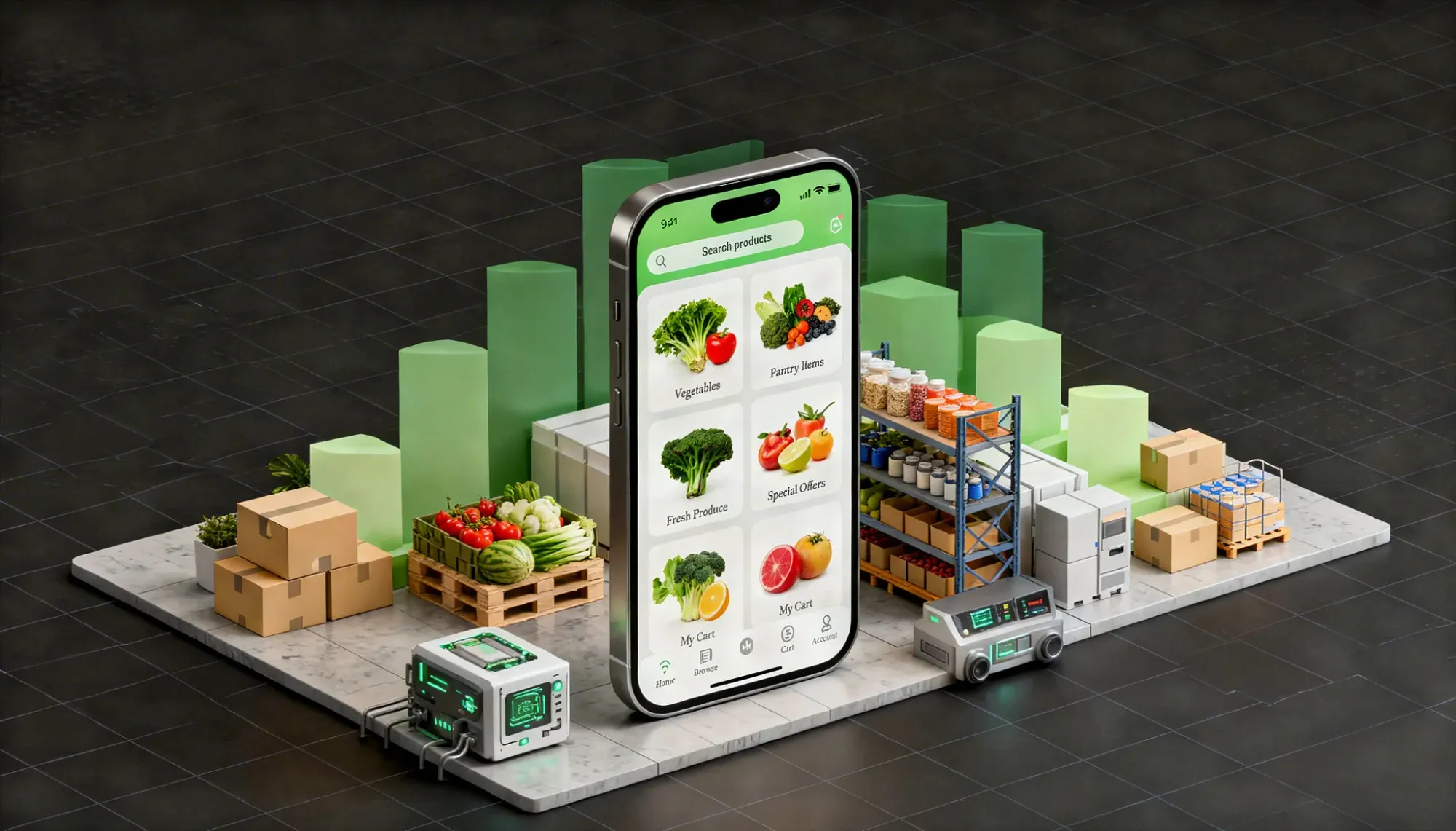
Most grocery delivery apps fall into three stages based on complexity and scale.
MVP (Basic App) — $25,000 to $50,000
Best for testing an idea with core features like browsing, cart, and checkout.
Mid-Level App — $50,000 to $120,000
Suitable for growing apps with real-time tracking, multiple payments, and notifications.
Advanced App — $120,000 to $300,000+
Built for scaling platforms with AI features, route optimization, and multi-region support.
Most articles throw random numbers when talking about grocery delivery app development cost, but don’t explain what actually drives it. In reality, the cost typically ranges from $25,000 to $300,000+, depending on features, scale, and complexity.
The demand is growing fast. Online grocery adoption is expected to reach around 15% eCommerce penetration by 2026, which explains why more businesses are investing in these apps.
From experience, the biggest mistake is clear: overbuilding too early or underestimating what it takes to scale.
This guide breaks down the cost in a practical way, what impacts it, where money actually goes, and how to approach building without wasting budget.
Grocery Delivery App Cost Breakdown by App Complexity
Grocery delivery app development cost mainly depends on how complex the product is. Instead of thinking in features alone, it’s easier to break it down into three stages: MVP, mid-level, and advanced.
| Complexity | Estimated Cost | What It Includes |
MVP (Basic App) | $25,000 – $50,000 | User login, product listing, cart, checkout, basic admin panel |
Mid-Level App | $50,000 – $120,000 | Real-time tracking, multiple payments, notifications, vendor management |
Advanced App | $120,000 – $300,000+ | AI recommendations, route optimization, analytics, multi-region scaling |
As complexity increases, cost goes up not just because of features, but because of real-time systems, integrations, and scalability requirements.
Most early-stage products don’t need advanced features from day one. Starting with an MVP and scaling based on actual usage usually helps control cost and avoid unnecessary complexity.
MVP vs Advanced Grocery App: What Should You Build First?
| Factor | MVP | Advanced App |
Cost | $25K – $50K | $120K – $300K+ |
Time to Launch | 2–3 months | 6+ months |
Risk Level | Low | High |
Features | Basic ordering flow | AI, automation, scaling systems |
Best For | Validating idea | Scaling an existing business |
If you're starting from scratch, an MVP is usually the better choice. It helps you test demand, reduce risk, and avoid unnecessary upfront investment.
Advanced apps make sense only when you already have traction and need to scale operations efficiently.
Key Factors That Affect Grocery Delivery App Development Cost
The cost of building a grocery delivery app isn’t just about features. It’s influenced by how the system is designed, how it handles real-time operations, and how well it scales over time.
App Complexity
A basic app with simple ordering costs less, while platforms with real-time tracking, multiple user roles, and automation require more development effort.
Number of Platforms
Building for Android or iOS alone is cheaper. Supporting both, along with web, increases development time and cost.
Real-Time Features
Features like live order tracking, inventory sync, and delivery updates require continuous data processing, which adds complexity and cost.
Third-Party Integrations
Payments, maps, notifications, analytics, and CRM integrations are essential, but each adds to development and maintenance effort.
UI/UX Design
Custom, conversion-focused design takes more time than standard layouts, especially when user flows are detailed and optimized.
AI and Automation
Features like recommendations, demand forecasting, and route optimization increase cost, but are often needed for scaling.
Scalability Requirements
Apps built for high traffic, multiple locations, and large order volumes require stronger backend systems and cloud infrastructure.
Development Team Location
Costs vary by region. Teams in North America or Europe charge more, while India and Southeast Asia offer more cost-effective options.
Grocery Delivery App Cost Estimation Formula
Grocery delivery app development cost can be broken down into a few core components:
Most cost overruns happen when teams underestimate real-time systems and scaling needs.
Total Cost = Features + Integrations + Real-Time Systems + Scalability
- Features → Core functionality like cart, payments, and admin panel
- Integrations → Payments, maps, notifications, analytics tools
- Real-Time Systems → Live tracking, inventory sync, delivery updates
- Scalability → Infrastructure to handle users, orders, and expansion
Cost increases when systems become more complex, not just when features are added.
Understanding this helps you estimate budgets more realistically and avoid unexpected costs later.
Grocery Delivery App Features and Their Cost Impact
Features play a major role in defining the overall cost of a grocery delivery app. The more systems you add, especially real-time and multi-user workflows, the higher the development effort.
Core Features (Must-Have)
| Feature | What It Does | Estimated Cost Impact |
User Registration & Login | Account creation, authentication | $1,000 – $3,000 |
Product Listing & Search | Browse products, filters, categories | $2,000 – $5,000 |
Cart & Checkout | Add items, place orders | $3,000 – $8,000 |
Payment Integration | UPI, cards, wallets, COD | $2,000 – $6,000 |
Order Tracking | Basic order status updates | $3,000 – $7,000 |
Admin Panel | Manage users, orders, products | $5,000 – $15,000 |
These features are enough to launch an MVP and validate the idea without heavy investment.
Advanced Features (Increase Cost)
| Feature | What It Does | Estimated Cost Impact |
Real-Time Tracking | Live delivery tracking with maps | $5,000 – $15,000 |
Inventory Sync | Real-time stock updates | $8,000 – $20,000 |
Push Notifications | Alerts for orders, offers | $1,000 – $4,000 |
Vendor Panel | Multi-store management | $7,000 – $20,000 |
Delivery Partner App | Rider app with routing | $10,000 – $30,000 |
As you move beyond MVP, the system becomes more complex because it needs to handle multiple users and real-time data.
What This Means
Cost doesn’t increase with features alone. It increases when features introduce:
- Real-time systems
- Multiple user roles
- Continuous data syncing
That’s why starting with essential features and scaling gradually is usually more cost-effective.
Grocery App Business Models and Their Cost Implications
The business model you choose directly impacts grocery app development cost and how the platform scales. It defines how inventory is handled, how orders are fulfilled, and how complex the system becomes.
Inventory-Based Model
| Aspect | Details |
How it works | Owns and manages inventory through warehouses or dark stores |
Examples | Amazon Fresh, Blinkit |
Estimated Cost Impact | $100,000 – $300,000+ |
This model requires inventory systems, warehouse operations, and logistics control. The upfront cost is higher, but it offers better control over pricing and margins.
Marketplace / Aggregator Model
| Aspect | Details |
How it works | Connects users with multiple local stores |
Examples | Instacart, BigBasket (early stage) |
Estimated Cost Impact | $40,000 – $120,000 |
This approach reduces initial cost since inventory is handled by vendors. However, it requires strong vendor management and real-time syncing.
Build Lean. Learn Fast.
Launch an MVP that saves money while proving your concept works.
Hyperlocal Delivery Model
| Aspect | Details |
How it works | Delivers from nearby stores within minutes |
Examples | Zepto, Dunzo |
Estimated Cost Impact | $80,000 – $200,000+ |
Speed is the core here. Real-time tracking, rider allocation, and route optimization increase system complexity and cost.
Dark Store Model
| Aspect | Details |
How it works | Uses dedicated warehouses for fast fulfillment |
Estimated Cost Impact | $120,000 – $300,000+ |
This model improves delivery speed and accuracy but requires more investment in infrastructure and backend systems.
Each model impacts cost differently:
- Lower cost to start → Marketplace
- Higher control & margins → Inventory / Dark store
- Higher complexity → Hyperlocal
Choosing the right model early helps avoid unnecessary rebuilds and keeps development aligned with your business goals.
Hidden Costs of Grocery Delivery App Development
Most cost estimates focus only on development, but a large part of the budget goes into ongoing and often overlooked expenses. Ignoring these can lead to budget overruns later.
1. Maintenance and Updates
Apps require regular updates for bug fixes, performance improvements, and OS compatibility. This typically adds 15–25% of the initial development cost annually.
2. Cloud and Infrastructure
Hosting, databases, and real-time services come with recurring costs. As user traffic grows, infrastructure expenses increase significantly.
3. Third-Party Services
Payments, maps, notifications, analytics, and SMS services are not free. These costs scale with usage and can become a major expense over time.
4. Customer Acquisition
Marketing, ads, and promotions are often higher than development costs, especially in competitive markets. This is critical for early growth.
5. Delivery Operations
Costs related to delivery partners, incentives, and logistics management are ongoing and directly impact profitability.
6. Support and Operations
Customer support, refunds, dispute handling, and admin operations require dedicated resources as the platform scales.
What This Means
Development is just the starting point. The real cost comes from running and scaling the platform over time.
Most apps don’t fail because of development cost. They fail because of scaling costs.
Cost to Maintain and Scale a Grocery Delivery App
Building the app is just the starting point. A significant part of the cost comes from maintaining the system and scaling it as users and orders grow.
Ongoing Maintenance
Maintenance includes updates, bug fixes, and keeping the system stable.
| Area | What It Covers | Estimated Cost |
App Updates | OS updates, bug fixes, improvements | 15–25% of initial cost/year |
Server & Hosting | Cloud, databases, uptime monitoring | $500 – $5,000+/month |
Third-Party Services | Payments, maps, notifications | $0.5 – $2 per order (approx) |
Scaling Costs
As usage grows, costs increase with traffic, operations, and system complexity.
| Area | What It Covers | Estimated Cost |
Infrastructure Scaling | More users, higher load | $2,000 – $15,000+/month |
Delivery Operations | Rider payouts, logistics | $2 – $8 per order |
Advanced Systems | AI, analytics, automation | $10,000 – $50,000+ (one-time + ongoing) |
Multi-City Expansion | Localization, ops setup | $10,000 – $30,000 per city |
What This Means
Maintenance is predictable, but scaling is where costs grow fast.
As order volume increases, even small per-order costs add up quickly. Planning for this early helps avoid unexpected expenses and keeps the platform sustainable as it grows.
How to Reduce Grocery App Development Cost
Reducing cost isn’t about cutting features, it’s about making the right decisions early. Most unnecessary expenses come from overbuilding, rework, or poor planning.
Start with an MVP
Focus only on essential features like product listing, cart, checkout, and basic admin. This helps validate the idea before investing in advanced systems.
Build for One Platform First
Launching on either Android or iOS reduces initial development effort. You can expand to other platforms once the product is validated.
Use Cross-Platform Development
Frameworks like Flutter or React Native allow you to build for multiple platforms with a single codebase, reducing time and cost.
Avoid Overbuilding Early
Features like AI recommendations, advanced analytics, and automation can be added later. Building them too early increases cost without immediate value.
Use Pre-Built Integrations
Instead of building everything from scratch, use existing APIs for payments, maps, notifications, and analytics.
Keep UI/UX Simple Initially
A clean and functional design is enough for early stages. Complex animations and custom UI can be added later.
Choose the Right Development Team
Costs vary by region, but going too cheap can lead to rework. A balanced team helps avoid long-term expenses.
What This Means
Most cost overruns happen due to unnecessary complexity early on. Starting small, validating fast, and scaling based on real usage is usually the most cost-effective approach.
The cheapest app to build is the one you don’t overbuild early.
Grocery Delivery App Development Process and Timeline
The development process defines both cost and timeline. While timelines can vary, most grocery apps follow a structured flow from planning to launch.
Development Stages
| Stage | What It Includes | Timeline |
Discovery & Planning | Requirements, business model, feature planning | 1 – 2 weeks |
UI/UX Design | Wireframes, user flows, interface design | 2 – 4 weeks |
Development | Frontend, backend, integrations | 6 – 16 weeks |
Testing & QA | Bug fixes, performance testing | 2 – 4 weeks |
Launch & Deployment | App store release, server setup | 1 week |
Total Timeline
- MVP App → 2 to 3 months
- Mid-Level App → 3 to 5 months
- Advanced App → 6+ months
What This Means
Timelines increase with complexity, especially when real-time features, multiple user roles, and integrations are involved.
Most delays don’t come from development alone; they come from unclear requirements, frequent changes, and integration challenges. Planning properly up front helps keep both cost and timeline under control.
Technology Stack Required for Grocery Delivery Apps
The technology stack behind a grocery delivery app affects speed, scalability, security, and long-term maintenance. The right stack depends on your budget, feature set, and how complex the product needs to be.
| Layer | Common Technologies | Purpose |
Frontend | Flutter, React Native, Swift, Kotlin | Builds the customer-facing mobile app |
Backend | Node.js, Python, Java | Handles business logic, APIs, and order workflows |
Database | PostgreSQL, MongoDB, Redis | Stores product, user, and order data |
Cloud & Hosting | AWS, Google Cloud, Azure | Supports scalability, uptime, and storage |
Payments | Stripe, Razorpay, PayPal | Handles secure online transactions |
Maps & Tracking | Google Maps, Mapbox | Supports delivery tracking and route management |
Notifications | Firebase Cloud Messaging, Twilio | Sends order updates, OTPs, and alerts |
Analytics | Google Analytics, Mixpanel, Firebase Analytics | Tracks user behavior and app performance |
The stack usually becomes more advanced as the app scales. An MVP may need only the essentials, while larger platforms often require stronger backend systems, caching, monitoring, and real-time infrastructure.
If you're planning to build a scalable solution, exploring our AI development services can help accelerate development and reduce long-term costs.
Challenges in Grocery Delivery App Development
Building a grocery delivery app isn’t just about features. Most challenges come from real-time operations, logistics, and scaling the system reliably.
1. Real-Time Inventory Sync
Keeping inventory accurate across stores or warehouses is difficult. Stock changes frequently, and mismatches can lead to cancellations and poor user experience.
2. Delivery Partner Availability
Ensuring enough riders during peak hours or bad weather is a constant challenge. Delays here directly impact delivery time and customer satisfaction.
3. Managing Peak Demand
Traffic spikes during evenings, weekends, or offers can slow down the system. Without proper scaling, this can lead to failed checkouts or delays.
Build Lean. Learn Fast.
Launch an MVP that saves money while proving your concept works.
4. Last-Mile Delivery Optimization
Delivery is the most complex and costly part. Route planning, traffic conditions, and order clustering need to be handled efficiently to reduce time and cost.
5. Thin Profit Margins
Grocery businesses operate on low margins. Inefficiencies in operations, delivery, or cancellations can quickly affect profitability.
6. Multi-User System Complexity
The app needs to handle customers, vendors, delivery partners, and admins simultaneously. Managing these workflows smoothly increases development complexity.
What This Means
Most challenges are not just technical, they are operational. Solving them requires a balance between technology, logistics, and efficient system design.
Revenue Models for Grocery Delivery Apps
How you monetize the app directly impacts long-term sustainability. Most grocery platforms use a mix of revenue streams rather than relying on just one.
Commission on Orders
Charge a percentage from partner stores on every order placed through the platform.
- Typical range: 5% – 20% per order
- Works best for marketplace models
Delivery Fees
Charge users a fixed or dynamic fee for each order.
- Typical range: $1 – $5 per order
- Can vary based on distance, time, or demand
Subscription Model
Offer plans with benefits like free delivery, priority slots, or exclusive discounts.
- Typical pricing: $5 – $15/month
- Helps improve retention and predictable revenue
Surge Pricing
Increase delivery fees during peak hours or high demand.
- Common during evenings, weekends, or offers
- Helps balance demand and supply
In-App Advertising
Charge brands or sellers to promote products within the app.
- Sponsored listings, banner ads, featured products
- Works well as user base grows
No single model works alone. Most successful apps combine commissions, delivery fees, and subscriptions to balance revenue and user experience.
Is Building a Grocery Delivery App Worth the Cost in 2026?
In most cases, yes, but only if it’s approached correctly.
The market is growing fast. The global online grocery market is expected to reach around $794 billion in 2026, with strong growth driven by convenience and digital adoption . Demand is clearly there.
But building an app alone doesn’t guarantee success.
What actually matters is:
- Choosing the right business model
- Controlling costs early
- Scaling based on real demand, not assumptions
Grocery delivery is a high-volume, low-margin business. That means efficiency matters more than features. Overbuilding early or ignoring operational costs can quickly make the business unsustainable.
It’s worth the investment if the focus is on:
- Starting lean (MVP first)
- Building strong operations, not just the app
- Scaling gradually with real usage
Done right, it can become a scalable and high-frequency business. Done wrong, it becomes expensive to maintain without clear returns.
Conclusion
Grocery delivery app development cost isn’t just about how much you spend, it’s about how you structure the product from day one.
Most teams get this wrong by overbuilding early or ignoring what it takes to scale. That’s where costs spiral.
A better approach is simple: start lean, validate fast, and scale based on real demand.
That’s what keeps both cost and complexity under control.
If you're planning to build a grocery delivery app, it's worth discussing your requirements with a team that has experience in building scalable AI-powered systems.
Frequently Asked Questions
How much does grocery delivery app development cost in 2026?
It typically ranges from $25,000 for MVP apps to $300,000+ for advanced platforms, depending on features, integrations, and scalability requirements.
What factors affect grocery app development cost the most?
App complexity, real-time features, integrations, number of platforms, and scalability requirements have the biggest impact on overall cost.
How long does it take to build a grocery delivery app?
An MVP takes 2–3 months, while mid-level apps take 3–5 months and advanced platforms can take 6+ months.
What is the cheapest way to build a grocery app?
Start with an MVP, focus on essential features, use cross-platform development, and avoid building advanced systems until the product is validated.
Which business model is best for grocery apps?
Marketplace models are easier to start, while inventory and dark store models offer better control and margins at higher cost.
Can I build a grocery app without AI features?
Yes. AI features are not required initially and can be added later when scaling operations and improving efficiency.
What are the ongoing costs after development?
Maintenance, cloud hosting, third-party services, delivery operations, and customer acquisition are the main ongoing expenses.