- Function Calling allows an LLM to select a predefined tool and generate structured arguments for that tool.
- It works well for direct actions such as retrieving data, performing calculations, making bookings, or sending requests to an API.
- MCP is an open protocol for exposing tools, resources, and prompts to compatible AI applications through a standard client-server structure.
- Function-calling formats can differ between model providers, while MCP provides a reusable interface for connecting AI applications to external systems.
- Function Calling is usually simpler for a small, fixed set of tools.MCP becomes useful when several applications or models need consistent access to multiple tools and data sources.
- The two approaches are not direct replacements: an MCP-connected application may still use model-level function calling to choose and invoke an exposed tool.
As AI applications become more connected to real tools, data sources, and business systems, developers need better ways to let models take actions beyond simple text responses. That is where the debate around MCP vs Function Calling becomes important.
Both approaches help large language models interact with external systems, but they solve the problem in different ways. Function Calling is ideal for structured one-step actions, while MCP is designed for richer, context-aware integrations across multiple tools and workflows.
In this guide, I’ll break down MCP vs Function Calling, how each works, their differences, and when to use one over the other.
What is Function Calling in LLMs?
Function Calling allows LLMs to interact with external tools by generating structured requests based on user prompts. Instead of only replying with text, the model can trigger predefined functions such as checking weather, retrieving database data, sending emails, or performing calculations.
For example, if a user asks for the weather in Chennai, the model can call a weather function with the required inputs like location and unit. This helps LLMs access real-time data and complete tasks beyond their training knowledge.
Different AI providers implement Function Calling in their own formats, so there is no single universal standard yet.
Example of a Function call from different LLM providers
Different LLM providers support Function Calling, but each uses its own response format. While the structure may vary, the goal is the same: detect the user request, choose the right tool, and pass the required arguments.
1. OpenAI
OpenAI returns tool calls inside a tool_calls field. It includes the function name and arguments in structured JSON format.
{
  "index": 0,
  "message": {
    "role": "assistant",
    "content": null,
    "tool_calls": [
      {
        "name": "get_weather",
        "arguments": "{\n \"location\": \"Chennai\",\n \"unit\": \"Celsius\"\n}"
      }
    ]
  },
  "finish_reason": "tool_calls"
}
2. Claude
Claude uses a tool_use Block inside the response content. It can also include reasoning text before triggering the tool.
{
  "role": "assistant",
  "content": [
    {
      "type": "text",
      "text": "<thinking>To answer this question, I will: …</thinking>"
    },
    {
      "type": "tool_use",
      "id": "abcj8765",
      "name": "get_weather",
      "input": {"location": "Chennai", "unit": "Celsius"}
    }
  ]
}
3. Gemini
Gemini uses a functionCall Object with a function name and arguments. The format is compact and developer-friendly.
{
  "functionCall": {
    "name": "get_weather",
    "args": {
      "location": "Chennai",
      "unit": "Celsius"
    }
  }
}
4. Llama
Some Llama implementations return a function_call field containing the selected function and parameters.
{
  "role": "assistant",
  "content": null,
  "function_call": {
    "name": "get_weather",
    "arguments": {
      "location": "Chennai",
      "unit": "Celsius"
    }
  }
}
How Function Calling Works:
Function Calling follows a simple workflow that allows an LLM to use external tools and APIs when needed.
1. Function Definition
Developers define the functions the model can access, along with their purpose, inputs, and expected parameters.
2. Prompt Interpretation
When a user sends a request, the LLM decides whether answering normally is enough or if a tool should be called.

Walk away with actionable insights on AI adoption.
Limited seats available!

3. Function Invocation
If needed, the model generates a structured function call with the correct arguments, such as location, date, or search terms.
4. Execution and Response
The external tool runs the request and returns the result. The LLM then uses that output to generate the final response for the user.
What is Model Context Protocol (MCP)?
Model Context Protocol (MCP) is an open standard that helps large language models connect with external tools, data sources, and business systems in a secure, structured way. It reduces the need for custom integrations between each model and tool.
With MCP, AI applications can access real-time context such as documents, databases, APIs, and internal systems to deliver more useful and accurate responses.
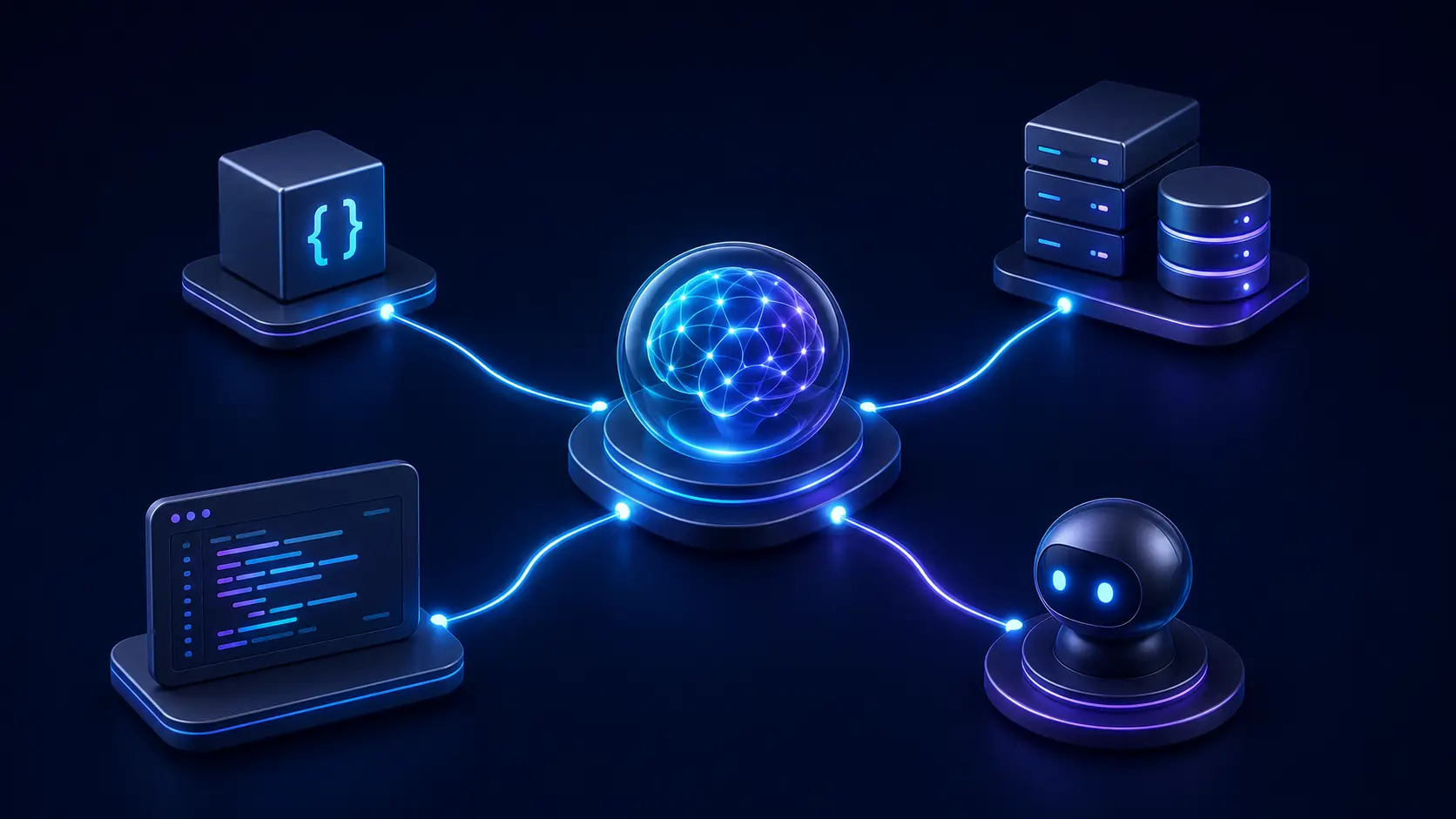
In an AI integration, MCP can act as a standard bridge between an LLM application and external tools, data sources, or business systems.
Key Features of MCP
1. Standardized Interface
MCP gives developers a consistent protocol for connecting LLMs with tools, APIs, and data sources, reducing the need to build separate custom integrations for every system.
2. Dynamic Context Access
It enables models to receive real-time context from external systems such as documents, databases, and internal platforms, improving response relevance and accuracy.
3. Scalability for Enterprise Use
MCP is designed to support complex multi-tool workflows at scale, making it a strong fit for enterprise-grade AI applications.
How does MCP work?
MCP Servers and Clients
Developers set up MCP servers to expose tools, data, or business systems. AI applications then act as MCP clients that connect to those servers when context is needed.
Context Exchange
Through MCP, LLMs can request and receive relevant information from connected sources such as documents, databases, or APIs to generate better responses.
Secure Communication
MCP is designed with secure data exchange in mind, helping protect sensitive information during interactions between AI systems and external tools.
Example MCP Request
The example below shows how MCP sends a structured request from an AI client to an MCP server. In this case, the model is asking to call a get_weather tool with the inputs Chennai and Celsius.
{
  "jsonrpc": "2.0",
  "id": 128,
  "method": "tools/call",
  "params": {
    "name": "get_weather",
    "arguments": {
      "location": "Chennai",
      "unit": "Celsius"
    }
  }
}
What It Means
- method: Tells the server to run a tool
- name: Selects the tool (
get_weather) - arguments: Passes the required inputs
- id: Tracks the request and response
This structured approach helps MCP connect LLMs with external tools in a consistent and scalable way.
When to Use Function-Calling
Function Calling is the better choice when tasks are clear, structured, and need immediate execution.
Use Function Calling When:
- You need to trigger well-defined actions such as sending emails, checking weather, or running calculations.
- Responses must be consistent and machine-readable, such as JSON outputs.
- The interaction is one-time and does not require memory or long-term context.
- You are integrating with APIs or systems that expect structured inputs and outputs.
In short, Function Calling works best for direct tool use, automation tasks, and predictable workflows.
When to Use MCP
MCP is the better choice when AI workflows need context, memory, and coordination across multiple tools or steps.
Walk away with actionable insights on AI adoption.
Limited seats available!
Use MCP When:
- The task involves reasoning across multiple conversations or exchanges.
- Long-term memory is needed for a smoother user experience.
- Responses must adapt based on previous inputs or changing context.
- You need to guide users through multi-step workflows with branching paths.
- Natural conversation and structured tool use need to work together.
In short, MCP works best for context-aware assistants, enterprise workflows, and advanced AI systems.
Comparative Analysis of MCP and Function Calling
| Aspect | Function Calling | Model Context Protocol (MCP) |
Architecture | Direct invocation of predefined functions by the LLM. Converts user prompts into structured function calls. | Standardized protocol facilitating two-way communication between LLMs and external systems. |
Use Cases | Suitable for tasks requiring specific, well-defined operations. | Ideal for scenarios needing dynamic, context-rich interactions with multiple data sources. |
Scalability | May face challenges as the number of functions increases. | Designed to handle complex integrations at scale. |
Flexibility | Limited to predefined functions; less adaptable to unforeseen tasks. | Offers greater flexibility through dynamic context provision. |
Implementation | Relatively straightforward, but can become complex with numerous functions. | Requires adherence to MCP standards; initial setup may be more involved. |
Security | Controlled access to specific functions enhances security. | Emphasizes secure data transmission and standardized access protocols. |
Conclusion
Both Model Context Protocol (MCP) and Function calling represent significant strides in enhancing the capabilities of LLMs by integrating them with external tools and data sources.
Function Calling offers a straightforward approach for extending LLM functionalities through predefined functions, ensuring predictability and control.
In contrast, MCP provides a standardized and scalable framework for dynamic, context-aware interactions, positioning it as a robust solution for complex enterprise applications.
The choice between implementing Function Calling or adopting MCP hinges on the specific requirements of the application, including factors such as scalability, flexibility, and the complexity of interactions needed.
As the AI ecosystem continues to evolve, both approaches are likely to play pivotal roles in shaping the future of LLM integrations.
Frequently Asked Questions
1. What is the difference between MCP and Function Calling?
Function Calling is used for direct tool execution with structured inputs, while MCP is a broader protocol for context-aware communication between AI models and external systems.
2. When should I use Function Calling?
Use Function Calling for simple tasks like API calls, calculations, bookings, searches, or any one-step action with predictable outputs.
3. When should I use MCP?
Use MCP when workflows need memory, multiple tools, dynamic context, or multi-step reasoning across conversations.
4. Is MCP better than Function Calling?
Not always. MCP is better for complex integrations, while Function Calling is often faster and simpler for straightforward tasks.
5. Can MCP and Function Calling work together?
Yes. Many modern AI systems use Function Calling for direct actions and MCP for managing broader context and tool connections.
6. Which is better for enterprise AI applications?
MCP is often stronger for enterprise use cases because it supports scalable, secure, and context-rich integrations across systems.

Walk away with actionable insights on AI adoption.
Limited seats available!