How to Outsource Mobile App Development (Complete Guide 2026)
Is hiring a full in-house mobile app team necessary when you only need to build, test, or launch your app faster?
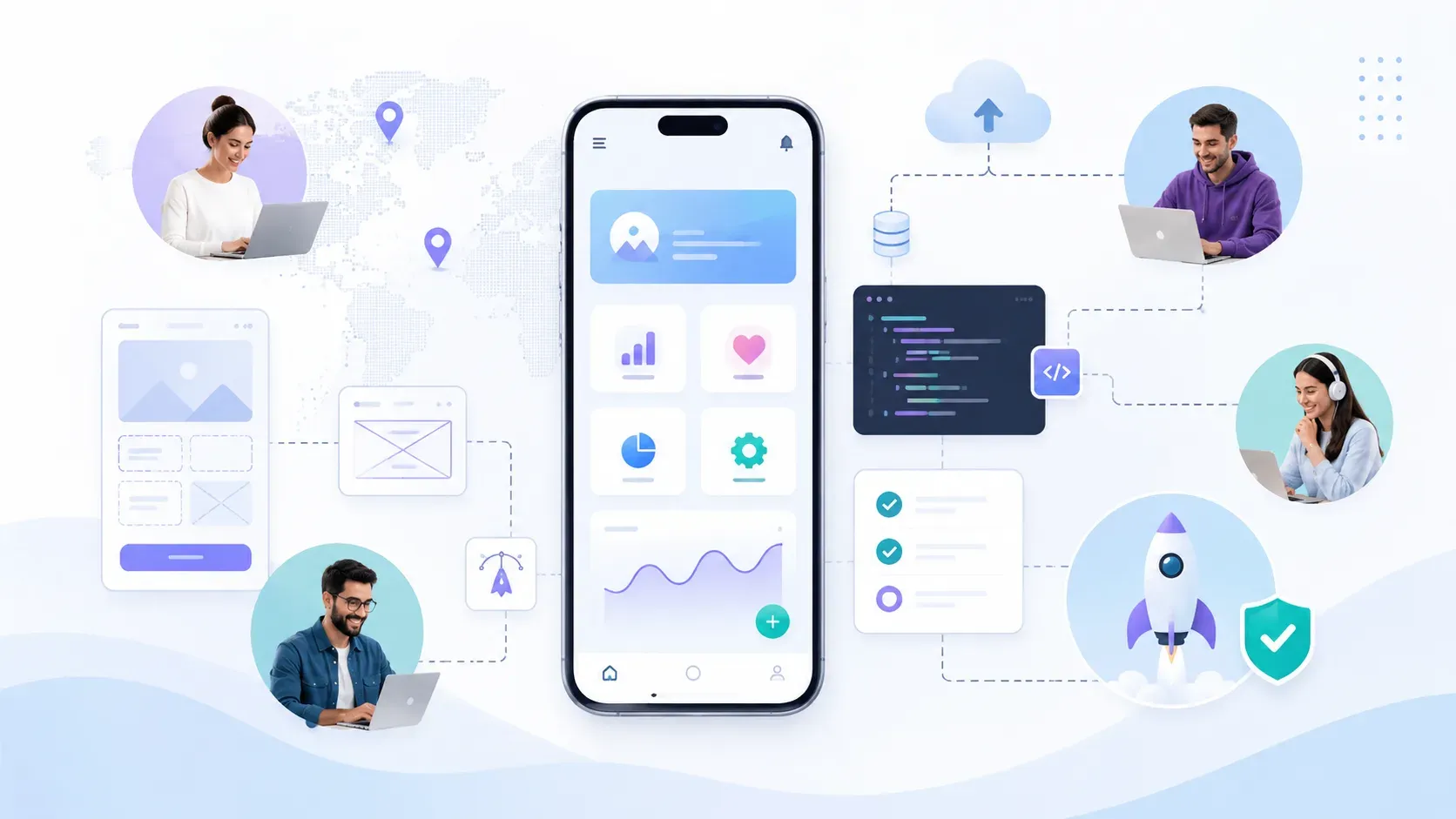
For many startups and businesses, outsourcing is a practical option when they need speed, mobile expertise, or a complete team without building everything in-house. It gives you access to product, design, development, and testing support while keeping the team structure flexible.
In this guide, we’ll explain how to outsource mobile app development, when it makes sense, what it costs, and how to choose the right partner based on common challenges we see in app outsourcing projects, such as unclear scope, delayed timelines, weak QA, and missing post-launch support.
What Is Mobile App Development Outsourcing?
Mobile app development outsourcing means hiring an external team or company to design, build, test, and maintain your mobile app instead of handling everything with an in-house team.
This can include product planning, UI/UX design, iOS development, Android development, cross-platform development, backend development, QA testing, app store launch, and post-launch support.
For startups and businesses, outsourcing is usually helpful when they need mobile app expertise, faster delivery, or a complete development team without hiring designers, developers, testers, and project managers separately.
When Should You Outsource Mobile App Development?
You should outsource mobile app development when building an in-house team is too slow, expensive, or unnecessary for your current stage. This is common when startups need to validate an app idea, build an MVP, or launch faster.
Outsourcing makes sense when you need:
- A mobile app MVP built quickly
- iOS, Android, or cross-platform expertise
- UI/UX design, backend, testing, and launch support
- Extra development capacity for your internal team
- A project-based team instead of long-term hiring
- Post-launch maintenance and feature updates
It is also useful when your app needs skills your current team does not have, such as Flutter, React Native, native Android, native iOS, API development, payment integrations, or app store deployment.
Mobile App Development Outsourcing Models
There are different ways to outsource mobile app development. The right model depends on your app scope, timeline, budget, and how much control you want over the team.
| Outsourcing Model | Best For | How It Works |
Project-Based Outsourcing | Apps with a clear scope, timeline, and feature list | You hire an external team to deliver the complete app based on agreed milestones. |
Dedicated Development Team | Long-term product development and ongoing feature updates | You work with a dedicated team of developers, designers, QA, and project managers. |
Staff Augmentation | Companies with an internal tech team that needs extra developers | You add external mobile developers to your existing team for specific skills or capacity. |
MVP Development Partner | Startups validating a new app idea | You work with a team that helps define, design, build, and launch the first version quickly. |
For most startups, a project-based or MVP development model works best in the early stage. A dedicated team is better when the app needs continuous development, maintenance, and scaling after launch.
How to Outsource Mobile App Development Step by Step
Outsourcing mobile app development works best when the process is clear from the beginning. Before choosing a team, define what you want to build, what the first version should include, and how success will be measured.
1. Define Your App Idea and Business Goal
Start with the problem your app will solve. Who is it for? What action should users take? What business goal should the app support?
This helps the outsourcing team understand whether you need a simple MVP, a customer-facing app, an internal tool, or a full-scale mobile product.
2. Decide Whether You Need an MVP or Full App
Not every app needs to launch with all features. If you are still validating the idea, start with an MVP that includes only the most important features.
A full app makes sense when the idea is already validated and you need a more complete product with advanced features, integrations, security, and scalability.
3. List Must-Have Features
Create a simple list of features your app needs in the first version. Separate them into must-have and nice-to-have features.
For example, login, user profiles, payments, notifications, search, booking, chat, or admin dashboards may be important depending on the app type.
4. Choose the Right Platform
Decide whether you need iOS, Android, or a cross-platform app. If your users are mostly on Android, you may choose to outsource Android development first. If you need to launch on both platforms faster, Flutter or React Native may be better.
5. Set a Realistic Budget and Timeline
Before approaching outsourcing partners, decide your expected budget and launch timeline. This helps teams suggest the right scope and avoids unrealistic estimates.
A clear budget also helps you decide whether to start with discovery, prototype, MVP, or full app development.
6. Shortlist Mobile App Development Companies
When comparing mobile app development outsourcing companies, look for teams with relevant app experience, strong UI/UX capability, backend expertise, a testing process, and post-launch support.
Partner with Us for Success
Experience seamless collaboration and exceptional results.
Do not choose only based on the lowest price. Check whether the team has built apps similar to your product category or complexity.
7. Review Their Portfolio and Case Studies
Review past mobile apps, app store links, case studies, design quality, and technical depth. A good portfolio should show what problem the app solved, what features were built, and what results were achieved.
This helps you understand whether the team can handle your app beyond basic development.
8. Check Communication, QA, and Delivery Process
Ask how the team manages communication, sprint updates, testing, bug fixes, and milestone reviews. A good outsourcing process should be transparent and easy to track.
Also check whether QA is included, because mobile apps need testing across devices, screen sizes, operating systems, and real user flows.
9. Start With Discovery or MVP Scope
Before full development, start with a discovery phase or MVP scope. This helps define user flows, technical requirements, wireframes, architecture, timeline, and cost.
This step reduces confusion and gives both sides a clear development plan.
10. Define Milestones, Ownership, and Post-Launch Support
Before development starts, agree on milestones, payment terms, source code ownership, documentation, deployment support, and maintenance.
This protects your project and ensures you are not left without support after the app goes live.
How Much Does It Cost to Outsource Mobile App Development?
The cost to outsource mobile app development depends on the app type, number of features, platform, design complexity, backend requirements, integrations, and team location. A simple MVP will cost much less than a full app with payments, real-time chat, dashboards, advanced security, or third-party integrations.
| App Type | Estimated Cost | Best For |
Basic Mobile App | $10,000–$30,000+ | Simple apps with limited screens and basic features |
Mobile App MVP | $25,000–$60,000+ | Startups testing a new app idea with core features |
Mid-Level Mobile App | $60,000–$120,000+ | Apps with user accounts, payments, APIs, notifications, and admin panels |
Complex Mobile App | $120,000–$250,000+ | Apps with advanced workflows, real-time features, custom backend, or multiple integrations |
Enterprise Mobile App | $250,000+ | Large-scale apps with security, compliance, scalability, and complex system integrations |
If you are still validating the idea, start with an MVP instead of building the full app. This keeps the budget controlled and helps you test the core user flow before investing in advanced features.
What Affects Mobile App Outsourcing Cost?
Mobile app outsourcing costs change based on how complex the app is, what platforms you want to build for, and how much design, backend, testing, and post-launch support are needed.
App Complexity
A simple app with a few screens costs less than an app with user accounts, payments, chat, booking, tracking, dashboards, or custom workflows. The more features and user flows you add, the more time the team needs for design, development, testing, and bug fixes.
Number of Platforms
Building only for iOS or Android costs less than building for both. If you want to launch on both platforms with a controlled budget, cross-platform frameworks like Flutter or React Native can help reduce development effort.
UI/UX Design Requirements
Basic UI costs less than a fully custom design system with user flows, animations, prototypes, and multiple screen variations. Apps that need a polished consumer experience usually require more design time.
Backend and Integrations
Costs increase when the app needs APIs, databases, admin panels, payment gateways, maps, push notifications, CRM integrations, or third-party tools. Backend-heavy apps usually take longer than simple frontend apps.
Security and Compliance Needs
Apps that handle payments, healthcare data, financial data, user identity, or business-sensitive information need stronger security, access control, encryption, and testing. This adds to the overall cost.
Team Location and Engagement Model
Costs also depend on where the outsourcing team is based and how you hire them. Freelancers, dedicated teams, and mobile app development outsourcing companies all have different pricing models, delivery processes, and levels of support.
How to Choose the Right Mobile App Development Outsourcing Partner
Choosing the right outsourcing partner is one of the most important steps in mobile app development. The wrong team can delay the project, increase costs, and leave you with an app that is difficult to scale or maintain.
Before you choose a partner, check for:
- Relevant app experience: Have they built apps similar to your idea, industry, or complexity?
- Strong UI/UX process: Do they understand user flows, wireframes, prototypes, and mobile-first design?
- Technical expertise: Can they handle iOS, Android, Flutter, React Native, backend, APIs, and integrations?
- Clear communication: Do they provide regular updates, sprint reviews, timelines, and transparent reporting?
- Testing process: Do they test across devices, screen sizes, operating systems, and real user scenarios?
- Code ownership: Will you get full ownership of source code, documentation, and app store accounts?
- Post-launch support: Can they help with bug fixes, updates, maintenance, and new features after launch?
A good mobile app development outsourcing partner should not just build what you ask for. They should help you refine the scope, avoid unnecessary features, and build the app in a way that supports future growth.
Common Mistakes to Avoid When Outsourcing Mobile App Development
Outsourcing can help you build faster, but only when the project is planned properly. Many problems happen because the scope, budget, communication, or ownership terms are not clear from the beginning.
Starting Without Clear Requirements
Do not approach an outsourcing team with only a rough idea. Define the app goal, target users, must-have features, platform, budget, and expected timeline first.
Choosing Only Based on Low Cost
The cheapest team may not always be the safest choice. Low-cost development can lead to poor code quality, weak UI/UX, delays, or expensive rework later.
Partner with Us for Success
Experience seamless collaboration and exceptional results.
Ignoring UI/UX and Product Strategy
A mobile app is not just about coding. If the user flow, design, and feature priority are weak, the app may fail even if the development is technically correct.
Skipping QA and Device Testing
Mobile apps need testing across devices, screen sizes, operating systems, and real user scenarios. Skipping QA can lead to crashes, bugs, and poor app store reviews.
Not Clarifying Code Ownership
Before development starts, confirm who owns the source code, design files, documentation, APIs, and app store accounts. This avoids dependency on the outsourcing partner later.
Not Planning Post-Launch Support
The app will need updates, bug fixes, OS compatibility changes, and new features after launch. Make sure maintenance and support are discussed before signing the contract.
How F22 Labs Helps You Outsource Mobile App Development
F22 Labs helps startups and businesses outsource mobile app development with support across product planning, UI/UX design, iOS, Android, Flutter, backend development, QA, launch, and post-launch maintenance.
Whether you need to build an MVP, improve an existing app, or scale a mobile product, our team helps you define the right scope, choose the right tech stack, and build with clear milestones, ownership, and delivery visibility.
Conclusion
Outsourcing mobile app development can be a practical way to build faster without hiring a full in-house team from day one. But the success of the project depends on how clearly you define the app idea, features, budget, timeline, and delivery process.
The right outsourcing partner should help with more than development. They should support product planning, UI/UX, platform selection, backend, testing, launch, and post-launch maintenance.
Start with a clear scope, choose the right engagement model, and work with a team that understands your product goals. This will help you outsource mobile app development with fewer delays, better cost control, and a smoother path to launch.
Frequently Asked Questions
What is mobile app development outsourcing?
Mobile app development outsourcing means hiring an external team or company to design, develop, test, launch, and maintain your mobile app instead of building everything in-house.
How much does it cost to outsource mobile app development?
The cost can range from $10,000 to $250,000+, depending on app complexity, features, platforms, design, backend, integrations, security needs, and team location.
Is outsourcing mobile app development a good idea?
Yes, if you need faster delivery, mobile app expertise, flexible team access, or an MVP without hiring a full in-house team from day one.
How do I choose a mobile app development outsourcing company?
Review their portfolio, mobile app experience, UI/UX process, technical skills, communication style, QA process, pricing clarity, and post-launch support.
Should I outsource iOS and Android app development separately?
Not always. You can outsource native iOS and Android separately, or choose cross-platform development with Flutter or React Native if you want to launch on both platforms faster.
How long does outsourced mobile app development take?
A basic app may take 2–3 months, while an MVP or mid-level app can take 3–6 months. Complex apps may take longer depending on scope.
What should I prepare before outsourcing my app?
Prepare your app idea, target users, must-have features, preferred platform, budget, timeline, reference apps, and any business or technical requirements.