How to Hire Node.js Developers in 2026
Node.js remains one of the most practical choices for building fast APIs, scalable web platforms, SaaS products, marketplaces, dashboards, and real-time applications in 2026.
But hiring the right Node.js developer is not just about finding someone who can write backend code. You need someone who can build reliable APIs, manage databases, handle integrations, support real-time features, and keep the backend stable as your product grows.
In this guide, we’ll cover when to hire Node.js developers, what skills to look for, where to find them, interview questions to ask, hiring mistakes to avoid, and how to choose the right developer for your project.
Why Hire Node.js Developers in 2026?
Node.js is a strong backend choice for startups and businesses that need fast APIs, real-time features, scalable web apps, and JavaScript-based development. It allows teams to build server-side applications using JavaScript, which can make development smoother when the frontend is also built with JavaScript frameworks.
You should hire Node.js developers when your product needs:
- Fast API development for web apps, mobile apps, dashboards, and third-party integrations
- Real-time features like chat, live notifications, collaboration tools, and live tracking
- Scalable backend systems that can handle growing users, requests, and product workflows
- SaaS or marketplace development with user roles, payments, subscriptions, reports, and admin panels
- JavaScript across the stack, so frontend and backend teams can work with the same language
For companies building modern web products, Node.js developers can help turn product ideas into stable, scalable backend systems without slowing down the development process.
What Skills Should Node.js Developers Have?
A good Node.js developer should be able to build secure, scalable, and maintainable backend systems, not just write basic server-side code. Before hiring, check whether the developer has the right mix of backend, database, API, testing, and deployment skills.
| Skill | Why It Matters |
Node.js Fundamentals | Helps build stable server-side logic, APIs, and backend workflows |
Express.js or NestJS | Used to structure backend applications and manage routes, services, and middleware |
API Development | Needed for REST APIs, GraphQL, third-party integrations, and frontend communication |
Database Knowledge | Important for working with PostgreSQL, MongoDB, MySQL, Redis, and data models |
Authentication and Security | Helps protect user accounts, access control, tokens, sessions, and sensitive data |
Real-Time Development | Useful for chat, notifications, live dashboards, tracking, and collaboration features |
Testing and Debugging | Reduces bugs through unit tests, integration tests, API testing, and error handling |
Cloud and DevOps Basics | Helps with deployment, CI/CD, logs, monitoring, scaling, and environment setup |
Performance Optimization | Improves API speed, database queries, caching, and backend response times |
For startups, technical skills are only one part of the decision. The right Node.js developer should also understand product priorities, avoid overengineering, communicate clearly, and build a backend that supports both the current MVP and future growth.
Types of Node.js Developers You Can Hire
The type of Node.js developer you hire depends on your product stage, backend complexity, and how much ownership you need from the developer.
| Type of Node.js Developer | Best For | What They Handle |
Junior Node.js Developer | Small tasks and backend support | Bug fixes, simple APIs, basic updates, documentation |
Mid-Level Node.js Developer | MVPs and growing products | API development, database work, integrations, dashboards |
Senior Node.js Developer | Complex backend systems | Architecture, scalability, security, performance, code quality |
Full-Stack Node.js Developer | Startups with lean teams | Backend, frontend coordination, APIs, basic product features |
Dedicated Node.js Developer | Long-term product development | Continuous backend development, maintenance, scaling, and feature upgrades |
Node.js Tech Lead | Large or complex projects | Technical planning, architecture reviews, team guidance, and delivery quality |
For startups, a mid-level or dedicated Node.js developer is often enough for MVPs and early product development. If your product needs real-time features, high traffic, complex integrations, or long-term scalability, hiring a senior developer or tech lead is safer.
How to Hire Node.js Developers Step by Step
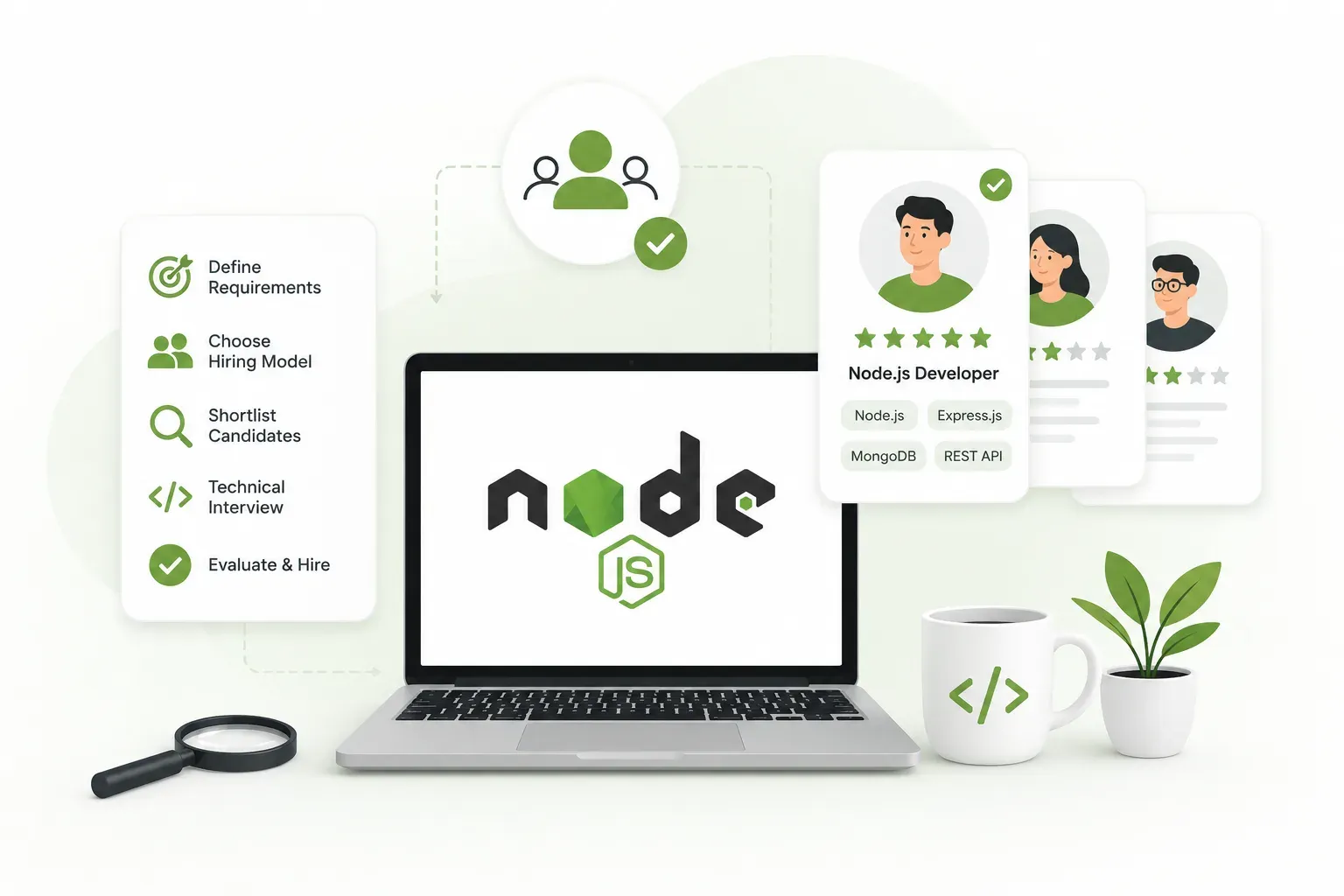
Hiring Node.js developers becomes easier when you know what your product needs before you start screening candidates. A clear process helps you avoid wrong-fit developers, unclear expectations, and costly rework later.
Step 1: Define Your Backend Requirements
List what you need the developer to build. This may include APIs, databases, authentication, real-time features, payment flows, dashboards, integrations, or cloud deployment.
Step 2: Decide the Right Hiring Model
Choose whether you need a freelancer, an in-house developer, a dedicated Node.js developer, or a development team. Small tasks may only need a freelancer, while MVPs and long-term products usually need dedicated support.
Step 3: Shortlist Developers With Relevant Experience
Look for developers who have worked on similar products, such as SaaS platforms, marketplaces, real-time apps, dashboards, or API-heavy systems.
Step 4: Check Technical Skills
Review their experience with Node.js, Express.js or NestJS, databases, REST APIs, GraphQL, authentication, security, testing, cloud deployment, and performance optimization.
Step 5: Review Past Work or Case Studies
Ask for examples of backend systems, APIs, integrations, or products they have built. This helps you understand whether they can handle your product’s complexity.
Partner with Us for Success
Experience seamless collaboration and exceptional results.
Step 6: Conduct a Practical Interview
Ask scenario-based questions instead of only theory. For example, how they would structure APIs, handle authentication, improve slow endpoints, or scale a real-time feature.
Step 7: Start With a Trial Task or Milestone
Before committing long-term, give a small paid task or first milestone. This helps you evaluate code quality, communication, speed, and ownership.
Step 8: Finalize Scope, Timeline, and Communication
Before development starts, confirm deliverables, timeline, code review process, communication channels, deployment expectations, and maintenance responsibilities.
Where to Hire Node.js Developers
You can hire Node.js developers from freelance platforms, job boards, developer communities, outsourcing companies, or dedicated development teams. The right place depends on your budget, project scope, timeline, and how much technical ownership you need.
Freelance Platforms
Freelance platforms are useful for small tasks, bug fixes, API updates, and short-term backend work. They give you access to many developers, but you need to screen carefully for code quality, communication, and reliability.
Job Boards
Job boards work well when you want to hire a full-time in-house Node.js developer. This gives you more control and long-term ownership, but the hiring process can take longer and usually costs more.
Developer Communities
GitHub, Stack Overflow, Reddit, and tech communities can help you find developers with real technical activity. This is useful when you want to review open-source work, problem-solving ability, or specific Node.js experience.
Dedicated Development Teams
Dedicated teams are a strong option for startups building MVPs, SaaS products, marketplaces, dashboards, or backend-heavy platforms. You get consistent development support without the cost and delay of building an in-house team.
Node.js Development Companies
A Node.js development company is useful when you need more than one developer. This usually includes backend developers, frontend support, QA, DevOps, project management, and long-term maintenance.
Freelance vs In-House vs Dedicated Node.js Developers
The best hiring model depends on your product stage, budget, timeline, and how much backend ownership you need. Freelancers work well for small tasks, in-house developers fit long-term product teams, and dedicated Node.js developers are often the middle ground for startups building MVPs or scaling products.
| Hiring Model | Best For | Choose This When |
Freelance Node.js Developer | Bug fixes, small APIs, short-term backend work | You have a clear task, limited budget, and do not need long-term ownership |
In-House Node.js Developer | Long-term product development | Node.js is core to your product and you want full internal control |
Dedicated Node.js Developer | MVPs, SaaS apps, dashboards, marketplaces, ongoing backend work | You need consistent development support without the cost and delay of hiring full-time |
Freelancers are useful when the scope is small and clearly defined. In-house hiring makes sense when you have enough product work to justify salary, benefits, onboarding, and management.
For many startups, dedicated Node.js developers are the practical option because they offer full-time focus, faster onboarding, and flexible scaling without building an internal engineering team from scratch.
How Much Does It Cost to Hire Node.js Developers?
The cost to hire Node.js developers usually ranges from $18 to $150+ per hour, depending on experience, location, hiring model, and project complexity. A junior developer may be enough for simple API work, while senior developers or dedicated teams are better for SaaS platforms, marketplaces, real-time apps, and scalable backend systems.
| Hiring Option | Estimated Cost | Best For |
Junior Node.js Developer | $18–$40/hour | Bug fixes, basic APIs, small backend tasks |
Mid-Level Node.js Developer | $40–$80/hour | API development, dashboards, integrations |
Senior Node.js Developer | $80–$150+/hour | Architecture, scaling, security, performance |
Dedicated Node.js Developer | $3,000–$10,000+/month | MVPs, SaaS apps, long-term backend work |
Node.js Development Team | $5,000–$50,000+/project | Full product development, QA, DevOps, maintenance |
For startups, the cheapest option is not always the best option. The right choice depends on how complex your backend is, how fast you need to launch, and how much support the product needs after release.
Interview Questions to Ask Node.js Developers
The best Node.js interview questions should test how the developer thinks about backend architecture, APIs, databases, security, performance, and real product problems. For startups, scenario-based questions are more useful than only asking theory.
Technical Questions
- How do you structure a Node.js backend for a SaaS or marketplace product?
- What is the difference between Express.js and NestJS, and when would you choose each?
- How do you handle authentication and authorization in a Node.js application?
- How do you design REST APIs that are easy to maintain and scale?
- How do you manage errors and logging in a production Node.js app?
Database and API Questions
- How do you choose between PostgreSQL, MongoDB, MySQL, and Redis for a project?
- How do you optimize slow API endpoints?
- How do you handle database migrations and schema changes?
- How do you design APIs for mobile apps and web dashboards?
- How do you manage third-party integrations like payments, CRMs, email, or analytics tools?
Security and Performance Questions
- How do you protect a Node.js app from common security issues?
- How do you handle rate limiting, input validation, and token security?
- How do you improve backend performance when traffic starts increasing?
- How do you use caching, queues, or background jobs in Node.js?
- How do you monitor a Node.js app after deployment?
Product Thinking Questions
- How would you build the first backend version of an MVP without overengineering it?
- What would you do if a feature request increases backend complexity too much?
- How do you decide whether to build custom logic or use an existing library?
- How do you communicate technical risks to non-technical founders?
- How do you make sure the backend is simple today but scalable later?
Partner with Us for Success
Experience seamless collaboration and exceptional results.
A strong Node.js developer should not only answer the questions but also explain trade-offs clearly. Look for developers who can balance speed, code quality, security, and long-term maintainability.
How F22 Labs Helps You Hire Node.js Developers
F22 Labs helps startups and businesses hire Node.js developers based on product scope, backend complexity, timeline, and support needs.
You can hire Node.js developers from F22 Labs for API development, SaaS backends, marketplace platforms, real-time features, integrations, performance optimization, and ongoing maintenance.
We help you choose developers who fit your product stage, so you can build faster without creating backend issues later.
Conclusion
Hiring Node.js developers in 2026 starts with knowing your product needs. Small backend tasks may only need a freelancer or mid-level developer, while SaaS platforms, marketplaces, real-time apps, and scalable products usually need dedicated or senior Node.js support.
Look for developers with strong backend, API, database, security, and testing skills. The right hiring choice can help you build a stable Node.js backend without overspending or creating costly rework later.
Frequently Asked Questions
How do I hire Node.js developers?
Start by defining your backend requirements, project scope, timeline, and hiring model. Then shortlist developers based on Node.js experience, API skills, database knowledge, security, testing, and relevant product work.
What skills should I look for in a Node.js developer?
Look for Node.js fundamentals, Express.js or NestJS, API development, database knowledge, authentication, security, testing, cloud basics, performance optimization, and real-time development experience.
Where can I hire Node.js developers?
You can hire Node.js developers from freelance platforms, job boards, developer communities, dedicated development teams, or Node.js development companies.
Should I hire freelance or dedicated Node.js developers?
Hire freelancers for small tasks, fixes, or short-term API work. Choose dedicated Node.js developers for MVPs, SaaS platforms, marketplaces, dashboards, and ongoing backend development.
How much does it cost to hire Node.js developers?
Node.js developers usually cost $18–$150+ per hour, depending on experience, location, hiring model, and project complexity.
When should I hire Node.js developers?
Hire Node.js developers when your product needs backend APIs, real-time features, integrations, scalable architecture, performance improvements, or long-term backend support.
Is Node.js good for startups?
Yes. Node.js is useful for startups building APIs, SaaS products, marketplaces, dashboards, real-time apps, and scalable web platforms.
Can I hire Node.js developers monthly?
Yes. Many companies offer monthly dedicated Node.js developer hiring, which works well for startups that need continuous backend development and support.