How to Hire a Backend Development Team
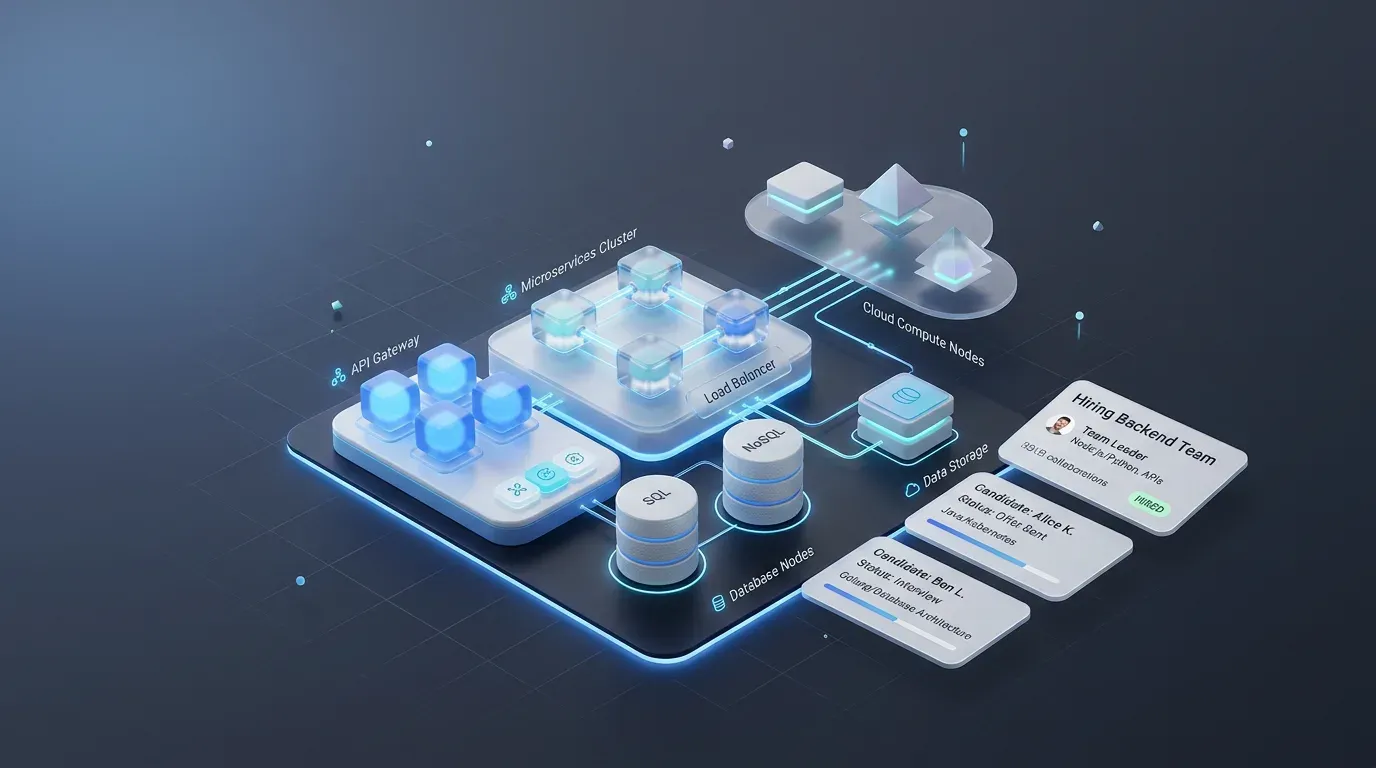
A product's frontend is what users see. The backend is what determines whether it actually works: the APIs, databases, business logic, authentication, third-party integrations, and infrastructure that run quietly behind every interaction. When the backend is well-built, it scales without drama. When it isn't, the problems compound until a rewrite becomes unavoidable.
Most of those problems trace back to how the team was built, not just what they built. Hiring one strong developer early and scaling the team reactively, bringing in contractors when something breaks, or assembling a group without clear ownership are the patterns that lead to expensive outcomes.
This guide covers how to structure a backend development team, what roles belong on it at each stage, what it costs, and how to evaluate candidates before they join. Here's what you need to know.
What a Backend Development Team Is Responsible For
Backend developers build and maintain the server side of a product, the APIs connecting frontend to data, the databases storing it, the business logic processing it, and integrations with external systems like payment gateways, CRMs, and analytics platforms.
At the team level, that accountability expands to system architecture, infrastructure reliability, security, performance under load, and the long-term technical health of everything running in production.
The signal that a single developer is no longer enough usually comes in one of four forms: APIs slowing under increased load, delivery timelines stretching because one person owns too many services, compliance requirements needing dedicated attention, or a codebase too complex for any one person to fully hold.
Who Belongs on a Backend Development Team?
The roles that make up a backend team depend on the stage and complexity of the product. These are the core positions and what each one covers:
Backend Developers write and maintain server-side code, APIs, and business logic. Most teams need at least two, one senior to drive technical decisions and one mid-level to execute alongside them.
A team of only junior developers without senior oversight is one of the most common sources of backend technical debt.
A Database Engineer / Administrator manages schema design, query optimization, data modeling, and database performance. At an early stage, a senior backend developer often covers this. As data volume and complexity grow, it becomes a dedicated role.
A DevOps / Infrastructure Engineer handles cloud infrastructure, CI/CD pipelines, containerization, monitoring, and deployment processes.
In 2026, this role is inseparable from backend engineering on any team shipping regularly to production.
Tech Lead / Backend Architect owns system design decisions, reviews major architectural changes, and ensures technical consistency across the team. This is typically the most senior backend developer on the team, not necessarily an additional headcount.
QA Engineer (Backend-focused) handles integration testing, API testing, performance benchmarking, and test coverage for server-side functionality. Often, the last role added is the one whose absence shows up in production incidents.
How Large Should the Team Be
Team size should match the stage and scope of the product, not the ambition of a roadmap. Overstaffing early adds overhead without output. Understaffing during a growth phase creates bottlenecks that delay everything.
| Stage | Typical Team Size | Core Composition |
Early-stage / MVP | 1–2 developers | 1 senior full-stack or backend developer |
Growing product | 3–5 developers | 1 tech lead, 2 mid-level backend, 1 DevOps |
Scaling product | 6–10 developers | Tech lead, backend specialists, DevOps, DBA, QA |
Enterprise / Platform | 10+ | Multiple squads with dedicated ownership per domain |
The most common mistake at the early stage is hiring two mid-level developers when one senior developer would deliver more, faster, and with fewer architectural decisions to undo later. At the scaling stage, the mistake is the reverse: trying to stretch a small team across too many systems before specialisation becomes necessary.
Core Skills to Look for in a Backend Development Team
Evaluating individual developers is different from evaluating team composition. Both matter. For individual hires:
Partner with Us for Success
Experience seamless collaboration and exceptional results.
Technical depth: Proficiency in at least one primary backend language (Python, Java, Node.js, Go), strong SQL and database design skills, hands-on cloud experience (AWS, GCP, or Azure), and familiarity with Docker and CI/CD pipelines. Cloud proficiency is a baseline expectation in 2026, not a differentiator.
System design reasoning: The ability to design a service that works under realistic load conditions, handles failure gracefully, and can be maintained by others. This is distinct from writing clean code and is the skill most interviews fail to test adequately.
API design: Understanding of REST principles, authentication patterns, rate limiting, versioning, and the developer experience of the APIs being built.
Security awareness: Input validation, secure data storage, access control, and dependency management. Not a separate specialisation at mid-level, an expected competency across the team.
At the team level, evaluate documentation habits, communication clarity, and how ownership is distributed across services. A backend team where one person is the single point of knowledge for every critical system is a risk, not an asset.
Hiring Models for a Backend Development Team
The right hiring model depends on timeline, budget, and how central backend development is to the business long-term.
| Model | Cost | Speed | Best For |
In-House Team | Highest (full employment cost) | Slow to build | Long-term, core product teams |
Managed Development Partner | Moderate | Fast (1–2 weeks) | Ongoing development with senior oversight |
Staff Augmentation | Moderate | Fast | Filling specific skill gaps in an existing team |
Freelancers | Lower upfront | Fast for small tasks | Short-term, well-scoped work only |
For most businesses that need a backend team but are not at the stage where building a full internal engineering department makes sense, a managed development partner is the most practical model.
You get a dedicated team with defined ownership, senior technical oversight, and accountability structures, without the recruitment cycles, employment overhead, or management complexity of building in-house from scratch.
Freelancers are appropriate for clearly bounded tasks with a defined output. They are not a reliable model for team-scale backend development, where continuity, code consistency, and shared context across the codebase are essential to delivery quality.
What It Costs to Build a Backend Development Team
Individual backend developer salaries in the USA in 2026:
| Level | Salary Range | All-in Cost (inc. 25% overhead) |
Junior (0–3 yrs) | $67,000 – $95,000 | $84,000 – $119,000 |
Mid-Level (3–6 yrs) | $95,000 – $135,000 | $119,000 – $169,000 |
Senior (6+ yrs) | $135,000 – $180,000 | $169,000 – $225,000 |
Tech Lead / Architect | $160,000 – $220,000 | $200,000 – $275,000 |
A team of five, one tech lead, two senior developers, one mid-level, and one DevOps engineer, represents a total employment cost of approximately $850,000 to $1.1 million per year before tooling, infrastructure, or management overhead.
Nearshore teams (Latin America) and offshore teams (India, Eastern Europe) typically reduce these figures by 40–60% at comparable senior skill levels.
A managed development partner model with offshore execution typically delivers a full backend team in the $200,000–$400,000 per year range, a significant cost advantage for businesses that do not require full-time in-house headcount.
How to Evaluate Backend Developers During Hiring
The most reliable approach is replacing abstract interview questions with tasks that mirror actual job responsibilities. For backend hiring:
System design exercise — gives a realistic scenario: a service handling high transaction volume needs to remain available under a degraded third-party dependency. How do they approach it? What do they ask before answering? What tradeoffs do they acknowledge? This is a more useful signal than algorithm questions.
Code review task — provide a short piece of backend code with deliberate issues: a security gap, an inefficient query, and inadequate error handling. Ask them to review it. Strong developers identify the issues and explain why they matter. Weaker candidates either miss them or identify only the surface-level problems.
Production incident scenario — ask how they have handled a production issue they were responsible for. The specificity and honesty of the answer are more informative than the technical content. Developers who cannot recall a specific incident either have not shipped to production or are not being direct.
For senior and tech lead roles — ask about architectural decisions they have made and what they would change in retrospect. Self-critique at this level is a consistent indicator of engineering maturity.
Common Mistakes When Building a Backend Team
1. Hiring only mid-level developers to reduce cost
Without a senior or tech lead driving architectural decisions, mid-level teams build systems that work initially and require expensive rework as complexity grows.
2. Treating DevOps as optional
In 2026, infrastructure ownership is inseparable from backend delivery quality. Teams without a DevOps function spend disproportionate time on deployment issues and production incidents.
3. Delaying QA until launch
Backend defects found in production cost significantly more to fix than those caught during development. Integrating QA into the team from the beginning reduces total cost even when it increases short-term headcount.
Partner with Us for Success
Experience seamless collaboration and exceptional results.
4. Building dependency on one person
A backend team where critical services are understood by only one developer is not a team; it is a single point of failure. Service ownership should be distributed and documented.
5. Scaling headcount before scaling processes
Adding developers to a team without clear ownership boundaries, code standards, and a working review process produces slower delivery, not faster. Process clarity is a prerequisite to productive team growth.
Why F22 Labs for Backend Development?
F22 Labs builds and manages dedicated backend development teams for businesses that need senior-level technical execution without the cost and complexity of building an in-house engineering department.
Our teams are pre-vetted, senior-led, and managed by a US-based team that handles technical oversight, onboarding, and delivery accountability. Whether you need a single backend developer or a complete team, we structure the engagement around your specific product stage and requirements.
We offer a free 1-hour strategy consultation, no obligation, just an honest assessment of what your backend team needs and what it will cost.
Frequently Asked Questions
What roles should a backend development team include?
A well-structured backend team typically includes backend developers (at least one senior), a DevOps or infrastructure engineer, a tech lead for architectural oversight, and a QA engineer. Database specialisation becomes a dedicated role as data complexity grows.
How much does it cost to hire a backend development team?
A five-person in-house backend team in the USA costs $850,000–$1.1 million annually, including employment overhead. A managed development partner with offshore execution typically delivers comparable technical capability at $200,000–$400,000 per year.
How do I evaluate a backend developer's technical skills?
Use real-world tasks: a system design exercise, a code review of intentionally flawed code, and a production incident scenario. These produce a more reliable signal than algorithm tests or vocabulary-based interviews.
When does a business need a backend development team rather than a single developer?
When API performance is degrading under load, when one person owns too many critical systems, when security or compliance requirements need dedicated attention, or when the codebase has grown beyond what a single developer can maintain with reasonable coverage.
Should I hire backend developers in-house or use a managed partner?
In-house is the right model for long-term, core engineering teams with stable headcount needs. A managed development partner is more practical for businesses that need senior backend capability quickly, without the recruitment timeline and employment overhead of building an internal team from scratch.