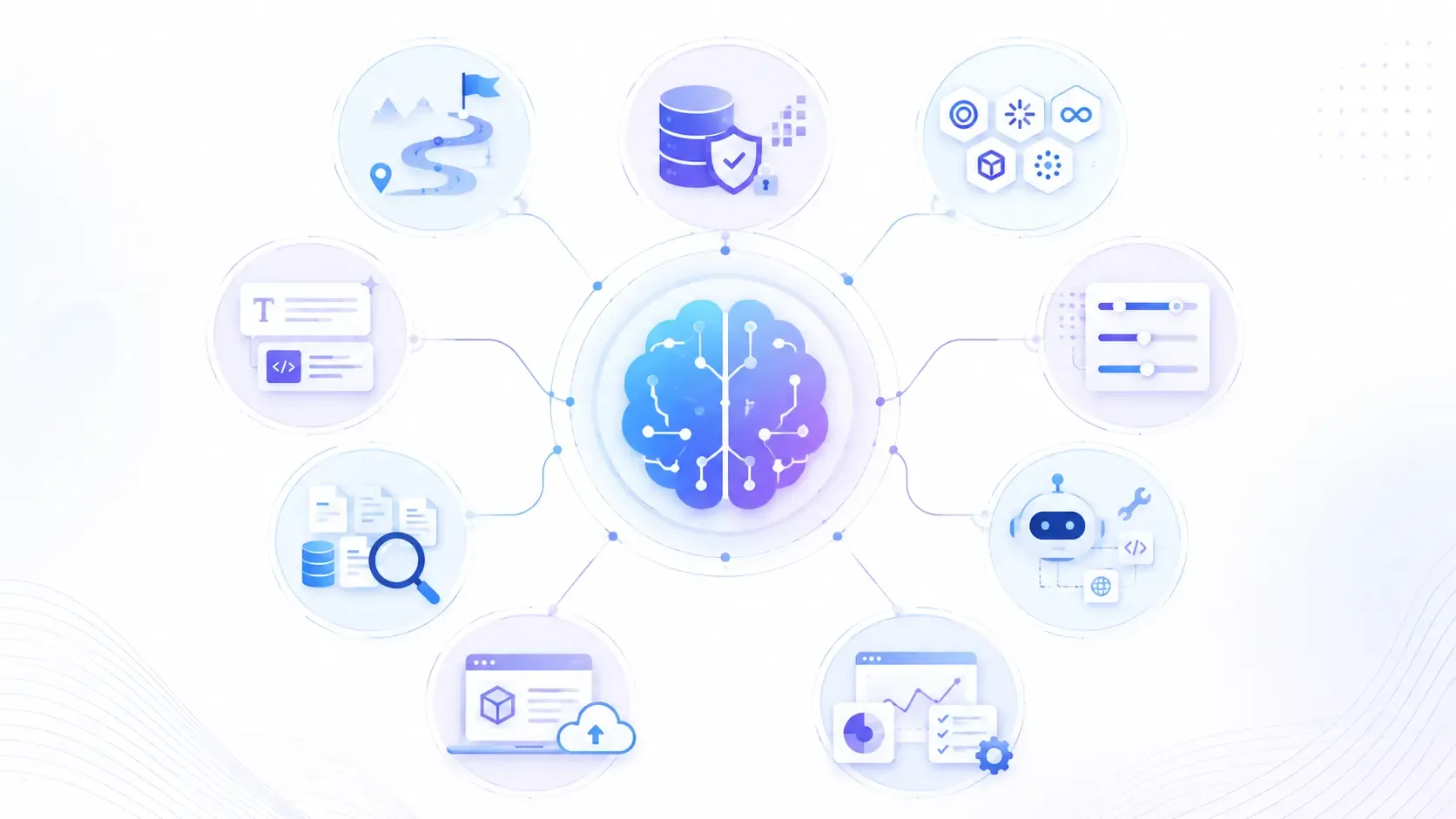
- Vector databases store and retrieve high-dimensional embeddings based on semantic similarity.
- Their workflow involves four stages: embedding, indexing, querying, and retrieval.
- HNSW, IVF, and Product Quantization help search large vector collections efficiently.
- Similarity is commonly measured using cosine similarity, Euclidean distance, or dot product.
- Vector databases support RAG pipelines, semantic search, recommendation systems, and AI assistants.
- Unlike traditional databases, they retrieve conceptually similar results rather than relying only on exact matches.
- The right option depends on scale, filtering needs, infrastructure, deployment model, and development stage.
Vector databases have become a core building block of modern AI applications, powering everything from RAG pipelines and semantic search to recommendation engines and AI assistants. If you are building with LLMs or exploring AI infrastructure in 2026, understanding how vector databases work is no longer optional.
This guide covers the full pipeline, key algorithms, a comparison of top solutions, and how to choose the right one for your use case.
What Is a Vector Database?
A vector database is a type of database designed to store, index, and retrieve high-dimensional vector embeddings, the mathematical representations that AI models use to understand meaning, context, and similarity in data.
When a user asks an AI chatbot a question, the system converts that question into a vector, searches the database for the closest matching vectors, and retrieves relevant content, all in milliseconds. This is what makes Retrieval-Augmented Generation (RAG) possible and why vector databases sit at the heart of nearly every production AI system today.
How Vector Databases Work
Vector databases follow a four-step pipeline to transform raw data into searchable, high-dimensional representations.

1. Embedding
Embedding is the process of converting raw data, text, images, audio, or video into numerical vectors using a machine learning model. Each vector is a list of numbers (dimensions) that captures the semantic meaning and relationships within the data.
For example, the sentences "How do I reset my password?" and "I forgot my login credentials" produce vectors that are mathematically very close, even though they share no common words. This is the power of embeddings.
Modern embedding models used in production:
- OpenAI text-embedding-3-large — one of the most widely used models for text embeddings
- Cohere Embed v3 — strong multilingual support, optimized for RAG pipelines
- Sentence-Transformers (SBERT) — open-source, ideal for local deployments
- Google's Gecko — powers Google's semantic search infrastructure
- CLIP (OpenAI) — multimodal embeddings for both text and images
2. Indexing
Once data is converted into vectors, indexing organizes these vectors so they can be searched efficiently. Without indexing, finding similar vectors would require comparing a query against every single stored vector, computationally impractical at scale.
Indexing methods create data structures that group similar vectors together, enabling the database to narrow down candidates quickly before performing precise similarity comparisons.
Popular indexing approaches:
- HNSW (Hierarchical Navigable Small World) — the most widely used in production; builds a multi-layer graph of vector connections
- IVF (Inverted File Index) — clusters vectors into groups and searches only the most relevant clusters
- Product Quantization (PQ) — compresses vectors to reduce memory usage while maintaining search quality
3. Querying
Querying begins when a user submits a search. The query is first converted into a vector using the same embedding model used during data ingestion. The database then computes the similarity between the query vector and indexed vectors using one of three common distance metrics:
- Cosine Similarity — measures the angle between vectors; best for text where direction matters more than magnitude
- Euclidean Distance (L2) — measures straight-line distance between two vectors; commonly used for image search
- Dot Product — efficient for normalized vectors; widely used in recommendation systems

Walk away with actionable insights on AI adoption.
Limited seats available!

4. Retrieval
Retrieval is the final step, fetching and returning the most similar results. The database returns the top-K most relevant vectors, which are then mapped back to their original data (documents, images, records) and presented to the user or passed to an LLM for further processing.
In a RAG pipeline, this retrieved context is injected directly into the LLM's prompt, enabling the model to generate accurate, grounded responses based on your private data.
What is Vector Embeddings?
Vector embeddings are dense numerical representations of data in a continuous, high-dimensional space. Each dimension captures a specific feature of the data, and mathematically similar data points cluster together in this space.
- Text Embeddings — capture semantic meaning, context, tone, and relationships. "King" − "Man" + "Woman" ≈ "Queen" is the classic example of how embedding spaces encode meaning.
- Image Embeddings — encode visual features like color, texture, edges, and shapes. Used in reverse image search and content moderation.
- Audio Embeddings — capture pitch, rhythm, tone, and acoustic patterns. Used in music recommendation and voice recognition.
- Multimodal Embeddings — models like CLIP represent both images and text in the same vector space, enabling cross-modal search (searching images using text queries).
Similarity Search Algorithms
The core of a vector database's performance lies in how it finds similar vectors. Three main approaches are used:
Brute Force Search (Exact KNN)
Computes similarity between the query vector and every stored vector. Guaranteed to return exact results, but becomes prohibitively slow at scale, O(n) complexity for every query.
Approximate Nearest Neighbour (ANN) Search
The industry standard for production systems. Algorithms like HNSW, Annoy, and ScaNN trade a small degree of accuracy for massive speed gains. For most applications, 95–99% recall at 10–100x the speed of brute force is a worthwhile trade-off.
Locality-Sensitive Hashing (LSH)
Hashes similar vectors into the same "buckets," enabling fast approximate search. Useful for high-dimensional, sparse data but less commonly used in modern production systems where HNSW dominates.
Vector Databases vs Traditional Databases
| Feature | Vector Database | Traditional (SQL/NoSQL) Database |
| Data Type | High-dimensional vectors | Structured rows, documents, key-value |
| Query Type | Similarity search (approximate) | Exact match, range queries |
| Best For | Semantic search, AI/ML applications | Transactional data, structured records |
| Indexing | HNSW, IVF, PQ | B-tree, Hash index |
| Scalability | Horizontal (vector-native) | Horizontal / Vertical |
| Use with LLMs | Native integration | Requires extensions (e.g. pgvector) |
| Examples | Pinecone, Weaviate, Qdrant | PostgreSQL, MongoDB, MySQL |
Traditional databases were built for exact lookups — "find all users where age > 30." Vector databases were built for fuzzy, semantic lookups — "find all content similar in meaning to this query." They solve fundamentally different problems, which is why many production AI systems use both together.
Vector Databases in RAG Applications
Retrieval-Augmented Generation (RAG) is the dominant architecture for building LLM-powered applications with private or up-to-date knowledge. Vector databases are the retrieval layer that makes RAG work.
Here is how a typical RAG pipeline uses a vector database:
- Ingest — Documents (PDFs, web pages, knowledge bases) are chunked and converted into embeddings
- Store — Embeddings are stored in the vector database alongside metadata (source, date, author)
- Query — The user's question is converted into a vector
- Retrieve — The vector database returns the top-K; most relevant chunks
- Generate — Retrieved chunks are injected into the LLM prompt as context
- Respond — The LLM generates an accurate, grounded response
This architecture powers AI chatbots, enterprise knowledge assistants, document Q&A systems, code search tools, and customer support automation. Without the vector database acting as the memory layer, LLMs are limited to their training data; RAG removes that limitation entirely.
Top Vector Database Solutions Compared
| Database | Type | Best For | Scalability | Managed Option | Open Source |
| Pinecone | Cloud-native | Production RAG, enterprise apps | Excellent | Yes (fully managed) | No |
| Weaviate | Vector DB | Semantic + hybrid search | Excellent | Yes | Yes |
| Qdrant | Vector DB | High-performance filtering | Very Good | Yes | Yes |
| Milvus | Vector DB | Large-scale distributed systems | Excellent | Yes (Zilliz) | Yes |
| ChromaDB | Lightweight | Prototyping, local RAG apps | Limited | No | Yes |
| Faiss | Library | Research, custom ML pipelines | Very Good | No | Yes |
| pgvector | PostgreSQL extension | Teams already using PostgreSQL | Good | Via managed Postgres | Yes |
Pinecone is the go-to for teams that want zero infrastructure overhead. Fully managed, serverless, and optimized for RAG workloads, but it comes at a cost for large-scale deployments.
Walk away with actionable insights on AI adoption.
Limited seats available!
Weaviate stands out for its hybrid search capability, combining vector similarity with keyword search (BM25) in a single query. A strong choice for semantic search applications.
Qdrant delivers exceptional performance with rich filtering. Built in Rust, it is fast, memory-efficient, and handles complex payload filters, strong for production-grade applications.
Milvus is designed for massive-scale deployments. Built for distributed environments with billions of vectors, it integrates well with the broader ML ecosystem (PyTorch, HuggingFace).
ChromaDB is the fastest way to get started locally. Minimal setup, Python-native, and perfect for prototyping RAG applications — but not designed for production scale.
Faiss is a library, not a database. It requires more engineering effort to productionize but offers unmatched flexibility for custom research and ML pipelines, especially with GPU acceleration.
pgvector is the pragmatic choice for teams already on PostgreSQL. Adds vector similarity search without introducing a new database to your infrastructure — though it does not match the performance of purpose-built vector databases at large scale.
Suggested Reads- Qdrant vs Milvus: Which Vector Database Should You Choose?
How to Choose the Right One?
The right vector database depends on where you are in the AI development lifecycle and what you are optimizing for:
- Prototyping / Experimenting → Start with ChromaDB or Faiss. Minimal setup, no cost, easy to swap later.
- Production RAG with minimal ops → Pinecone or Weaviate Cloud. Managed, scalable, well-documented.
- High-performance with advanced filtering → Qdrant. Especially strong when queries combine vector search with metadata filters.
- Billion-scale, distributed systems → Milvus. Built for this from the ground up.
- Already on PostgreSQL → pgvector. Avoid adding new infrastructure if your scale does not demand it.
- Research / Custom ML pipelines → Faiss. Maximum flexibility, especially with GPU acceleration.
Frequently Asked Questions
1. What is the main purpose of a vector database?
A vector database stores and retrieves high-dimensional vector embeddings, enabling similarity-based search across unstructured data like text, images, and audio. It is the core infrastructure behind RAG pipelines, semantic search, and AI-powered recommendation systems.
2. How do vector databases differ from traditional databases?
Traditional databases are built for exact matches and structured queries (SQL). Vector databases are built for semantic similarity, finding what is closest in meaning to a query, not what is an exact match. They use specialized indexing algorithms (HNSW, IVF) that traditional databases do not support natively.
3. Which vector database is best for beginners?
ChromaDB is the easiest starting point for developers, open-source, Python-native, and requires minimal setup. For teams that want a fully managed service from day one, Pinecone remains the most beginner-friendly option with excellent documentation and a generous free tier.

Walk away with actionable insights on AI adoption.
Limited seats available!