If you’re building a RAG system, choosing the right vector database quickly becomes a bottleneck. Options like Zvec, Qdrant, and Milvus all promise fast retrieval and scalability, but in practice, their behaviour inside a real pipeline can feel very different.
Instead of relying on feature lists or assumptions, this comparison evaluates how these vector databases perform under identical conditions. From indexing speed to query latency and retrieval consistency, the goal is simple: understand what actually changes when you switch the vector database in a RAG pipeline.
By the end, you’ll have a clear sense of which vector database fits your use case, whether you need low-latency local performance or scalable production-ready infrastructure.
What is the Best Vector Database for RAG?
There are many options, and each promises fast search and scalability. Instead of relying on assumptions, this analysis focuses on how different vector databases behave when used in a real retrieval pipeline.
I started by looking at Zvec and then ran the same setup. If you’re building a RAG system, choosing the right vector database quickly becomes a bottleneck. Options like Zvec, Qdrant, and Milvus all promise fast retrieval and scalability, but in practice, their behaviour inside a real pipeline can feel very different.
Instead of relying on feature lists or assumptions, this comparison evaluates how these vector databases perform under identical conditions. From indexing speed to query latency and retrieval consistency, the goal is simple: understand what actually changes when you switch the vector database in a RAG pipeline.
By the end, you’ll have a clear sense of which vector database fits your use case, whether you need low-latency local performance or scalable production-ready infrastructure.
What is the Best Vector Database for RAG?
There are many options, and each promises fast search and scalability. Instead of relying on assumptions, this analysis focuses on how different vector databases behave when used in a real retrieval pipeline.
I started by looking at Zvec and then ran the same setup with Qdrant and Milvus Lite to observe how they perform under identical conditions.
The goal was not to declare a winner but to see what actually happens, how fast indexing feels, how queries behave, and whether results stay consistent.
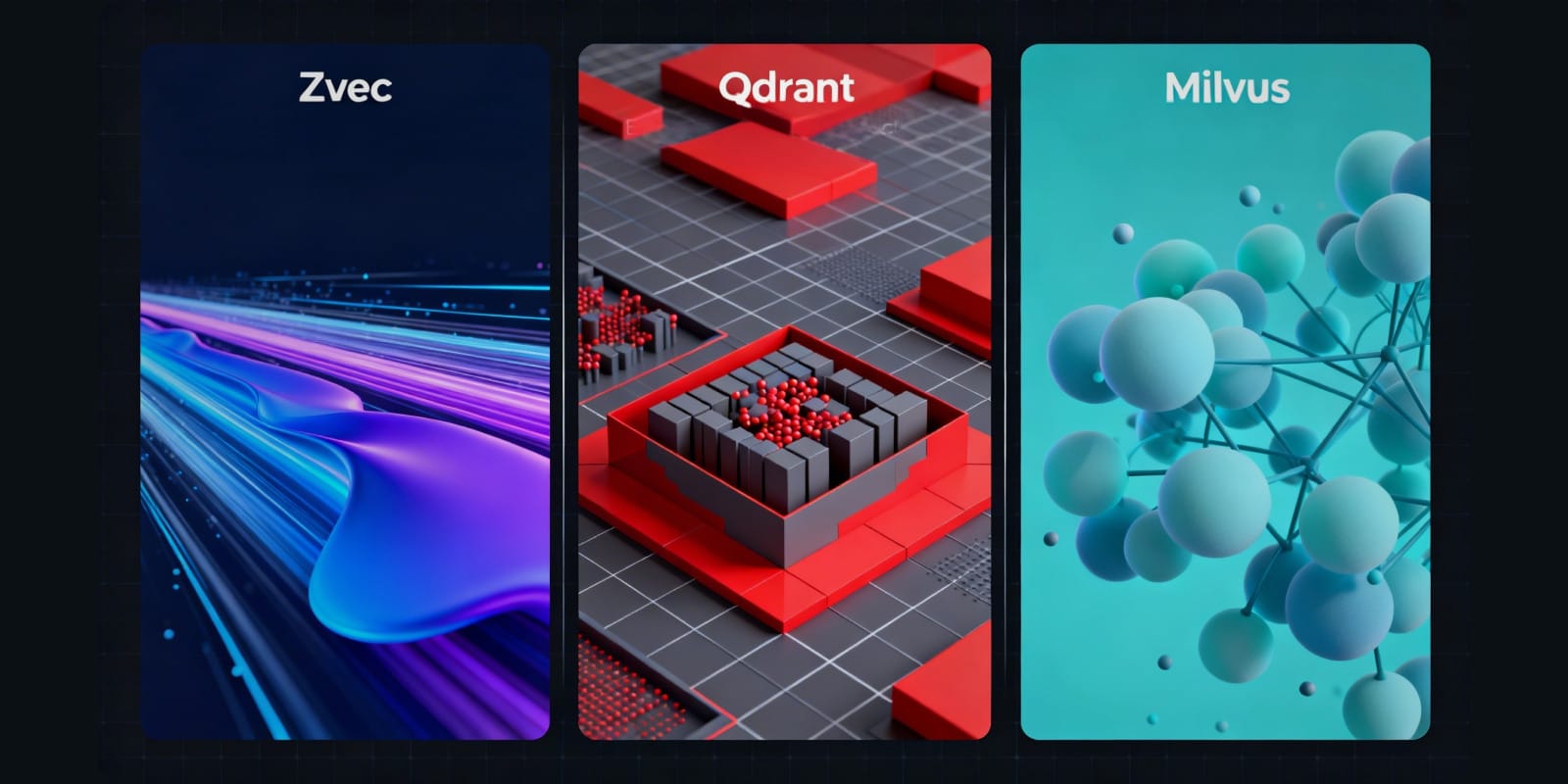
What Are Zvec, Qdrant, and Milvus in Vector Databases?
When comparing options in a vector database comparison, it’s important to understand how each system is designed and where it fits best in a RAG pipeline.
Zvec is an embedded vector database that runs directly inside your application, eliminating the need for external servers or network calls. It enables fast indexing and low-latency retrieval, making it ideal for real-time RAG systems.
Qdrant is a cloud-native vector database built for scalable, production-ready deployments. It operates as a managed service, handling infrastructure and enabling distributed search across large datasets.
Milvus (Lite) is a lightweight local vector database that offers flexible vector search capabilities without requiring a full distributed setup. It provides a balance between performance and ease of use for experimentation.
How This Vector Database Benchmark Was Run
To ensure a fair vector database comparison, all three systems were tested under identical conditions:
- Same embedding model (OpenAI text-embedding-3-small)
- Same chunking strategy
- Same hybrid retrieval (BM25 + vector)
- Same fusion logic
- Same queries and prompts
- Same dataset
The only variable changed was the vector database.
This setup ensures that any differences observed reflect true performance variations, not differences in pipeline configuration.
Vector Databases Compared
Zvec - Embedded Engine
Runs directly within the application process, allowing queries and indexing to happen locally with minimal overhead.
Qdrant - Managed Cloud Service
Operates as a hosted service accessed over the network, handling infrastructure and scaling behind the scenes.
Milvus Lite - Local Engine
A lightweight local version of Milvus that provides vector search capabilities without requiring a full distributed setup.
Dataset Used for RAG Benchmark
To avoid small-dataset bias, I used a full literary work:
- Dracula (Project Gutenberg)
- 548 chunks after tokenization

Walk away with actionable insights on AI adoption.
Limited seats available!

This provides a realistic retrieval workload.
For retrieval quality testing, I used a conversational text corpus to measure semantic similarity.
Vector Database Indexing Performance Comparison
| Database | Avg | p90 | p95 |
Zvec | ~0.02s | ~0.03s | ~0.03s |
Qdrant | ~1.44s | ~1.50s | ~1.51s |
Milvus Lite | ~0.61s | ~0.82s | ~0.84s |
Key Observations
- Zvec indexed almost instantly due to its fully local execution model.
- Qdrant showed higher latency because each operation involved network communication with a remote service.
- Milvus Lite performed faster than cloud-based setups but slower than fully embedded systems like Zvec.
In practice, this means adding new data feels nearly instantaneous with Zvec, while cloud-based systems introduce additional latency due to network overhead.

Vector Database Performance Comparison (Query Latency)
| Database | p50 | p90 | p95 |
Zvec | ~2.36s | ~2.79s | ~2.91s |
Qdrant | ~3.01s | ~3.39s | ~3.54s |
Milvus Lite | ~2.79s | ~3.33s | ~3.83s |
Key Observations
- Zvec delivered faster and more consistent query performance across runs.
- Qdrant remained stable but showed expected delays due to network communication.
- Milvus Lite showed occasional higher latency, likely due to internal indexing and query handling.
Overall, embedded systems like Zvec benefit from zero network overhead, while cloud-based and hybrid setups introduce slight latency variations.
Tail Latency in Vector Database Performance
Averages can appear similar across systems, but percentiles reveal how each database behaves under real conditions.
Key Observations
- Zvec maintained consistent response times across queries.
- Qdrant showed variability due to network communication.
- Milvus Lite experienced occasional slower queries under load.
This highlights why tail latency matters; users notice slow responses, not averages.
Vector Database Retrieval Quality Comparison
| Database | Similarity Range |
Zvec | 0.40 — 0.50 |
Qdrant | 0.35 — 0.49 |
Milvus | 0.34 — 0.46 |
Key Observations
- All systems returned relevant results with only minor differences in similarity scores.
- Variations were minimal, indicating retrieval quality is largely consistent across vector databases.
Overall, performance differences across systems are driven more by latency and architecture than by retrieval accuracy.
Vector Database Architecture Comparison for RAG Workloads
| Feature | Zvec | Qdrant | Milvus Lite |
Deployment | Embedded | Cloud | Embedded |
Network overhead | None | Yes | None |
Scaling model | Local | Distributed | Local |
Operational complexity | Low | Managed | Moderate |
Key Observations
- Zvec and Milvus Lite run locally, eliminating network overhead and reducing latency.
- Qdrant operates as a cloud service, enabling scalability but introducing network delays.
- Operational complexity is lowest for embedded systems, while managed cloud solutions handle infrastructure at scale.
Benchmark Methodology and Evaluation Metrics
Setup
- Index built from scratch for each database
- Same query executed 30 times
- Same dataset, pipeline, and configurations
Metrics Tracked
- Embedding latency
- Vector search latency
- LLM response time
- Total query latency
- Retrieval similarity
Evaluation
- Median (p50)
- p90 and p95 latency
Percentiles matter because users notice slow outliers, not averages.
How Vector Databases Work in a RAG Pipeline
Each query is converted into an embedding, used to find matching entries in the database, and combined to generate a final answer.
- Zvec runs locally, allowing immediate responses with no network delay.
- Qdrant introduces latency as queries are sent to a remote server.
- Milvus Lite runs locally but manages internal indexing, which can add slight delays.
Walk away with actionable insights on AI adoption.
Limited seats available!
These architectural differences directly impact latency and consistency across queries.
Which Vector Database Should You Choose?
Choosing the best vector database for RAG depends on your latency requirements, deployment model, and scalability needs.
- Local (Embedded) Systems - Faster and simpler, ideal for low-latency RAG use cases
- Cloud-Based Systems - Easier to scale, but introduce network overhead
While performance differences are subtle, they become noticeable across repeated queries and at scale.
Ultimately, the right choice depends on whether you prioritise speed, scalability, or operational simplicity in your RAG pipeline.
When to Use Each Vector Database
Zvec - Best for local, low-latency RAG systems where speed is critical
Qdrant - Ideal for scalable, production-ready deployments
Milvus Lite - Suitable for local experimentation with a balance of performance and flexibility
Frequently Asked Questions
1. What is the best vector database for RAG?
It depends on your use case. Zvec is best for low latency, Qdrant for scalability, and Milvus for flexible experimentation.
2. Do vector databases differ in performance?
Yes. Differences appear in indexing speed, query latency, and consistency—not significantly in retrieval accuracy.
3. Is Zvec better than Qdrant or Milvus?
Zvec is faster for local setups, while Qdrant is better for scalable, production environments.
4. Which vector database is fastest?
In this benchmark, Zvec showed the fastest indexing and most consistent query latency due to zero network overhead.
5. Does vector database choice affect RAG accuracy?
Not significantly. Most vector databases return similar results; differences mainly impact performance.
6. Which vector database should I use for RAG pipelines?
Choose Zvec for speed, Qdrant for scalability, and Milvus for balanced local experimentation.
Conclusion
Choosing the best vector database for RAG isn’t about picking a single winner; it’s about understanding how each system behaves in real-world conditions.
This benchmark shows that while retrieval quality remains largely consistent, performance varies based on architecture. Embedded systems like Zvec offer lower latency, while cloud-based solutions like Qdrant provide scalability.
Now you have a clearer view of how Zvec, Qdrant, and Milvus perform in practice, making it easier to choose the right vector database based on your specific RAG requirements.

Jeevarathinam V
AI/ML Engineer exploring next-gen AI and generative systems, driven by curiosity to build, experiment, and push boundaries in the world of intelligent systems.
Walk away with actionable insights on AI adoption.
Limited seats available!