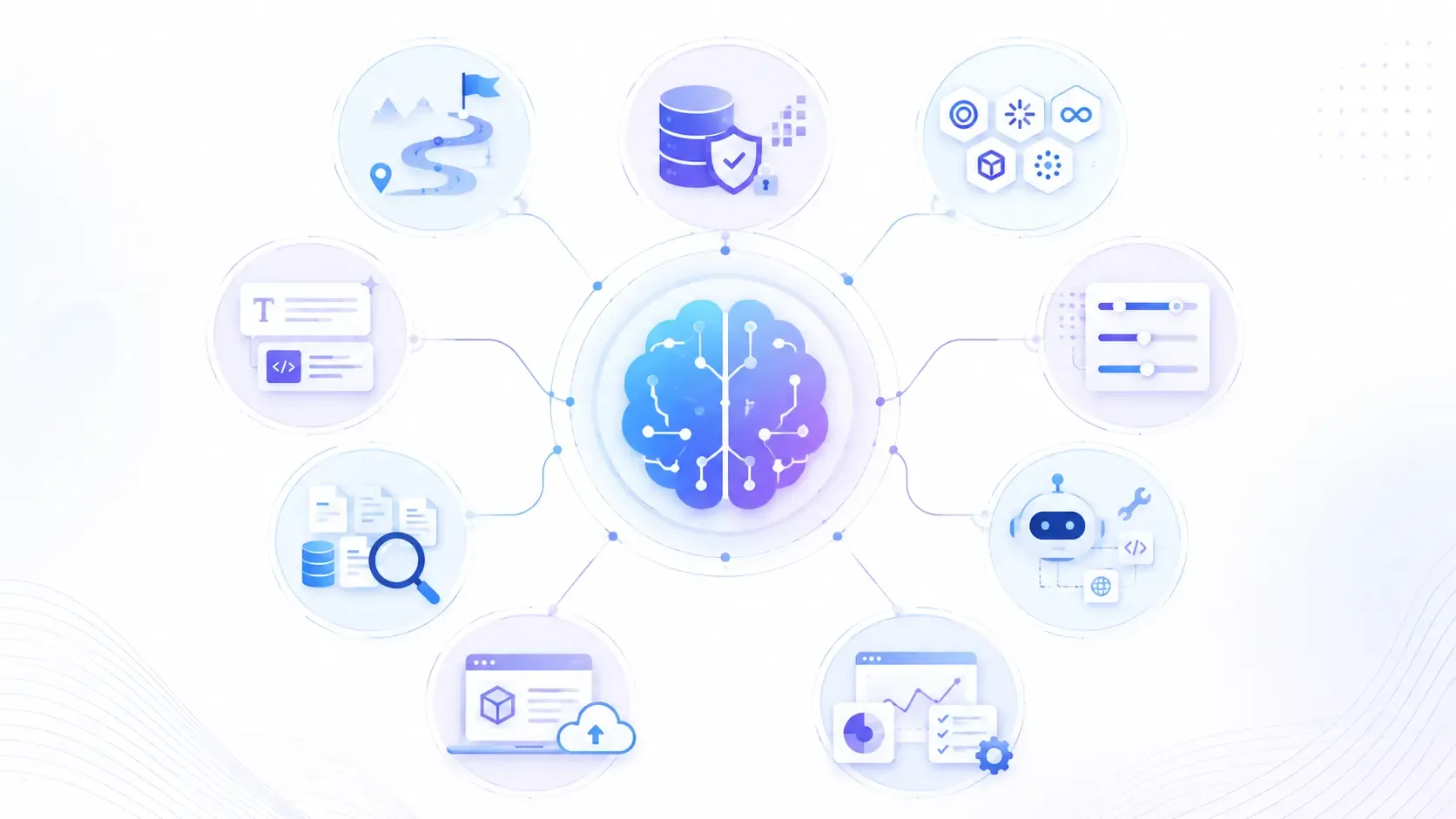
- Data mining analyzes large datasets to uncover patterns, anomalies, correlations, and trends.
- The process typically includes business understanding, data collection, cleaning, transformation, pattern discovery, and evaluation.
- Common techniques include classification, clustering, regression, anomaly detection, association rule mining, text mining, and time-series analysis.
- Data mining supports fraud detection, recommendations, customer segmentation, predictive maintenance, and demand forecasting.
- The quality of the results depends heavily on accurate, complete, and unbiased data.
- Discovered patterns must be evaluated for both statistical validity and business relevance.
- Privacy, compliance, technical expertise, and interpretation remain important limitations.
Every business collects data. The hard part is knowing what to do with it. Data mining is the structured process of analyzing large datasets to discover patterns, trends, and relationships that would otherwise stay hidden, and turning those discoveries into decisions that actually move the business forward.
Think of it like panning for gold in a river. The river is your data. Data mining is the technique that separates the valuable nuggets from the sediment. According to IBM, data mining makes big data functional. Without it, organizations sit on terabytes of information they cannot use.
What Is Data Mining? (Definition)
Data mining is the process of discovering patterns, anomalies, and correlations within large datasets using statistical, mathematical, and machine learning techniques, with the goal of generating actionable insights.
The data mining definition goes beyond simply analyzing data. It is about finding what is non-obvious: the customer segment you did not know existed, the product combination that predicts churn, the equipment behavior that precedes failure. These are insights that manual analysis cannot surface at scale.
Data mining sits at the intersection of statistics, computer science, and business intelligence. It is what transforms raw data into competitive advantage.
Why Data Mining Matters
Businesses today generate more data than any team can manually process. A major retailer captures millions of transactions daily. A hospital records thousands of patient interactions. A streaming platform logs every click, pause, and skip.
Without data mining, this information accumulates without purpose. With it, organizations can:
- Predict customer behavior before it happens
- Detect fraud in real time, not after the damage is done
- Personalize experiences at a scale no human team could manage
- Identify operational inefficiencies that are invisible to the naked eye
According to SAS, organizations that apply data mining strategically shift from reactive to proactive decision-making. Responding to what has happened becomes less important than anticipating what will.
The Data Mining Process
Data mining is not a single step. It is a structured workflow. The most widely adopted framework is CRISP-DM (Cross-Industry Standard Process for Data Mining), which breaks the process into six interconnected phases.
1. Business Understanding
Before touching any data, define the problem clearly. What decision needs to be made? What would a successful outcome look like? Weak problem definition is the most common reason data mining projects fail. Not bad algorithms, but the wrong question.
2. Data Selection and Collection
Identify which data sources are relevant to the problem: databases, CRM systems, transaction logs, sensor outputs, web analytics, or third-party feeds. The scope of this step directly determines the quality of what follows. Collecting the wrong data makes every downstream step harder.
3. Data Preprocessing and Cleaning
Raw data is almost never clean. It contains duplicates, missing values, inconsistent formats, and outliers that distort analysis. This phase, often the most time-consuming, involves:
- Removing duplicate records
- Filling or removing missing values
- Standardizing formats and units
- Detecting and handling outliers
- Resolving inconsistencies across data sources
Skipping this phase is the fastest way to produce confident but wrong conclusions.
4. Data Transformation
Once clean, data must be reshaped into a format that mining algorithms can use effectively. This involves normalizing numerical values, converting categorical variables into numerical representations, reducing dimensionality to remove redundant features, and creating new derived attributes that may reveal hidden patterns.

Walk away with actionable insights on AI adoption.
Limited seats available!

5. Pattern Discovery (Mining)
This is where the actual analysis happens. Algorithms are applied to the prepared data to surface patterns, relationships, and predictions. Different techniques serve different purposes: classification for predicting categories, clustering for grouping similar records, regression for forecasting numbers. The right technique depends entirely on the business question defined in step one.
6. Evaluation and Presentation
Discovered patterns must be evaluated before they are acted on. Statistical significance matters, but so does business relevance. A pattern can be mathematically valid and practically useless.
Findings that pass evaluation are then translated into reports, dashboards, and recommendations that decision-makers can act on.
The process is cyclical. Insights from one cycle often prompt new questions that restart the loop with a sharper focus.
Data Mining Techniques
Different problems require different analytical approaches. These are the core data mining techniques used across industries today.
Classification
Classification predicts which category a data point belongs to. A bank classifying loan applications as "likely to repay" or "high risk" is using classification. So is an email filter deciding what is spam.
Algorithms include decision trees, random forests, support vector machines, and neural networks. Classification is one of the most widely used techniques because categorical prediction problems are everywhere.
Clustering
Clustering groups similar data points together without predefined labels. The algorithm figures out the natural groupings on its own. Retailers use clustering to discover customer segments they did not know existed.
Streaming services use it to group users with similar taste profiles. Unlike classification, there is no "right answer" to train on. The insight comes from the structure the algorithm finds in the data.
Association Rule Mining
This technique finds items that frequently appear together. The classic example: supermarket data showing that customers who buy diapers often buy beer in the same trip.
Retailers use this insight to optimize product placement, bundling, and promotions. In e-commerce, it powers "frequently bought together" recommendations.
Regression Analysis
Regression forecasts a numerical value based on historical data. A logistics company predicting delivery times, a manufacturer forecasting equipment failure rates, or a retailer projecting next quarter's sales: all of these use regression. When the outcome is a number rather than a category, regression is the starting point.
Anomaly Detection
Anomaly detection identifies data points that deviate significantly from expected patterns. In financial services, it catches fraudulent transactions. In manufacturing, it flags defective products before they leave the line.
In cybersecurity, it surfaces unusual network activity that signals a breach. The value of anomaly detection lies in catching problems early, before they escalate.
Text Mining and NLP
Most enterprise data is unstructured: emails, support tickets, reviews, contracts, social media posts. Text mining extracts structured insights from this content. Sentiment analysis, topic modeling, and document classification are all text mining applications. Modern implementations use large language models to handle nuanced language at scale.
Time Series Analysis
Time series analysis identifies patterns in data that changes over time. Retail demand forecasting, financial market prediction, energy consumption modeling, and predictive maintenance all rely on time series techniques.
The goal is to understand trends, seasonality, and cycles, and use them to predict what comes next.
Real-World Applications of Data Mining
Financial Services: Banks apply data mining to detect fraud, assess credit risk, and identify investment opportunities. Transaction patterns that deviate from a customer's normal behavior trigger real-time alerts, stopping fraud before it completes.
Healthcare: Hospitals use data mining to identify patients at risk of readmission, discover treatment patterns that improve outcomes, and predict disease outbreaks before they peak. It enables medicine to move from reactive treatment to proactive prevention.
Retail and E-Commerce: Retailers mine purchase histories to power recommendation engines, optimize inventory, and design targeted promotions. Amazon's recommendation system, responsible for a significant portion of its revenue, is data mining applied at scale.
Manufacturing: Sensor data from production equipment is mined to predict failures before they happen, reducing unplanned downtime and extending machinery lifespan.
Walk away with actionable insights on AI adoption.
Limited seats available!
Telecommunications: Telecom companies mine usage patterns to predict customer churn, identify which customers are likely to leave, and intervene with targeted offers before they do.
Benefits of Data Mining
Better decisions, faster. Data mining replaces gut-feel with evidence. Decisions backed by discovered patterns are more reliable and more defensible than those based on intuition alone.
Deeper customer understanding. Mining behavioral data reveals what customers actually do, not just what they say in surveys. This enables personalization that genuinely reflects individual preferences.
Proactive fraud and risk management. Anomaly detection identifies suspicious activity in real time, allowing intervention before damage accumulates rather than after.
Operational efficiency. Mining process data surfaces inefficiencies that are invisible in day-to-day operations: bottlenecks, waste, and failure patterns that cost money at scale.
Limitations of Data Mining
Data quality is everything. The output of any data mining process is only as good as the input. Incomplete, inconsistent, or biased data produces misleading patterns, and acting on misleading patterns causes real damage.
Privacy and compliance. Mining personal data carries significant regulatory risk. GDPR, CCPA, and sector-specific regulations impose strict limits on what data can be collected, stored, and analyzed. Compliance must be built into the process from the start.
It requires the right expertise. Data mining is not a button you press. It requires people who understand both the technical methods and the business context. Knowing which algorithm to use matters less than knowing what question to ask.
Results need interpretation. A statistically significant pattern is not automatically a useful one. Every finding requires business judgment to determine whether it is worth acting on.
Frequently Asked Questions
What is data mining in simple words?
Data mining is the process of analyzing large amounts of data to find useful patterns and relationships. Like mining for gold, it involves searching through vast amounts of material to extract something valuable, in this case, insights that help organizations make smarter decisions
What is a simple example of data mining?
A supermarket analyzes purchase data and discovers that customers who buy diapers often buy beer in the same shopping trip. Using that insight, the store repositions products to increase sales of both items. Netflix analyzing your viewing history to recommend shows is another everyday example.
Why is it called data mining?
The name comes from the analogy to mining for minerals. Just as mining involves extracting valuable ore from large amounts of rock, data mining involves extracting valuable insights from large volumes of data. Both processes require effort, the right tools, and expertise to find what is worth keeping.
What is the difference between data mining and data analysis?
Data analysis typically involves examining known data to answer specific, predefined questions. Data mining is more exploratory, it looks for patterns and relationships that were not specifically anticipated. Data analysis confirms hypotheses. Data mining generates them.
What are the most common data mining techniques?
The most widely used data mining techniques are classification, clustering, association rule mining, regression analysis, anomaly detection, text mining, and time series analysis. Each serves a different type of problem, and real-world projects often combine multiple techniques.

Walk away with actionable insights on AI adoption.
Limited seats available!