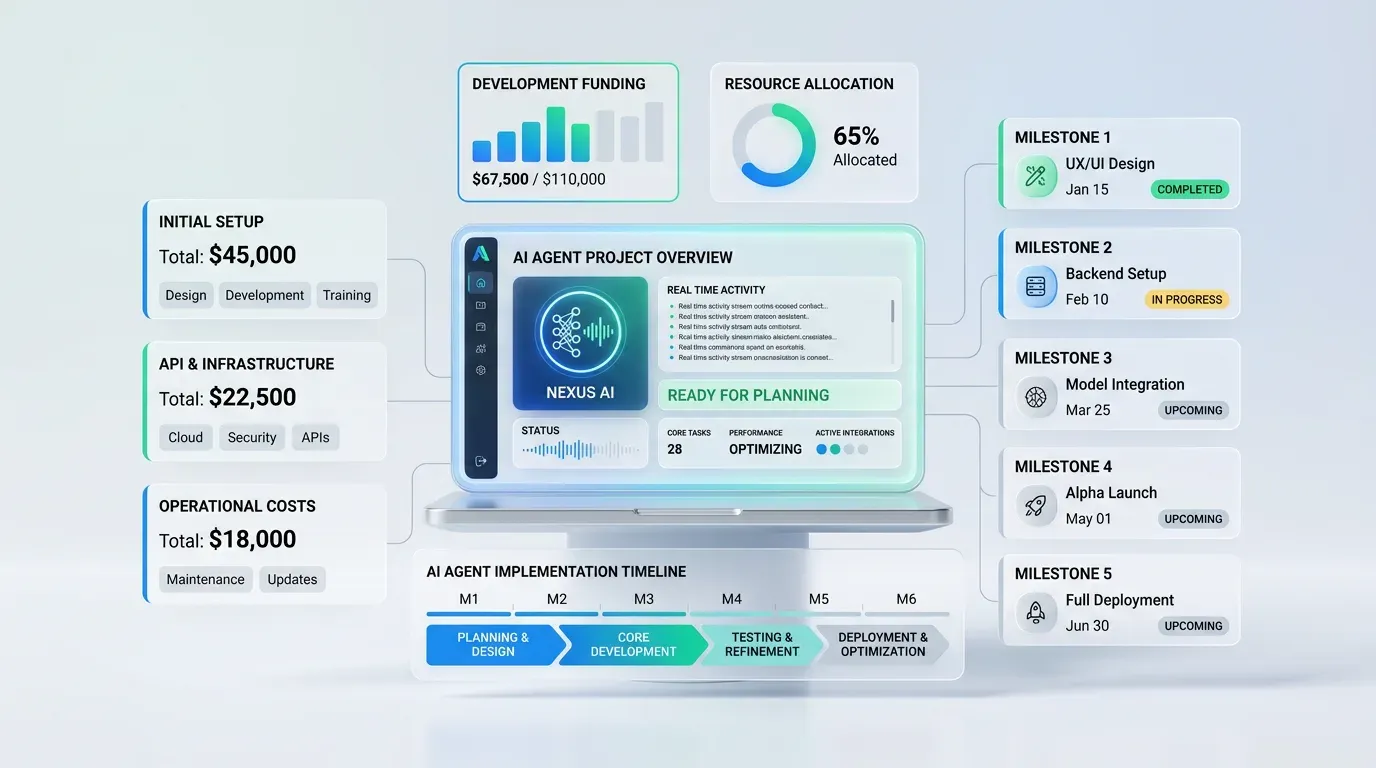
- AI agent cost ranges from $5,000 (basic single-task agent) to $100,000+ (enterprise, multi-agent systems), with most landing $15,000–$60,000.
- Cost scales with workflow complexity, number of integrations, and level of autonomy, an agent that suggests actions is cheaper than one that executes them unsupervised.
- Hidden costs add up post-launch: LLM/API usage, vector database hosting, monitoring, human review, and ongoing maintenance.
- Build time is typically 2–12 weeks; start with a PoC if the workflow is complex or untested.
- Reduce cost by starting with one workflow, using existing models instead of custom ones, limiting integrations in v1, and keeping humans in the loop for sensitive actions.
Building an AI agent sounds exciting until the cost questions start coming in. Do you need a simple agent that answers questions, or a workflow agent that can use tools, connect with your systems, and complete tasks on its own?
That difference matters because an AI agent is not priced like a regular chatbot. The cost depends on what the agent needs to do, how many tools it connects with, what data it uses, how much control it has, and how reliable it needs to be.
In this guide, we’ll break down how much it costs to build an AI agent, what affects the budget, what is included in development, and how to plan the first version without overbuilding.
How Much Does It Cost to Build an AI Agent?
The cost to build an AI agent usually ranges from $5,000 to $100,000+, depending on what the agent needs to do, how many systems it connects with, and how much autonomy it has.
A simple AI agent that answers questions, summarizes information, or handles one basic workflow may cost around $5,000 to $15,000. A more advanced AI agent that can use tools, connect with CRMs or databases, process documents, trigger actions, and follow multi-step workflows can cost between $15,000 and $60,000+.
Enterprise-grade AI agents can cost more if they need custom workflows, sensitive data handling, compliance checks, role-based access, human approval flows, monitoring, and production-level reliability.
The best way to estimate the cost is to define what the agent should actually do. If the goal is to validate one workflow, the budget can stay lean. If the agent needs to act across multiple systems with high accuracy and security, the cost will naturally increase.
AI Agent Development Cost by Complexity
AI agent pricing depends on how much the agent needs to do. A simple single-task agent will cost less than an agent that needs memory, tool use, approvals, integrations, and production monitoring.
| AI Agent Type | Estimated Cost | Best For |
Basic AI Agent | $5,000–$15,000 | FAQ agents, simple internal assistants, single-task automation |
Workflow AI Agent | $15,000–$40,000 | Sales follow-ups, support triage, CRM updates, document workflows |
Advanced AI Agent | $40,000–$75,000+ | Multi-step workflows, tool use, memory, human review, and multiple integrations |
Enterprise AI Agent System | $75,000–$100,000+ | Compliance-heavy workflows, role-based access, monitoring, governance, and production reliability |
These are practical estimates, not fixed prices. The cost increases when the agent needs to make decisions, call external tools, handle sensitive data, or work across multiple business systems.
AI Agent Cost by Use Case
AI agent cost also depends on the business workflow you want to automate. A simple support or internal assistant agent will usually cost less than an agent that handles finance workflows, document processing, or multiple system integrations.
| AI Agent Use Case | Estimated Cost |
Customer Support AI Agent | $5,000–$25,000 |
Internal Knowledge Assistant | $5,000–$20,000 |
Sales AI Agent | $10,000–$35,000 |
HR AI Agent | $10,000–$40,000 |
Research AI Agent | $10,000–$40,000 |
Document Processing AI Agent | $15,000–$50,000 |
Finance or Billing AI Agent | $20,000–$60,000 |
Multi-Agent Workflow System | $50,000–$100,000+ |
These ranges are practical estimates. The final cost depends on the workflow complexity, data quality, number of integrations, approval steps, security needs, and how much autonomy the agent needs.
What Is Included in AI Agent Development Cost?
AI agent development cost is not just for connecting an AI model. A good agent needs workflow planning, data setup, integrations, testing, guardrails, and ongoing improvements so it can work reliably in real business conditions.
Use Case Discovery and Workflow Mapping
The first step is to define what the AI agent should actually do. This includes the task it owns, the workflow it supports, the systems it needs to access, and where human approval is required.
For example, a sales AI agent may need to read CRM data, qualify leads, draft follow-ups, and update deal stages. Mapping this workflow clearly helps keep the scope realistic and avoids overbuilding.
Agent Architecture and Tool Planning
AI agents often need more structure than chatbots. The team needs to decide whether the agent needs memory, retrieval, API calls, tool use, approval steps, or multi-step reasoning.
This planning helps define how the agent will move from input to action without breaking the workflow or creating unnecessary risk.
LLM or Model Integration
The cost includes choosing and integrating the right model. This could be OpenAI, Anthropic, Gemini, open-source models, or a custom/fine-tuned model depending on the use case.
For most first versions, existing models are enough. Custom models or fine-tuning may increase cost and are usually needed only for specialized accuracy, privacy, or domain-specific requirements.
Data Preparation and Knowledge Base Setup
An AI agent needs the right data to work well. This may include FAQs, documents, CRM records, product data, internal policies, support tickets, or workflow history.
The data may need to be cleaned, structured, chunked, embedded, or added to a knowledge base before the agent can use it reliably.
Backend, APIs, and Third-Party Integrations
Most AI agents need to connect with business systems. This can include CRMs, support tools, ERPs, databases, calendars, email, billing tools, or internal dashboards.
The more systems the agent connects with, the more effort goes into API setup, permissions, data flow, error handling, and testing.
Testing, Evaluation, and Guardrails
AI agents need to be tested for accuracy, hallucinations, latency, workflow completion, edge cases, and failure handling.
Guardrails are also important, especially when the agent can take actions. This may include human approvals, restricted permissions, fallback flows, audit logs, and escalation rules.
Deployment, Monitoring, and Maintenance
Once the agent is built, it needs to be deployed and monitored. This includes tracking usage, errors, model costs, failed workflows, user feedback, and output quality.
AI agents usually need ongoing improvements as workflows change, data updates, or users start using the agent in new ways.
Key Factors That Affect AI Agent Development Cost
The cost of building an AI agent depends on how complex the workflow is, how much autonomy the agent has, and how many systems it needs to work with. A simple assistant that answers questions will cost much less than an agent that can read data, make decisions, call tools, and complete tasks across business systems.

Walk away with actionable insights on AI adoption.
Limited seats available!

Workflow Complexity
The more steps the agent needs to handle, the higher the cost. A basic agent may answer questions or summarize information, while a more advanced agent may need to check records, compare data, trigger actions, and update systems.
Multi-step workflows need more planning, testing, and error handling.
Number of Integrations
AI agents become more complex when they need to connect with tools like CRMs, ERPs, helpdesk software, payment systems, calendars, email, or internal databases.
Each integration adds work around API setup, permissions, data flow, testing, and failure handling.
Level of Autonomy
An agent that only suggests actions is cheaper to build than one that can take actions on its own.
For example, an agent that drafts a sales email for review is simpler than one that sends the email, updates the CRM, schedules a follow-up, and changes lead status automatically.
Data Quality and Knowledge Base Readiness
Clean, structured data can reduce development time. Messy documents, scattered knowledge bases, outdated records, or incomplete data can increase the cost because the team needs to clean and prepare the data before the agent can use it.
Security and Access Control
If the agent works with customer data, financial records, HR information, healthcare data, or internal business systems, it needs stronger security.
This may include role-based access, data masking, audit logs, approval flows, and restricted permissions.
Testing and Reliability Requirements
AI agents need more testing than simple AI tools because they may take actions inside real workflows.
The cost increases when the agent needs high accuracy, low latency, fallback flows, human approval, hallucination checks, and monitoring after launch.
Hidden Costs of Building an AI Agent
The development cost is only one part of building an AI agent. Businesses should also plan for the ongoing costs that come after the first version is built.
LLM and API Usage Costs
Most AI agents use large language models through APIs. Every time the agent reads a prompt, checks context, calls a tool, or generates a response, it can add to usage costs.
These costs may look small during testing but can increase when more users or workflows start using the agent regularly.
Vector Database and Knowledge Base Costs
If the agent needs to search documents, policies, support tickets, or internal knowledge, it may need a vector database or knowledge base setup.
This can add costs for storage, hosting, indexing, embedding generation, and ongoing updates when new data is added.
Monitoring and Logging Costs
AI agents need monitoring to track errors, failed workflows, response quality, latency, and usage patterns.
Without proper logging, it becomes hard to understand why the agent failed, what users asked, or where the workflow needs improvement.
Human Review Costs
Some agents need human approval before taking action, especially in finance, healthcare, legal, HR, sales, or compliance workflows.
This adds operational cost because someone still needs to review outputs, approve actions, and handle exceptions.
Maintenance and Workflow Updates
Business workflows change over time. New tools are added, policies change, data sources move, and users ask for new actions.
An AI agent needs regular updates to prompts, integrations, workflows, permissions, and evaluation rules to stay useful.
Security and Compliance Costs
If the agent works with sensitive data, there may be extra costs for access control, audit logs, data masking, encryption, compliance checks, and internal security reviews.
These costs are easy to miss early but become important when the agent moves closer to production.
How Long Does It Take to Build an AI Agent?
Most AI agents take around 2 to 12 weeks to build, depending on the workflow, integrations, data readiness, and level of autonomy required.
A simple AI agent that answers questions or handles one basic task may take 2 to 4 weeks. A workflow agent that connects with CRMs, databases, support tools, or internal systems may take 4 to 8 weeks. More advanced agents with memory, tool use, human approvals, security controls, and monitoring can take 8 to 12 weeks or more.
| AI Agent Type | Estimated Timeline |
Basic AI Agent | 2–4 weeks |
Workflow AI Agent | 4–8 weeks |
Advanced AI Agent | 8–12 weeks |
Enterprise AI Agent System | 12+ weeks |
The timeline stays shorter when the workflow is clear, the data is ready, and the first version focuses on one specific task instead of trying to automate too many processes at once.
AI Agent vs Chatbot: Cost Difference
An AI chatbot is usually cheaper to build than an AI agent because it mainly answers questions or follows a fixed conversation flow. An AI agent costs more because it can understand context, use tools, connect with systems, make decisions, and complete tasks.
| Factor | AI Chatbot | AI Agent |
Main Purpose | Answers questions or guides conversations | Completes tasks and workflows |
Tool Use | Limited or none | Can call APIs, use tools, and trigger actions |
Integrations | Usually fewer | Often connects with CRMs, databases, calendars, support tools, or internal systems |
Autonomy | Low | Medium to high, depending on approvals and permissions |
Testing Needs | Basic response testing | Accuracy, workflow completion, hallucinations, failure cases, and guardrails |
Estimated Cost | $3,000–$15,000+ | $5,000–$100,000+ |
A chatbot is a good starting point if the goal is to answer common questions or support simple interactions.
An AI agent is better when the business needs automation beyond conversation, such as updating a CRM, processing documents, qualifying leads, scheduling tasks, or completing multi-step workflows.
How to Reduce AI Agent Development Cost
AI agent development becomes expensive when the first version tries to do too much. The best way to control cost is to start with one clear workflow, prove that it works, and then expand the agent step by step.
Start With One Workflow
Do not try to automate sales, support, finance, and operations in the first version. Pick one workflow where the agent can create clear value.
For example, start with support ticket triage before building a full customer support agent.
Use Existing Models First
Most AI agents do not need a custom model at the beginning. Existing models from OpenAI, Anthropic, Gemini, or open-source options can usually handle the first version.
Custom model training or fine-tuning should come later if the agent needs stronger domain accuracy or private model control.
Walk away with actionable insights on AI adoption.
Limited seats available!
Limit Integrations in the First Version
Every integration adds cost. Start with the most important system first, such as a CRM, helpdesk, database, or knowledge base.
Once the agent proves value, you can add more tools and systems.
Keep Human Approval for Sensitive Actions
Let the agent suggest actions first instead of acting fully on its own. This reduces risk and keeps development simpler.
For example, the agent can draft an email, create a CRM note, or recommend a refund, while a human approves the final action.
Track Token and Usage Costs Early
AI agents may call the model multiple times for one task. Track usage from the beginning so costs do not surprise you later.
This also helps you optimize prompts, reduce unnecessary calls, and choose the right model for each step.
Build an AI PoC Before Full Development
If the workflow is complex, start with an AI PoC before building the full agent. A PoC helps test whether the agent can complete the task, use the right data, and produce reliable outputs before you invest in a bigger system.
When Is an AI Agent Worth the Investment?
An AI agent is worth the investment when it can handle a repeatable workflow that takes up time, slows down teams, or creates avoidable errors. The goal should not be to build an agent because AI is trending. It should solve a workflow problem better than the current process.
AI agents usually make sense when they can:
- Reduce manual work for internal teams
- Speed up customer support or sales follow-ups
- Improve accuracy in document-heavy workflows
- Connect data across tools and systems
- Handle repetitive tasks at scale
- Support teams without increasing headcount
- Give users faster answers or actions
For example, an AI agent may be worth building if it can qualify leads, summarize support tickets, process invoices, check documents, update CRM records, or answer internal knowledge questions. If the agent saves time, reduces cost, improves quality, or creates a better customer experience, the investment becomes easier to justify.
How F22 Labs Helps Businesses Build AI Agents
F22 Labs helps businesses build AI agents for customer support, sales, operations, document processing, internal automation, and AI-powered product workflows.
As an AI Development company, we support AI PoCs, MVPs, integrations, testing, deployment, and roadmap planning. Our team can help you build agents that use your data, connect with your tools, and support real business workflows.
Conclusion
The cost to build an AI agent depends on what the agent needs to do, how many tools it connects with, the quality of your data, and how reliable it needs to be in real workflows.
A simple agent can start with a smaller budget, while advanced agents with integrations, memory, approvals, and monitoring will cost more. The safest approach is to begin with one clear workflow, validate it through a focused PoC, and then expand once the agent proves business value.
When planned properly, an AI agent can reduce manual work, improve response speed, and help teams complete repeatable tasks more efficiently.
Frequently Asked Questions
How much does it cost to build an AI agent?
An AI agent usually costs between $5,000 and $100,000+, depending on the workflow complexity, integrations, data quality, autonomy, and testing requirements.
How long does it take to build an AI agent?
Most AI agents take 2 to 12 weeks to build. Simple agents may take 2–4 weeks, while advanced workflow agents can take 8–12 weeks or more.
Is an AI agent more expensive than a chatbot?
Yes. AI agents usually cost more because they can use tools, connect with systems, make decisions, and complete workflows, while chatbots mostly answer questions.
What affects AI agent development cost?
The main factors include workflow complexity, number of integrations, level of autonomy, data readiness, security needs, testing, and monitoring requirements.
Can I build an AI agent using existing AI APIs?
Yes. Many AI agents can start with existing AI APIs before investing in custom models or fine-tuning.
What are the hidden costs of AI agents?
Hidden costs may include LLM usage, vector database hosting, monitoring, logging, human review, maintenance, security, and workflow updates.
Should I build an AI agent PoC first?
Yes, if the workflow is complex or untested. A PoC helps validate whether the agent can complete the task reliably before full development.
How much does it cost to maintain an AI agent?
Maintenance cost depends on usage, model costs, integrations, monitoring, and updates. Most businesses should plan for ongoing monthly optimization and support.

Walk away with actionable insights on AI adoption.
Limited seats available!