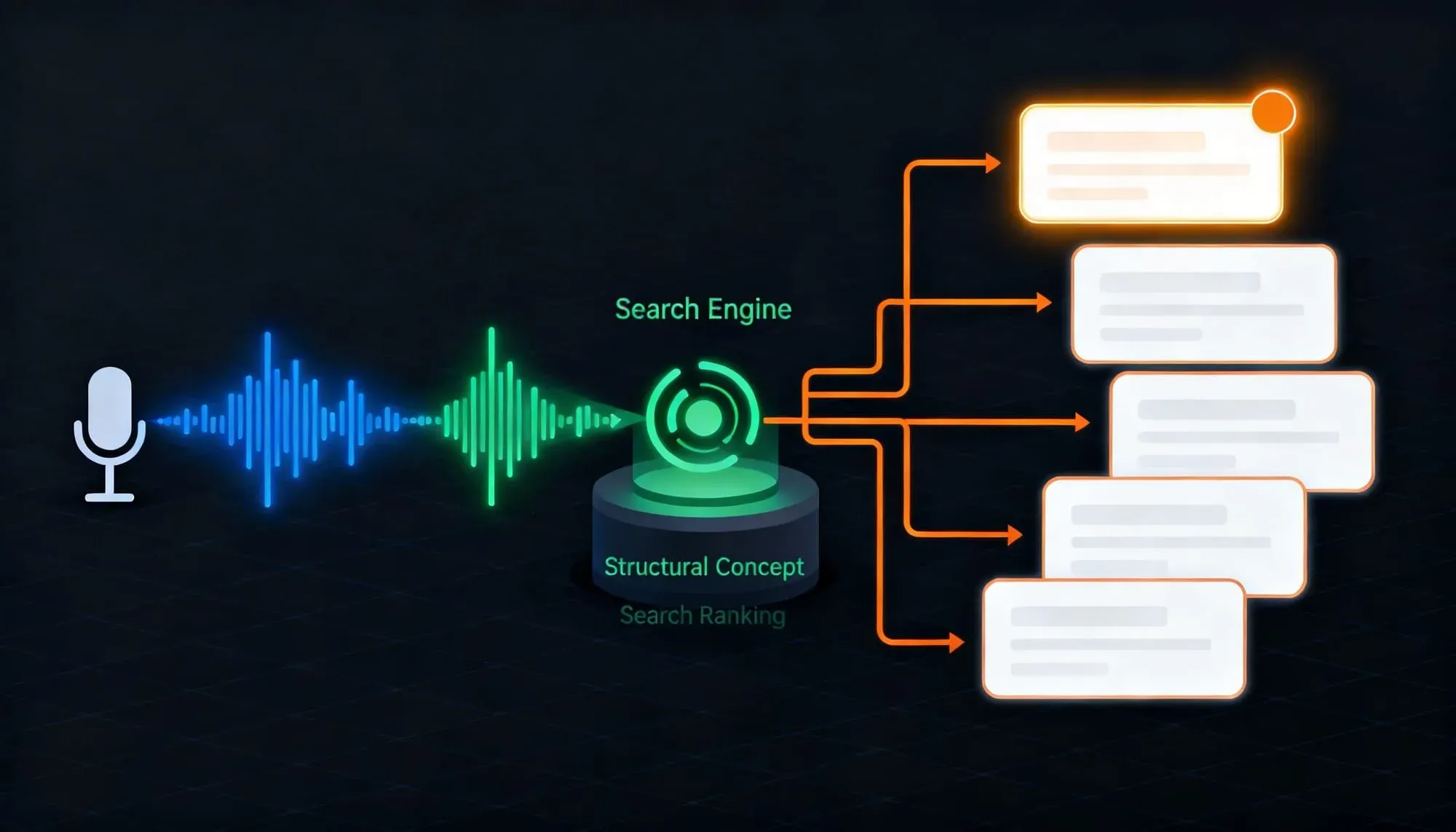
- Voice search SEO helps your content appear as a direct answer when users search through Google Assistant, Siri, Alexa, or other voice assistants.
- Voice queries are usually longer, more conversational, and often framed as questions like “how,” “what,” “where,” or “near me.”
- To rank for voice search, answer questions clearly, target long-tail queries, improve page speed, optimize for featured snippets, and strengthen local SEO.
- Voice search is especially important for local businesses because many spoken searches are action-based, such as finding stores, services, or places nearby.
- The goal is not just to rank on Google, but to make your content easy for assistants to understand, extract, and read aloud.
Voice search changes how people look for information. Instead of typing short keywords, users ask complete questions and expect quick, direct answers.
Recent voice search reports still show strong mobile usage, with several industry roundups citing around 27% of users using voice search on mobile devices. The exact number varies by source, but the behavior is clear: more users are searching through spoken, conversational queries.
This shift changes how SEO works.
When someone types a query, they scroll through results. But with voice search, assistants often choose a single answer. If your content isn’t structured for how people actually speak, it simply won’t get picked.
I’ve seen this firsthand: content that ranks well for traditional search doesn’t always perform in voice results. The difference comes down to how clearly and directly you answer real questions.
In this guide, I’ll break down how voice search works, how assistants choose answers, and what you need to do to rank for voice queries.
What Is Voice Search?
Voice search is a technology that allows users to search the internet using spoken commands instead of typing. It works by converting speech into text, understanding the intent behind the query, and delivering a direct, relevant answer, often read aloud by a voice assistant.
Voice assistants like Google Assistant, Siri, and Alexa use Automatic Speech Recognition (ASR) and Natural Language Processing (NLP) to understand natural, conversational questions and respond accurately.
Unlike traditional search, voice queries are longer, question-based, and focused on getting a single, immediate answer rather than browsing multiple results.
What Is Voice Search SEO?
Voice Search SEO is the process of optimising your content so it can be selected as a direct answer to voice queries. It focuses on helping search engines and voice assistants understand your content and deliver it as a single, spoken response.
Unlike traditional SEO, where users choose from multiple results, voice search often provides one primary answer. This means your content must be clear, direct, and structured to succeed in voice search SEO.
Voice Search SEO involves:
- targeting conversational, question-based queries
- structuring content for clear, direct answers
- optimizing for featured snippets (position zero)
- improving page speed and mobile experience
In simple terms, it’s about making your content easy to understand, easy to extract, and easy for voice assistants to read aloud.
Why Voice Search Matters for SEO?
Voice search is no longer a trend; it’s a shift in how people search.
Around 27% of the global online population uses voice search on mobile, and millions of users rely on voice assistants daily to find information, services, and products.
More importantly, voice search is highly action-driven:
- 22% of smart speaker users have made a purchase using voice
- 58% of consumers use voice search to find local businesses
This behaviour shows a clear shift; users are not just searching, they are acting immediately.
Voice search fits naturally into everyday moments like driving, cooking, or multitasking. Instead of browsing multiple results, users expect one quick, accurate answer.
For businesses, this means content needs to answer questions clearly and work well on mobile, especially for local and action-based searches.
Voice search isn’t replacing traditional SEO; it’s expanding it. The goal is no longer just to rank, but to be the answer.
How Voice Search Queries Are Different From Text Searches
Voice search queries are fundamentally different from typed searches. People don’t speak the way they type, and this directly impacts how content should be optimized.
1. Conversational and Longer Queries
Voice searches are usually longer and more natural. Instead of short keywords, users speak in full sentences.
Example:Typed: “weather Chennai tomorrow”Voice: “What’s the weather like in Chennai tomorrow morning?”
2. Question-Based Structure
Most voice queries are framed as questions using words like what, how, where, when, and why.Content that directly answers these questions has a higher chance of being selected.
3. Strong Local Intent
Voice searches often include location-based intent like “near me” or “open now”.These queries usually come from users ready to take immediate action.
4. Immediate and Action-Oriented
Voice search is often used in real-time situations, such as driving, cooking, or multitasking.Users expect quick, direct answers they can act on instantly.
5. Single Answer Expectation
Unlike traditional search, users don’t browse multiple results. Voice assistants typically provide one best answer, making competition more intense.
5 Types of Voice Searches
Understanding the different types of voice searches helps you create content that matches real user intent and increases your chances of being selected as the answer.
1. Informational Queries
These are the most common. Users are looking to learn something or get an answer.
Example: “How do you make paneer at home?”
Content that provides clear, direct, and conversational answers performs best for voice search SEO.
2. Navigational Queries
Users want to go to a specific website or app.
Example: “Open YouTube” or “Go to Amazon”This is less about content optimisation and more about brand presence and recognition.
3. Transactional Queries
Users are ready to take action, such as buying or booking a service.

Walk away with actionable insights on AI adoption.
Limited seats available!

Example: “Order pizza from Domino’s” or “Book a cab to the airport”These queries have high commercial intent and require strong product, service, and conversion-focused pages.
4. Local Queries
These are highly intent-driven and often include phrases like “near me” or “open now.”
Example: “Find a pharmacy near me open right now”Local SEO, Google Business Profile optimisation, and reviews play a key role here.
5. Device-Control Queries
These involve controlling smart devices.
Example: “Turn off the lights” or “Set a timer for 20 minutes.” While less relevant for content creators, they are important for smart home and IoT applications.
How Voice Assistants Choose Search Results
This is the question every SEO professional should be asking. Voice assistants choose answers based on relevance, clarity, authority, and how easily the content can be delivered as a spoken response.
Voice assistants don’t randomly pick answers. They follow a clear set of signals to decide which content is the most accurate, relevant, and easy to deliver as a spoken response.
1. Featured Snippets (Position Zero)
For Google Assistant, the most important factor is the Featured Snippet, the answer box that appears at the top of search results.
If your content is selected here, there’s a high chance it will be read aloud for voice queries.
While Featured Snippets are the primary source, assistants may also pull answers from AI summaries, knowledge panels, and top-ranking pages.
2. Authority and Trust Signals
Voice assistants prioritise content from trusted, authoritative websites.
Factors like domain authority, backlinks, secure HTTPS, and consistent content quality all influence whether your content gets selected.
3. Relevance to Conversational Intent
It’s not just about keywords; it’s about intent.
Assistants look for content that directly answers questions in a natural, conversational way. Pages that clearly match how people speak are more likely to be chosen.
4. Page Speed and Mobile Optimisation
Voice search is primarily mobile. Slow-loading or poorly optimised pages are less likely to be selected.
Fast, mobile-friendly websites have a clear advantage in voice search results.
Voice Search SEO Strategies to Rank for Voice Queries
To rank for voice search, your content must be clear, conversational, and structured for direct answers. Here are the most effective strategies to improve your visibility through voice search optimisation.
1. Target Conversational and Long-Tail Keywords
Voice queries are longer and more natural than typed searches. Users don’t say “best pizza NYC”, they ask, “What’s the best pizza place near me right now?”
To capture this:
- Focus on full questions and natural phrases
- Include “how”, “what”, “where”, “why”, and “near me” queries
- Use tools like AnswerThePublic, AlsoAsked, and Google’s “People Also Ask”
The goal is to match how people speak, not just keywords.
2. Optimize Content for Question-Based Searches
Voice search is heavily question-driven. If your content doesn’t directly answer questions, it won’t be selected.
Structure your content like:
- clear question as a heading
- direct answer in the first 40–60 words
- additional explanation after
This format works for both:
- voice assistants (quick answers)
- users who want deeper information
3. Format Content for Featured Snippets
Most voice answers come from Featured Snippets (position zero). If you’re not optimized for snippets, you’re missing the biggest opportunity.
To improve your chances:
- start definitions with “X is…”
- use bullet points and numbered lists
- keep answers concise and structured
If you already rank on page 1, this is your fastest way to win voice traffic.
4. Improve Local SEO for Voice Searches
A large percentage of voice searches are local and action-driven, like “pharmacy near me open now.”
To capture these:
- fully optimise your Google Business Profile
- Keep NAP (Name, Address, Phone) consistent
- collect reviews and respond to them
- create location-specific pages and content
Voice search users are often ready to act; this is high-intent traffic.
5. Use Structured Data (Schema Markup)
Schema markup helps search engines clearly understand your content.
Key schema types for voice SEO:
- FAQ schema → for question-answer content
- LocalBusiness schema → for local visibility
- HowTo schema → for step-by-step guides
This increases your chances of appearing in:
- rich results
- featured snippets
- voice responses
6. Improve Page Speed and Mobile Experience
Voice search often happens on mobile, so page speed and mobile experience matter.
Focus on:
- improving mobile PageSpeed scores
- keeping Core Web Vitals healthy
- using responsive design
- compressing images
- reducing unnecessary JavaScript
- using caching and lazy loading
Run key pages through Google PageSpeed Insights and fix the highest-impact issues first. Faster pages help both voice search and regular SEO.
7. Write in Natural, Conversational Language
This sounds obvious, but most website copy is written for corporate audiences, not real people having real conversations. Voice search rewards content that sounds like a person explaining something clearly to another person.
Practical writing principles for voice optimization:
- Use active voice instead of passive voice
- Write at a 6th–8th grade reading level, clarity matters more than complexity
- Use contractions like “you’ll” instead of “you will” and “it’s” instead of “it is”
- Avoid unnecessary jargon unless your audience expects it
- Read your content out loud before publishing. If it sounds unnatural, rewrite it
The Flesch Reading Ease score is a useful benchmark. Aim for a score between 60 and 70 to keep your content conversational and easy to understand. Tools like Hemingway App, Grammarly, and even Google Docs can help identify overly complex sentences.
8. Create Clear and Direct Answers
Voice assistants don’t have time for long introductions, company background, or filler content. They need the answer immediately. The most effective voice-optimised content gets straight to the point.
Structure winning answers like this:
- Lead with the answer in the very first sentence
- Keep the core answer between 40 and 60 words
- Follow with supporting details for users who want more context
- Use clear headings (H tags) to signal what each section covers
Walk away with actionable insights on AI adoption.
Limited seats available!
Think of it like an inverted pyramid; the most important information comes first, followed by supporting context. This structure works for both voice users who need a quick answer and text users who want to explore further.
Common Voice Search SEO Mistakes
Knowing what not to do is just as important as knowing what to do. Avoid these common pitfalls:
1. Ignoring Question-Based Keywords
Focusing only on short, generic keywords misses how people actually speak. Voice queries are conversational. If you’re not targeting “how”, “what”, “where”, “when”, and “why” queries, your content won’t appear in voice results.
2. Skipping Schema Markup
Schema markup is one of the clearest signals you can send to search engines and voice assistants. Without it, you’re relying on Google to interpret your content structure, while competitors who use schema have a clear advantage.
3. Neglecting Google Business Profile
For local businesses, an incomplete or inaccurate Google Business Profile can cost you valuable traffic. Voice assistants pull business data directly from GBP, so missing or incorrect details can mean lost opportunities.
4. Writing for Bots, Not Humans
Keyword stuffing and robotic language hurt your chances in voice search SEO. Assistants prioritise content that sounds natural, helpful, and easy to understand. Natural language is essential, not optional.
5. Ignoring Page Speed
Even great content won’t perform if your site is slow. A page that takes several seconds to load on mobile is unlikely to be selected for voice results. Speed is a critical ranking factor.
6. Targeting Featured Snippets for Irrelevant Queries
Not every featured snippet leads to voice traffic. Focus on queries that match real conversational intent, not just high search volume. Relevance matters more than rankings alone.
The Future of Voice Search and AI Assistants
Voice search is becoming more connected with AI assistants, multimodal search, and personalized results. This makes clear answers, structured content, and strong local signals more important. The next phase will reward businesses that build a strong foundation now and adapt to how users interact with AI-driven systems.
AI-Powered Conversations
Voice assistants are moving beyond single queries toward real conversations. Tools like Google’s Search Generative Experience (SGE), ChatGPT voice mode, and next-generation Siri are enabling multi-turn interactions where users ask follow-up questions and receive context-aware responses. Content that supports conversational depth will become more valuable.
Multimodal Search
Voice search is expanding beyond audio. Users will combine voice with visuals, location data, and real-world context. For example, pointing a phone at a restaurant and asking, “What’s their best-rated dish?” Content that is structured, descriptive, and easily interpreted across formats will perform better.
Personalized Voice Results
Voice assistants are becoming more personalized. They consider user behavior, location, and preferences to deliver tailored answers. This makes consistent brand presence, local optimization, and audience-focused content more important than ever.
Commerce-Driven Voice Search
Voice is becoming a key part of how users discover and purchase products. While Amazon led early adoption, Google and Apple are rapidly expanding voice commerce capabilities. As conversational shopping grows, businesses that optimize for voice now will be better positioned to capture future demand.
Frequently Asked Questions
What is voice search SEO?
Voice search SEO is the process of optimizing content so it can be selected as a direct answer to spoken queries. It focuses on conversational keywords, clear answers, and structured content that voice assistants can easily extract and read aloud.
How is voice search different from traditional search?
Voice search uses longer, conversational queries and usually delivers a single direct answer, while traditional search shows multiple results for users to explore and compare.
Why is voice search important for SEO?
Voice search is growing rapidly, and users expect instant answers. If your content isn’t optimized for voice queries, you miss high-intent traffic, especially from mobile and local searches.
How do you optimize content for voice search?
Focus on question-based keywords, provide clear 40–60 word answers, structure content for featured snippets, improve page speed, and use schema markup to help search engines understand your content.
Does voice search impact local SEO?
Yes, many voice searches have local intent, such as “near me” queries. Optimizing your Google Business Profile, reviews, and local content is essential to appear in these results.
How do voice assistants choose answers?
Voice assistants prioritize featured snippets, authoritative content, relevance to conversational queries, and fast, mobile-friendly websites when selecting answers.
What type of content works best for voice search?
Content that answers questions clearly, uses natural language, and is structured for quick extraction performs best. Short, direct answers followed by supporting details are most effective.
Conclusion
Voice search is changing how users find information. Instead of browsing multiple results, they expect one clear, direct answer.
You don’t need to rebuild your SEO strategy, but you do need to adapt it for voice search SEO. Focus on answering real questions, using conversational language, and structuring content so it’s easy to extract and deliver.
Start with high-impact areas: optimize for featured snippets, improve page speed, and align your content with how people actually speak.
The voice-first web is already here. Make sure your content is the answer users hear.

Walk away with actionable insights on AI adoption.
Limited seats available!