I recently tried to book an appointment at a multi-branch clinic and realised how broken the experience still is. You either wait on hold, get bounced between branches, or leave your number and hope someone calls back. Even when clinics have chatbots, most of them only collect details and hand it off to staff, the booking still doesn’t happen.
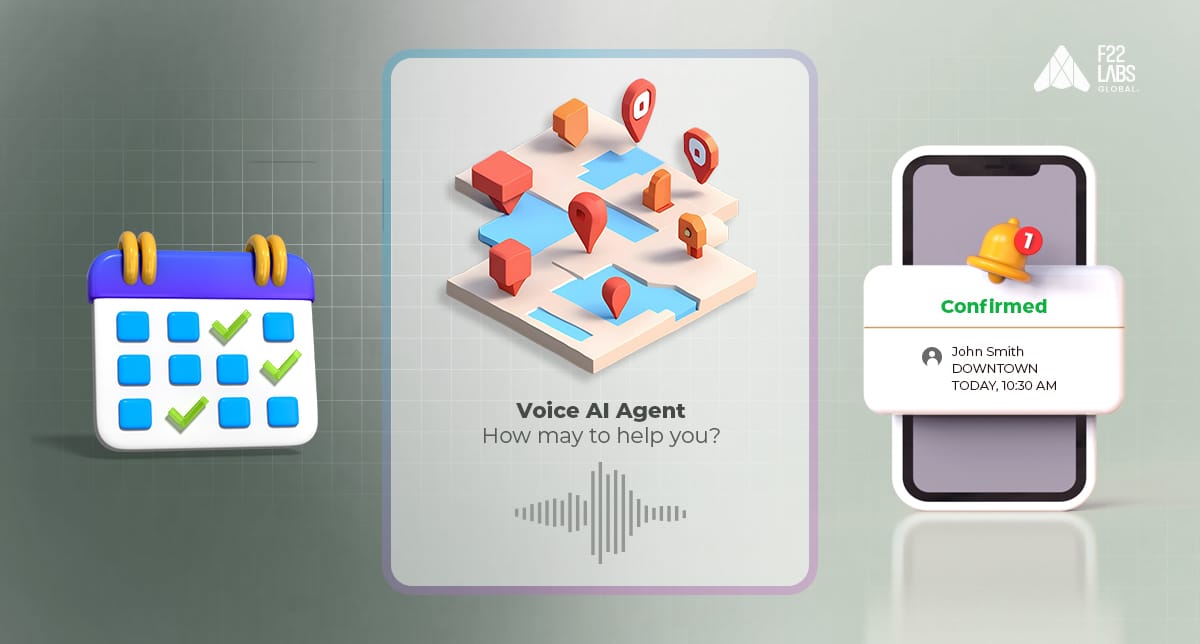
That’s what pushed us to build this Voice AI Appointment Agent. We designed it to complete the booking end-to-end: start in chat, capture consent, trigger an outbound AI call, route the patient to the right branch, fetch real-time slots, confirm the appointment, and send an SMS confirmation, without humans stitching the workflow together.
In this article, we show how the agent is structured, how the workflow runs end-to-end, and how it can be adapted for different clinic setups.
How This AI Appointment Agent Compares to Traditional Systems
| Criteria | Manual Booking (Front Desk / Phone) | SaaS Scheduling Tools | IVR Systems | AI Appointment Agent (Voice + Chat) |
Booking Flow | Fully manual and staff-dependent | Form-based, user-driven | Rigid menu navigation | Conversational, guided end-to-end flow |
Multi-Branch Support | Requires staff coordination | Limited or manual setup | Hardcoded menus | Dynamic branch logic and routing |
Real-Time Slot Handling | Manual slot checks | Often static or limited | Not supported | Live slot fetching from backend systems |
Consent Management | Manual and inconsistent | Rarely built-in | Not supported | Built-in and enforced by the agent |
Workflow Completion | Multiple handoffs required | Partial automation | Call deflection only | End-to-end booking completion |
Scalability | Limited by staff availability | Limited by system design | Scales volume, not intelligence | Scales conversations and reasoning |
Patient Experience | Wait times and callbacks | Functional but impersonal | Often frustrating | Natural, guided, low-friction experience |
How the Voice AI Appointment Agent Works?
The AI appointment agent is designed as a structured, multi-stage workflow that orchestrates chat, voice, backend systems, and messaging into a single booking experience.
Step 1: Intent Detection in Chat
The flow begins on the website chatbot when the user clicks “Book an Appointment.” The agent identifies booking intent and immediately moves into a focused flow, avoiding unnecessary questions. It asks for the user’s mobile number, validates the format, and prepares the context for the next stage.
This ensures that only genuine booking requests move forward, keeping the system efficient and reducing noise for the voice workflow.
Step 2: Consent Collection
Before any call is placed, the agent explicitly requests consent for both the outbound call and SMS communication.
This step is mandatory and enforced at the workflow level to meet healthcare communication standards.
If consent is not provided, the agent can fall back to a chat-based flow or offer to connect the user to the support team.
Step 3: Outbound AI Voice Call
Once consent is captured, the agent automatically triggers an outbound AI call.
This is where the main booking logic is handled. The voice interaction is designed to be short, clear, and task-focused, keeping friction low for patients.
Step 4: City & Branch Selection
During the call, the agent asks for the user’s city and applies branch logic.
If the city is Chennai, it presents the available branches and helps the user choose the most convenient location. This can be based on area, proximity, or direct user preference.
This logic allows the same agent to scale across multiple locations without hardcoding flows.
Step 5: Slot Discovery
After branch selection, the agent queries the backend system for real-time slot availability.
It dynamically presents available dates and times, handles vague inputs like “tomorrow evening,” and guides the user to a clear selection.
This ensures bookings are always aligned with actual availability, not static schedules.
Step 6: Booking Confirmation
Once a slot is selected, the agent confirms the appointment details with the user before finalising.

Walk away with actionable insights on AI adoption.
Limited seats available!

On confirmation, it books the appointment via API and generates a unique appointment ID.
This step closes the booking loop without requiring any human intervention.
Step 7: SMS Confirmation
Immediately after booking, the agent sends an automated SMS with the branch name, date, time, appointment ID, and location link.
This gives the patient a permanent reference and reduces no-shows.
If SMS delivery fails, the agent can prompt for an alternative channel such as WhatsApp or email.
Step 8: Guardrails & Validation
Throughout the flow, the agent enforces strict guardrails. It avoids medical advice, detects urgent or emergency language, validates inputs, and ensures sensitive data is not collected.
These safeguards are built into the agent logic, not added as afterthoughts, ensuring safe and predictable behavior in healthcare environments.
How is this AI Agent Customised for Different Clinics?
This AI appointment agent is not built as a fixed product. It is designed as a modular system that can be adapted to different clinic structures, workflows, and operational rules. Customization happens at multiple layers of the agent.
1. Branch & Location Logic
Some clinics operate from a single location, while others run multiple branches across different areas or cities.
The agent’s branch logic is configurable, allowing it to:
- work with any number of branches
- apply location-based routing
- suggest the nearest branch based on area or pin code
- handle city-specific availability rules
This means the same agent can be deployed for a 2-branch clinic or a 20-location hospital network without redesigning the flow.
2. Slot Rules & Availability Windows
Every clinic manages time differently. Some work with fixed slots, some with doctor-based schedules, and some with dynamic availability.
The agent can be customized to:
- fetch slots from different scheduling systems
- apply buffer times between appointments
- block specific time windows
- prioritize certain doctors or services
- handle walk-in vs pre-booking rules
This ensures the agent follows clinic reality, not generic scheduling assumptions.
3. Consent & Compliance Flows
Healthcare communication rules vary by region and organisation.
The agent’s consent flow is configurable to match:
- local compliance requirements
- internal policies for calling and messaging
- data collection restrictions
Some clinics may require verbal consent, others written. Some allow WhatsApp, others only SMS. The agent logic adapts accordingly.
4. Data Capture & CRM Integration
Some clinics need only basic details. Others require patient IDs, visit reasons, or doctor preferences.
The agent can be customised to:
- capture specific fields
- integrate with existing CRM, HIS, or ERP systems
- push data into internal dashboards
- trigger internal workflows after booking
This makes the agent part of the clinic’s system, not a standalone tool.
Try the Agent
The best way to understand this AI agent is to interact with it.
You can trigger the booking flow and experience how the system works through voice, guiding you through branch selection, checking availability, and confirming the appointment. This allows you to see how the agent handles real conversations, context switching, and task completion without human involvement.
We encourage teams to test the agent as a user would, click “Book an Appointment,” receive the AI call, and go through the full flow. This gives a clear picture of how the orchestration works in practice and how the experience feels from a patient’s perspective.
Walk away with actionable insights on AI adoption.
Limited seats available!
If you would like access to a demo environment or want us to enable testing for your use case, our team can set that up quickly.
Why F22 Labs for AI Agents & Voice AI?
At F22 Labs, we specialise in designing and building custom AI agents, not just integrating off-the-shelf tools. In a span of 6 months, we have built 50+ AI proofs-of-concept and delivered multiple production-grade solutions across voice AI, conversational AI, workflow automation, and intelligent agents.
Our work spans:
- AI voice agents for healthcare, sales, human resources and more
- multi-step conversational workflows
- AI-powered screening and scheduling systems
- domain-specific agents with compliance guardrails
What sets us apart is speed and customization. We do not force your process into a template. We design the agent around your operations, data, and constraints. This allows us to move from idea to working AI agent in a short span of time, without sacrificing depth or quality.
Whether you need a simple booking agent or a complex multi-agent system, we help you go from concept to live AI solution faster, with the flexibility your business actually needs.
Conclusion
This Voice AI appointment agent demonstrates what is possible when AI is designed as a system, not just a feature. By orchestrating chat, voice, backend integrations, and messaging into a single workflow, the agent removes friction from appointment booking and aligns with real clinic operations.
More importantly, this is not a one-off build. It is a repeatable pattern that can be customized for different clinic models, workflows, and compliance requirements. Whether it is multi-branch routing, doctor-specific scheduling, or region-specific consent flows, the agent can be adapted without reworking the core architecture.
At F22 Labs, we focus on building AI agents that move beyond demos and into production. If you are exploring AI for scheduling, operations, or customer engagement, we can help you design and deploy an agent that fits your business, not the other way around.
Frequently Asked Questions (FAQs)
1. What is an AI appointment agent?
An AI appointment agent is a system that can autonomously handle the full booking workflow, from intent detection to confirmation. Unlike basic chatbots, it can reason over user input, orchestrate voice interactions, apply business logic, fetch real-time availability, and complete bookings without human intervention.
2. How is this different from a regular chatbot or booking form?
Most chatbots and forms only collect information and pass it to staff. This AI appointment agent completes the entire workflow end-to-end. It handles branch selection, slot discovery, voice interaction, confirmation, and SMS follow-up as a single continuous process, without handoffs.
3. Can this AI agent work for clinics with multiple branches and locations?
Yes. The agent is designed specifically for multi-branch environments. It can apply location logic, suggest nearby branches, handle city-based routing, and manage availability across different locations without hardcoding flows.
4. Is patient data secure when using an AI appointment agent?
Yes. The agent is built with data restrictions, consent handling, and guardrails. It does not collect sensitive medical or payment information, avoids medical advice, and follows healthcare communication standards. Data access and storage can be aligned with the clinic’s internal compliance policies.
5. How long does it take to build and deploy a custom AI appointment agent?
Because the agent is built on a modular architecture, we can move from use case definition to a working AI agent in a short span of 2 to 3 weeks. The exact timeline depends on integrations, compliance requirements, and workflow complexity, but rapid PoC development is one of our strengths.
6. Can this AI appointment agent be used outside healthcare?
Yes. While this implementation is designed for clinics, the same agent pattern can be adapted for salons, service centers, education, real estate, field services, and other appointment-driven businesses. The workflow, logic, and integrations are customized based on the industry.

Saisaran D
I'm an AI/ML engineer specializing in generative AI and machine learning, developing innovative solutions with diffusion models and creating cutting-edge AI tools that drive technological advancement.
Walk away with actionable insights on AI adoption.
Limited seats available!