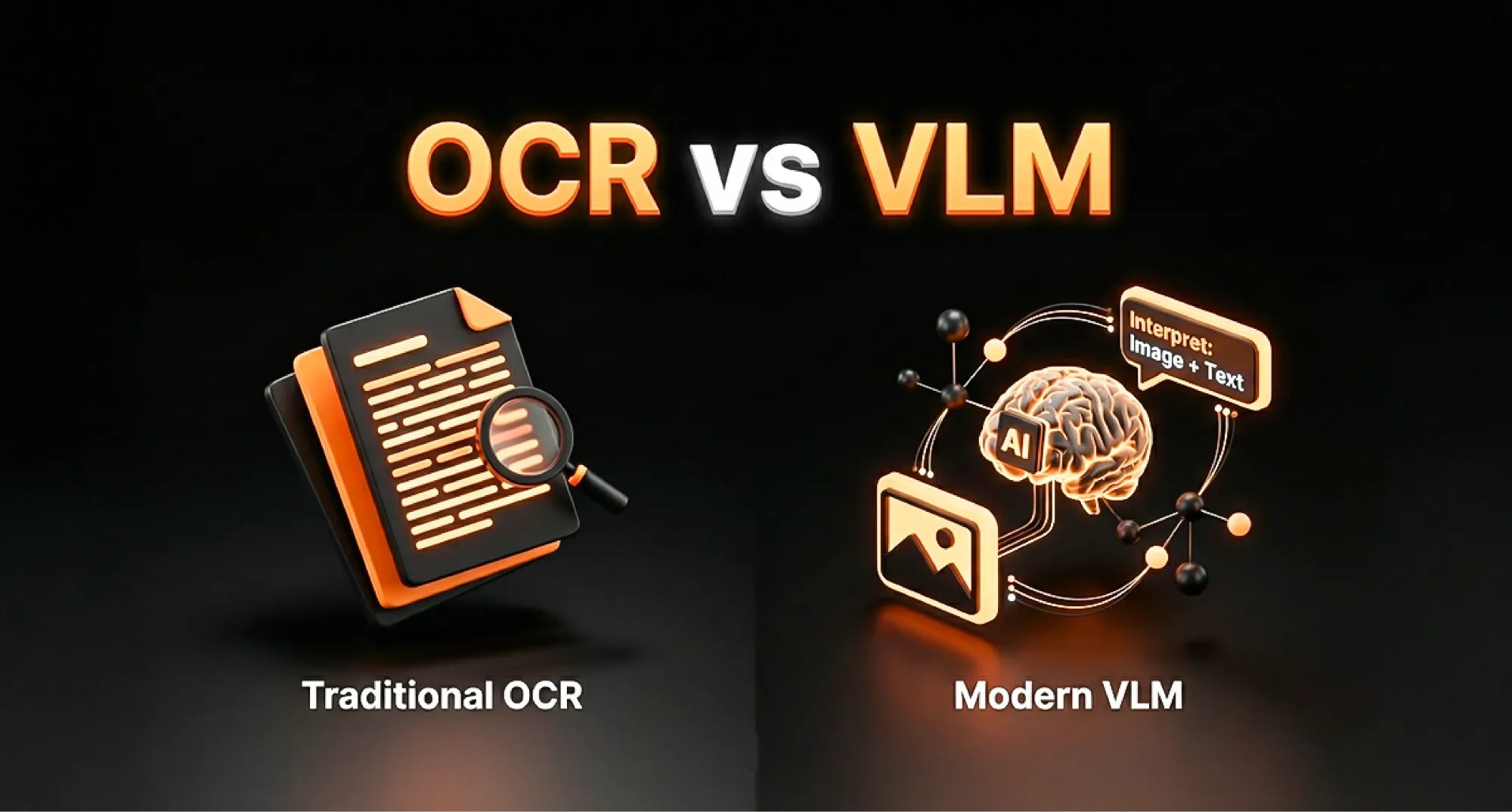
- OCR extracts text quickly and predictably from clean, structured documents.Vision Language Models analyse text alongside layout and visual context, making them useful for handwriting, noisy scans, tables, and complex forms.
- OCR is generally faster and more cost-effective for high-volume processing, while VLMs usually require more compute.
- VLM outputs can vary based on the model, prompt, and generation settings, whereas OCR is typically more deterministic.
- The right choice depends on document quality, layout complexity, required accuracy, processing volume, and cost.
- In many production workflows, a hybrid approach works best: OCR handles standard documents, while low-confidence or complex files are routed to a VLM.
- Both approaches require validation when extracted information affects important business decisions.
I’ve worked with document pipelines where OCR looks great on clean demos but struggles when real files show up. Handwritten notes, skewed scans, stamps, noisy backgrounds, and multi-column layouts quickly expose its limits.
I still use OCR when documents are clean and speed or cost matters most. But when files are messy or context matters, I’ve seen Vision Language Models (VLMs) deliver stronger results because they understand text, layout, and visuals together.
That’s why the OCR vs VLM debate matters now. It’s no longer just about extracting text; it’s about getting reliable output that works in real workflows.
In this guide, I’ll compare OCR vs VLM across accuracy, performance, cost, and real-world use cases so you can choose the right fit for production systems.
OCR vs VLM: Key Differences at a Glance
| Factor | OCR | Vision Language Models (VLMs) |
Core Approach | Recognizes characters through a fixed extraction pipeline | Understands text, layout, and visual context together |
Best For | Clean, structured, high-volume documents | Handwriting, noisy scans, complex layouts |
Accuracy on Messy Files | Drops quickly when quality is poor | Stronger due to contextual understanding |
Speed | Fast and efficient | Slower than OCR in many cases |
Cost | Lower cost at scale | Higher compute or API cost |
Determinism | Predictable and repeatable outputs | Can vary based on prompts/model settings |
Tables & Forms | Often needs templates or rules | Better at understanding structure naturally |
Scalability | Excellent for bulk processing | Best for selective or high-value tasks |
My Practical View | Best for scale | Best for understanding |
Bottom Line
I use OCR when throughput, speed, and cost matter most. I use VLMs when document quality is poor or layout understanding is critical.
In production, hybrid systems usually win: OCR handles bulk processing, while VLMs validate, correct, and extract complex fields.
Benchmark Focus: OCR vs VLM on Scanned Documents
I’m framing this comparison around a problem I see often in production: scanned documents that are difficult to process at scale.
These usually include:
- Low-resolution scans
- Skewed or rotated pages
- Handwritten notes
- Stamps and annotations
- Noisy backgrounds
- Multi-column forms where reading order matters
This isn’t just a theoretical OCR vs VLM debate. What matters in practice is which approach produces usable text, where accuracy breaks down, and what trade-offs appear in speed, cost, and reliability.
If you’re building a document knowledge base, extraction quality affects everything downstream: search, indexing, chunking, retrieval, and question answering.
My goal is simple: help you choose the right fit for your document types, not just understand the theory.
What is OCR?
Optical Character Recognition (OCR) is a technology that converts printed or handwritten text from images, PDFs, or scanned documents into digital, editable text.
In most OCR systems I’ve used, the process is straightforward: clean the image, detect text regions, recognise characters, and apply post-processing to fix common errors.
OCR performs extremely well on clean, structured documents such as invoices, forms, IDs, and printed pages. It is fast, scalable, and cost-efficient for high-volume workloads.
However, OCR often struggles when documents contain blurred text, handwriting, noisy backgrounds, stamps, or irregular layouts. That’s because OCR reads characters, not meaning or context.
OCR Confidence Scores
Most OCR engines return confidence scores for words or characters. In practice, I use these scores as routing signals:
- High confidence → Move directly through the pipeline
- Low confidence → Send for validation, correction, or escalation to a stronger model
This is one of the most effective ways to improve OCR reliability in production systems.
What are Vision Language Models?
Vision Language Models (VLMs) represent a significant advancement in document understanding, moving beyond the traditional, step-by-step methods of legacy Optical Character Recognition (OCR).
These models, including GPT-4 Vision, Gemini Flash 2.0, Llama 3.2 Vision Instruct, and Qwen2.5-VL, utilize a complete transformer-based architecture. They employ deep transformers to process both visual and textual information simultaneously.
VLMs offer an end-to-end neural workflow that integrates vision and language, enabling deeper VLM document understanding beyond character recognition. enabling them to go beyond simple character recognition to comprehend document structure, layout, and semantics.
OCR vs VLM Architecture: Pipeline-Based vs End-to-End Models
Understanding the architectural difference between OCR and Vision Language Models is the fastest way I know to explain why performance diverges so sharply on real scanned documents. OCR is a staged pipeline where early mistakes cascade. VLMs are end-to-end, using visual + language context jointly, which makes them more robust, but also less transparent.
Traditional OCR Architecture (Pipeline-Based)
Conventional OCR systems rely on a modular, pipeline-based design where each stage performs a specific task and passes its output to the next stage. This architecture makes OCR predictable and debuggable, but also rigid and sensitive to errors.

Walk away with actionable insights on AI adoption.
Limited seats available!

A typical OCR pipeline includes:

- Image acquisition and preprocessing: The input document image is cleaned using techniques such as noise reduction, binarization, deskewing, and contrast enhancement. Preprocessing quality directly affects downstream recognition accuracy.
- Segmentation and layout analysis: The system identifies text blocks, columns, lines, words, and characters while determining reading order. This step is often rule-based and struggles with complex or irregular layouts.
- Character recognition: Characters are recognized using pattern matching, feature extraction, or supervised machine learning models such as CNNs trained on labeled character datasets.
- Post-processing and error correction: Dictionaries, language rules, and heuristics are applied to fix spelling, grammar, and formatting errors introduced during recognition.
- Output generation: The final text is produced in formats such as plain text, searchable PDFs, or structured JSON.
While this architecture works well for clean, standardized documents, errors in early stages compound downstream. Unusual layouts, handwritten text, or noisy scans can significantly degrade OCR accuracy.
Vision Language Model Architecture (End-to-End)
Vision Language Models follow a fundamentally different approach. Instead of a rigid pipeline, VLMs use an end-to-end neural architecture that processes visual and textual information jointly.
Modern VLM architectures consist of three core components:

- Vision encoder: The input image is converted into dense visual embeddings using deep vision transformers (ViT) or CNN–Transformer hybrids. These encoders capture both fine-grained details (characters, strokes) and global structure (layout, spatial relationships).
- Cross-modal fusion layer: Visual embeddings are fused with language representations through attention mechanisms. This allows the model to associate text with spatial context, for example, understanding that a value next to “Total” represents a total amount regardless of exact position.
- Language decoder: A transformer-based decoder generates output conditioned on both visual and linguistic context. By changing the prompt, the same model can perform extraction, summarization, classification, or question answering.
Because VLMs perform recognition, layout understanding, and semantic reasoning in a single forward pass, they are far more robust to noise, blur, handwriting, and layout variation. However, this end-to-end design makes them less transparent and harder to debug compared to traditional OCR pipelines.
Demonstration on OCR and VLM on Handwritten data
In this demonstration, I used a messy, unclear handwritten scan to compare OCR against Google’s Gemini Flash 2.5 vision model. The contrast is the same pattern I’ve repeatedly seen in production: OCR fails in predictable ways on handwriting and noisy scans, while a strong VLM can return readable, structured output.


It’s not just “better character recognition.” The win usually comes from context: even when the raw text is imperfect, VLMs can infer intent, preserve structure, and produce output that’s actually usable.
OCR vs VLM: Practical Comparison Snapshot
This snapshot summarizes what I’ve observed most consistently when comparing OCR vs VLM on scanned documents: OCR is cheaper and more deterministic at scale, while VLMs are more reliable when handwriting, noise, and layout complexity are involved.
| Dimension | Traditional OCR | Vision Language Models (VLMs) |
Handwritten text | Struggles, high error rates | Strong performance using context |
Noisy / low-quality scans | Accuracy drops significantly | More robust to noise and blur |
Layout understanding | Limited, rule-based | Context-aware and layout-sensitive |
Tables and forms | Requires templates or heuristics | Extracts structure naturally |
Determinism | High, predictable output | Medium, can vary by prompt |
Processing cost | Low | Higher (compute + inference) |
Best use case | Bulk, clean documents | Complex, high-value documents |
OCR vs VLM: Which Should You Use for Scanned Documents?
Choosing between OCR and Vision Language Models comes down to document quality, layout complexity, and business value.
If your documents are clean, consistently formatted, and high-volume, I still recommend OCR first, it’s fast, predictable, and inexpensive at scale.
If your scanned documents include handwriting, complex layouts, noisy backgrounds, stamps, annotations, or mixed content like tables and forms, VLMs are usually the better fit because they combine layout and semantic understanding.
In real pipelines, the approach I see working best is hybrid: OCR handles scale, and low-confidence or high-value documents get routed to VLMs for deeper extraction, correction, and validation.
Comparison Across Text Data Types and Scenarios
The choice between OCR and Vision Language Models hinges on your specific use case, document types, accuracy requirements, and resource constraints. Let's explore when each technology excels:
| Data Type / Scenario | Conventional OCR (DeepSeek, Tesseract, PaddleOCR) | Vision Language Models (GPT-4o Vision, Gemini Flash, Claude, Qwen2.5-VL, MinerU2.0) |
Handwritten Text | 65–78% field accuracy (DeepSeek "not showcased"/Tesseract struggles on messy forms); high variability; needs custom post-processing. | 85–95% (GPT-4o, Gemini, Claude, Qwen2.5-VL, MinerU2 prompt and script sensitive; multi-script support, handles context) |
Blurred / Low-Res Text | Accuracy drops below 60% as image quality degrades (Tesseract, PaddleOCR); DeepSeek-OCR can compress and recover structure with 7–10x efficiency at ~96–97% accuracy. | VLMs are robust to moderate blur and low-res; context/prompting helps recover above 92% by filling gaps; layout preserved (GPT-4o, Qwen) |
Tabular / Structured Data | Structure often lost unless columns are pre-marked; column/row alignment issues are common, token usage is high (MinerU2.0 uses ~7000 tokens, DeepSeek <800 tokens, GPT-4o not as efficient) | VLMs excel at table/fiducial extraction, markdown/HTML output (DeepSeek, Gemini, Qwen, Llama layout preserved at ~95%+); hallucination risk in open-source |
Multi-Lingual / Multi-Script | Varies; DeepSeek authors claim 100+ scripts, but independent tests are needed. Tesseract has limitations on non-Latin, accuracy of 70–90% for print. | VLMs are strong on printed/common scripts; prompt engineering is crucial for rare/complex scripts; performance drops on noisy/ancient text. |
Vertical / Rotated / Angled | Deskewing required; baseline OCR fails if orientation is not detected/detected incorrectly (PaddleOCR); DeepSeek is robust under 10% degradation at moderate rotations. | VLMs (GPT-4o, Gemini, Qwen) are robust to arbitrary orientation, context aware, and layout has minimal effect. |
Scene Text (Natural Images) | Challenging, accuracy <70% without image preprocessing; DeepSeek performs well if text is isolated, context helps. | VLMs adaptively identify and extract scene text; accuracy 75–90% depending on background complexity; strong at context linking. |
Printed Document/Scanned Text | High accuracy OCR >97% for clean scan; DeepSeek-OCR matches or exceeds state-of-the-art with fewer tokens; Tesseract, PaddleOCR are strong for clear, uniform input. | VLMs are equally strong; near-perfect (98+%) accuracy for print, easy cloud deployment cost-effective on moderate volumes. |
Complex Backgrounds / Overlays | OCR accuracy can fall <60% on noisy backgrounds, and overlays confuse boundary detectors. | VLMs (GPT-4o, Claude, Qwen) are robust against complex backgrounds, fill gaps contextually, accuracy of 85–92%. |
Annotated / Overlaid Text | OCR: text recognized but annotation/metadata stripped; bounding boxes returned but association weak. | VLMs can simultaneously extract text and classify/associate annotations, preserving structure for downstream tasks (Data labeling, Review). |
Low-Contrast / Faded / Noisy | OCR accuracy <65% (DeepSeek compression at ~20x drops to ~60% ), Tesseract/PaddleOCR fails to recover faded inputs. | VLMs denoise and infer missing letters using context, maintaining ~90%+ accuracy for most historic scans. |
Recent benchmarks show that Vision Language Models (VLMs) often outperform traditional OCR on complex and low-quality documents. I see this most in multi-column files, handwritten forms, noisy scans, and multi-language documents where layout and reading order matter.
The advantage comes from context. VLMs do more than read characters; they understand structure, recover unclear text, and handle messy layouts more effectively.
OCR still remains stronger for clean, standardised, high-volume inputs where speed, lower cost, and predictable output are the priorities.
That’s why many modern pipelines use a hybrid approach: OCR for scale, VLMs for documents that need deeper understanding.
Hybrid Approaches and Future Directions in Document Understanding:
From what I’ve seen, the future of document understanding isn’t choosing between OCR and VLM but combining them intelligently. A well-designed AI integration can route clean documents through OCR and send low-confidence or complex files to a VLM for additional extraction or validation.

- OCR + VLM Validation: OCR extracts text quickly, and VLM validates and corrects critical fields.
- Intelligent Routing: Simple docs to OCR, complex/poor quality to VLMs.
- Bulk Digitization (OCR), Contextual Answers (VLM): OCR builds searchable archives, VLM answers user queries.
- Confidence-Based Fallback: If OCR confidence is low, use VLM for that portion.
- VLM-Assisted OCR Training: VLMs produce ground-truth for custom OCR training, improving performance on niche document types
| Use Case | Recommended Workflow |
Bulk Digitization | Use OCR for speed; VLMs for validation or refinement. |
Complex or Low-Quality Files | Route directly to VLMs for context-aware extraction. |
Confidence-Based Processing | Fallback to VLM when OCR confidence drops. |
OCR Model Training | Use VLM outputs to generate high-quality ground truth. |
Semantic Querying / QA on Documents | Use OCR for text storage, VLM for interpreting and answering from documents. |
When to Use OCR vs Vision Language Models
Vision Language Models are best suited for:
- Data involves handwriting, multi-language, or complex scene text needing contextual understanding.
- Images are blurry, rotated, or contain noisy backgrounds where context reconstruction helps.
- Structured layouts (tables, forms) must retain spatial relationships and formatting.
- Text appears in natural images, annotations, or overlays requiring joint text–metadata extraction.
- Budget allows for higher compute cost or GPU availability, as VLMs are more resource-intensive.
Conventional OCR is preferred for:
- Input is clean, printed, or scanned documents with standard layouts.
- Large-scale digitization is required under cost constraints.
- Deployment is on CPU or limited hardware without GPU acceleration.
- Latency and throughput are critical for bulk processing.
- Data doesn’t need contextual reasoning; plain text extraction suffices.
Advantages and Disadvantages of OCR and Vision Language Models (VLMs)
Optical Character Recognition (OCR)
Advantages:
- Fast and efficient for clean, printed documents.
- Lightweight and can operate on local devices with low computational resources.
- Produces highly accurate (>97%) and searchable text for structured or scanned inputs.
Disadvantages:
- Performs poorly on handwritten, blurred, or noisy data.
- Sensitive to image orientation, alignment, and complex backgrounds.
- Lacks understanding of context or semantics, limiting extraction from complex layouts or multi-lingual scripts without extensive tuning.
Walk away with actionable insights on AI adoption.
Limited seats available!
Vision Language Models (VLMs)
Advantages:
- Strong contextual and semantic understanding, even with noisy or complex inputs.
- Effectively handles varied data types, including handwriting, multi-lingual text, and complex document layouts.
- Robust against distortions like rotation, blur, or background noise, and can generate structured outputs directly.
Disadvantages:
- Require significantly more computational resources and typically higher latency.
- Higher operational costs, especially for large-scale deployments.
- Can hallucinate or misinterpret ambiguous inputs without careful prompting and tuning.
FAQs:
What is the main difference between OCR and Vision Language Models?
OCR focuses on recognizing characters and converting images into text using a fixed pipeline. Vision Language Models go further by understanding visual layout and semantic context together, allowing them to interpret complex documents more accurately.
Is OCR still relevant with the rise of Vision Language Models?
Yes. OCR remains highly relevant for clean, structured, and high-volume documents where speed, cost efficiency, and deterministic output are critical. Many production systems still rely on OCR as a foundational component.
Are Vision Language Models more accurate than OCR?
Vision Language Models generally outperform OCR on handwritten text, noisy scans, and layout-heavy documents. However, for clean printed documents, traditional OCR can achieve similar accuracy at a much lower computational cost.
Do Vision Language Models replace OCR completely?
No. In most real-world systems, VLMs complement OCR rather than replace it. OCR is often used for fast bulk extraction, while VLMs handle complex cases, validation, or semantic understanding.
Why do Vision Language Models perform better on scanned documents?
VLMs process images and language jointly, allowing them to use context to infer missing or unclear text. This helps them recover meaning even when characters are distorted, poorly scanned, or embedded in complex layouts.
Are Vision Language Models deterministic like OCR?
No. OCR produces predictable and repeatable outputs. Vision Language Models are probabilistic and can vary based on prompts and model settings, which is why guardrails and validation steps are often required in production systems.
What are the cost differences between OCR and VLMs?
OCR is significantly cheaper and faster, often running on CPUs at scale. Vision Language Models require more compute resources and typically incur higher inference costs, especially when deployed via cloud APIs or GPUs.
When should I use a hybrid OCR + VLM approach?
A hybrid approach is ideal when processing mixed-quality documents. OCR handles clean documents efficiently, while VLMs are routed only when OCR confidence is low or when a deeper understanding is required.
Are Vision Language Models suitable for enterprise document pipelines?
Yes, but with careful design. Enterprises often combine VLMs with OCR, confidence scoring, and routing logic to balance accuracy, cost, latency, and reliability.
Will OCR and VLM technologies continue to evolve?
Absolutely. OCR engines are improving with deep learning, while Vision Language Models are becoming faster, more accurate, and more controllable. The future of document understanding lies in systems that intelligently combine both.
Conclusion
Choosing between OCR and Vision Language Models comes down to your document quality, accuracy needs, and scale.
I still see OCR as the best choice for bulk, standardized workloads where speed, low cost, and predictable output matter most.
VLMs become far more valuable when documents are messy, layout-heavy, handwritten, or require understanding beyond raw text extraction.
In practice, the strongest systems use both: OCR for speed, VLMs for validation, correction, and deeper document understanding.
As both technologies improve, the future will belong to hybrid pipelines that combine OCR, VLMs, and retrieval workflows to power more reliable document automation.

Walk away with actionable insights on AI adoption.
Limited seats available!