8 Best No-Code Tools to Build Your MVP in Days (2026 Guide)
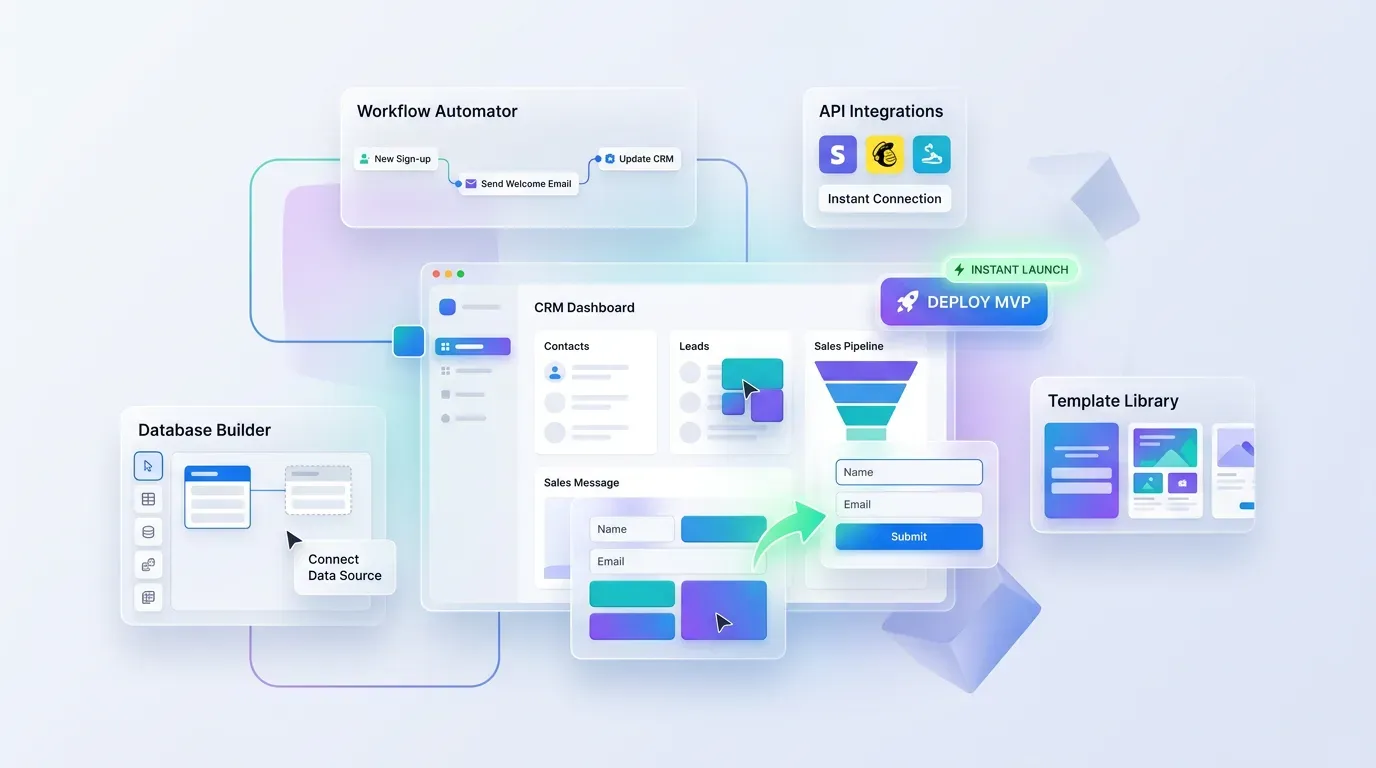
Speed is one of the few real advantages an early-stage startup has. The faster you get something in front of users, the faster you learn whether you're building the right thing.
No-code tools have changed what's possible at this stage. What used to require months of engineering work can now be shipped in days, functional enough to test a real idea with real users. The tooling has matured. In 2026, the best no-code tools aren't a workaround for founders without technical resources. For most digital products, they're a reasonable first step.
The landscape is crowded and moves fast. This guide organizes the best no-code tools for building an MVP by what they actually do, with honest notes on where each one fits and where it doesn't.
What Makes a No-Code Tool Worth Using for an MVP?
The right no-code tool can take a founder from idea to live product in days, but not every tool is built for that context.
One that works well for an established business may be overkill, or simply wrong, for someone still validating a hypothesis. For MVP purposes, you want something fast to start, flexible enough to iterate, and honest about its own ceiling.
The goal isn't to build something production-ready. It's to build something that tells you whether the idea works. The best no-code tools at this stage move quickly but stay extensible, so you're not rebuilding from scratch at the first sign of traction.
8 Best No-Code Tools to Build Your MVP in Days
1. Bubble - Best for Complex Web App MVPs
Bubble remains the most powerful no-code app builder available. It handles multi-user logic, databases, payment flows, and custom workflows, without writing a line of code. The learning curve is steeper than simpler tools, but the ceiling is significantly higher.
If your MVP involves user accounts, dashboards, booking flows, or anything with meaningful logic, Bubble is the right starting point.
Pricing: Free tier available. Paid plans start at $29/month.
Best for: SaaS MVPs, marketplaces, internal tools, and booking platforms.
2. Webflow - Best for Marketing-First or Content-Driven MVPs
Webflow gives you full design control over a responsive website or landing page, with a CMS for dynamic content.
It's not suited for complex app logic, but for MVPs where the primary goal is capturing signups, validating demand, or presenting a product, it's unmatched in output quality.
Pricing: Free tier available. Paid plans start at $14/month.
Best for: Landing pages, content-driven products, marketing MVPs, waitlist validation.
3. Glide - Best for Mobile-First MVPs Built on Data
Glide turns a Google Sheet or Airtable database into a mobile app in hours. It's not the right tool for complex products, but for internal tools, simple consumer apps, or directory products, the speed advantage is significant.
Build Lean. Learn Fast.
Launch an MVP that saves money while proving your concept works.
Pricing: Free tier available. Paid plans start at $25/month.
Best for: Directory apps, internal tools, simple consumer apps.
4. Framer - Best for Design-Heavy Web MVPs
Framer sits between a design tool and a website builder. It's the right choice when visual quality and interaction design are central to the product experience, think creative agencies, design tools, or consumer products, where first impressions drive conversion.
Pricing: Free tier available. Paid plans start at $10/month.
Best for: Design-led MVPs, portfolios, interaction-heavy landing pages.
5. Airtable - Best Flexible Database for MVPs
Airtable is the default database layer for most no-code stacks. It works as a spreadsheet, a relational database, and a lightweight CMS simultaneously. It integrates with almost everything else on this list, making it the connective tissue for many early-stage products.
Pricing: Free tier available. Paid plans start at $20/month per user.
Best for: Any MVP needing structured data, content management, or lightweight CRM.
6. Make (formerly Integromat) - Best for Complex Automations
Make is the most powerful no-code automation platform available. It handles multi-step workflows, conditional logic, data transformation, and API calls with a visual builder that's significantly more capable than Zapier for complex processes.
For MVPs with real operational logic, onboarding flows, notifications, and data pipelines, Make is the right tool.
Pricing: Free tier available. Paid plans start at $9/month.
Best for: Complex multi-step automations, API integrations, operational workflows.
7. Zapier - Best for Quick, Simple Connections
Zapier remains the easiest automation tool for simple, linear workflows. If you need to connect two apps with a trigger and an action, form submission to CRM, or a new user to Slack notification, Zapier sets it up in minutes with no friction.
Pricing: Free tier available. Paid plans start at $19.99/month.
Best for: Simple two-step automations, quick integrations between common tools.
8. Memberstack - Best for Gated Content and Membership MVPs
Memberstack adds login, user accounts, and membership tiers to any Webflow or HTML-based site without backend code.
It integrates directly with Stripe for billing. For MVPs built around access, paid communities, content platforms, and SaaS with user accounts, it's the fastest path to working auth.
Pricing: Free tier available. Paid plans start at $49/month.
Best for: Membership sites, gated content, Webflow-based SaaS MVPs.
When No-Code Is Not Enough?
No-code tools have real ceilings. Knowing when you've hit them prevents the costly mistake of building too far on a foundation that won't scale.
Build Lean. Learn Fast.
Launch an MVP that saves money while proving your concept works.
The signals that you've outgrown no-code: performance becomes a user-facing problem, you're working around your tool's limitations more than building features, you need custom integrations the platform doesn't support, or your data model has grown too complex for the visual builder to handle cleanly.
When those signals appear, it's not a failure; it's evidence that the product has enough traction to warrant proper engineering. That's exactly the point no-code was built to get you to.
Build Your MVP with F22 Labs
F22 Labs helps product teams move from idea to working MVP quickly through flexible MVP development services, whether that means a no-code build, a lean-coded prototype, or a hybrid of both, depending on what the product needs.
If you're at the stage of figuring out the fastest path to something users can actually respond to, we can help you choose the right approach and execute it properly. Reach out and let's talk through what you're building.
Frequently Asked Questions
What is the best no-code tool for building an MVP?
It depends on the product type. Bubble handles complex web apps. Webflow is best for marketing-led or content MVPs. Glide works for data-driven mobile apps. The right tool matches the type of product you're validating.
How long does it take to build an MVP with no-code tools?
A simple landing page or validation MVP can be live in one to three days. A functional multi-user web app with payments and auth typically takes one to three weeks, depending on complexity and the builder's familiarity with the tools.
Can you scale a product built on no-code tools?
Up to a point. Most no-code tools support meaningful traction before hitting limits. When performance, custom integrations, or complex data models become requirements, transitioning to coded infrastructure is the natural next step.
What is the cheapest way to build an MVP without code?
Combine free tiers: Webflow for the site, Airtable for the database, Tally for forms, and Zapier for basic automation. Most early validation can be done at near-zero cost before committing to paid plans.
Should I use no-code or hire a developer for my MVP?
No-code first is usually the right call for validating an idea. Once the concept is validated with real user data, bring in developers to build the production version on a foundation that scales.