Why is Speed Critical in MVP Development?

- Speed in MVP development isn't about rushing the build, it's about shortening the time between an assumption and the real user feedback that proves or disproves it.
- Typical MVP timelines run 3-6 months; a narrow single-feature MVP can ship in 6-8 weeks, while integrations, compliance needs, or marketplace features extend that significantly.
- Faster iteration cycles compound, a team shipping every 4 months gets roughly twice the feedback loops of one shipping every 9 months.
- Scope creep, unclear requirements, and manual testing are the most common speed killers, not the tech stack itself.
- Speed and quality aren't a trade-off when structured correctly, agile sprints, automation, and CI/CD keep velocity up without shipping a broken product.
Have you ever heard the expression, "Slow and steady wins the race?"
In MVP (Minimum Viable Product) development, that mindset often costs startups their advantage. Markets shift quickly, funding windows tighten, and competitors move fast.
I’m writing this for founders who are deciding whether speed in MVP development is a strategic discipline or unnecessary pressure. In reality, speed is not about rushing; it is about reducing uncertainty, validating assumptions early, and protecting runway.
In MVP development, speed is not optional; it is a competitive lever. Businesses today operate in a rapidly evolving landscape where consumer preferences shift like quicksilver and competition is fierce. Delaying product launches can mean losing the market opportunity entirely.
Research from McKinsey & Company shows that businesses accelerating MVP development are 1.5 times more likely to exceed business goals, reinforcing that execution velocity correlates with strategic outcomes. These numbers underscore the importance of MVP Development Speed; it's the driving force behind the success of many businesses.
Time to Market (TTM)
Time to Market (TTM) is a critical aspect of MVP Development Speed. The faster a business transitions from idea to customer validation, the sooner it converts assumptions into measurable feedback. It's about getting a lead in the race and sustaining it.
| Company A | Company B | |
| Development Time | 9 months | 4 months |
| Market Entry | Lateral Entry | Earlier Entry |
| Market Share | Struggling to gain market share upon entry | Captured a substantial share upon early entry |
| Feedback Cycle Start | Starts later after the product launch | Starts early after product launch |
| Product Improvement | Delayed due to later feedback cycle start | Ongoing, thanks to the earlier feedback cycle start |
| Market Position | Attempting to catch up | Strong position with continual product improvement |
This example illustrates why speed is of the essence in MVP development. It's not just about how quickly a product is developed and launched; it's about how that speed impacts market entry, feedback cycles, product improvement, and ultimately, market position.
This is the advantage of a fast Time to Market (TTM) and why MVP development speed is so crucial.
Let's take the example of an MVP development agency providing MVP development services. By getting a product out faster, they can gather customer feedback, make necessary adjustments, and re-release the improved product. The sooner this feedback loop starts, the more chances they have to refine their product and outpace competitors.
Importance of Speed in MVP Development
In the world of Minimum Viable Product (MVP) development, it's not enough to simply have a good idea; the rate at which you can bring that idea to life is equally, if not more, critical.

The essence of MVP Development Speed is the ability to swiftly progress from concept to market-ready product. This speed allows businesses to rapidly validate assumptions, test market reception, and swiftly iterate to refine their offerings.
Capturing Market Opportunities
Market demand is time-sensitive, and delayed launches compress opportunity windows.
Just as seasons change, consumer needs and preferences evolve, creating fleeting opportunities for businesses to tap into. Here's where the MVP Development Process comes into play. The faster a company can recognize these opportunities and release a product to address them, the higher the chances they have to succeed.
MVP Development Speed enables companies to seize these windows of opportunity before they close.

The comparative tale of Company A and Company B underlines the criticality of Time to Market (TTM) in the world of MVP development. The speed at which an MVP Development Company can translate an idea into a market-ready product can significantly impact its market positioning, the initiation of the feedback loop, and overall competitive advantage.
As the business adage goes, "The early bird catches the worm" and in MVP development, the swift captures a greater share of the market.
Faster TTM has numerous benefits, but the most notable one is the early feedback loop. The sooner a product is in the hands of users, the quicker a company can collect and analyze feedback.
This allows MVP development services to swiftly refine their product, align it more closely with user needs, and re-launch an improved version. Moreover, an early launch means an early start to revenue generation.
Iterative Development Process
One of the key elements of MVP development speed is the iterative development process. The process involves releasing a viable product, receiving feedback, making improvements, and releasing the improved product.
The speedier this cycle, the more iterations a product goes through, and the better it becomes.
Sprint vs. Marathon Analogy
In MVP development, the race is more of a series of sprints rather than a marathon. You sprint to release your MVP, you pause to gather and analyze feedback, then you sprint again to make improvements. This cycle continues until you have a product that perfectly meets market needs.
How Speed Helps In Achieving Faster Iterations
The faster you launch your MVP, the sooner you initiate the feedback loop, allowing for quicker iterations. Speed in this context is not about rushing through development but efficiently navigating the cycle of release, feedback, improvement, and re-release.
Benefits Of Rapid Iterations for MVP Improvement
- Faster feedback loop for quick validation and adjustments.
- Improved product-market fit through continuous user feedback.
- Reduced development time and costs by identifying issues early on.
- Increased agility to respond to market dynamics and user demands.
- Enhanced adaptability by iterating and learning from each iteration.
In MVP development, sustained iteration speed determines competitive advantage more than prolonged perfection.
Build Lean. Learn Fast.
Launch an MVP that saves money while proving your concept works.
Strategies to Supercharge Time to Market
In the quest for rapid MVP development, the approach taken is as crucial as the destination. By strategizing to supercharge the Time to Market, startups ensure they're not just speeding - they're speeding smartly.
So, as startups race against the clock, these strategies work as their secret weapon, supercharging their journey and leading them toward triumph.
Efficient Project Planning And Management
Project planning and management are the lifeblood of the MVP Development Process. Let's envision a fintech startup about to develop its MVP. Before a single line of code comes into existence, they need to design a roadmap, an overarching strategy with precise milestones and realistic deadlines.
Now, imagine this roadmap as a GPS, guiding the startup through the dense forest of development. Each milestone is a landmark, a beacon showing them they're on the right path. And the MVP Development Speed? That's the pace at which they're moving, determined by how efficiently they follow this GPS.
How can they maintain a brisk pace? Agile methodologies come into play here. These methodologies, like a high-performance engine, fuel the speed, breaking development into smaller "sprints".
Picture this: The startup is focusing on creating a secure login feature for their fintech app. They dedicate a sprint for this, develop, test, and perfect it, before moving on to the next sprint. This iterative approach enables faster, more efficient cycles of development.
Streamlining The Development Process
Streamlining the MVP Development Process is akin to crafting a beautiful sculpture. It starts with a block of marble, which is then chipped away, bit by bit until a masterpiece emerges.
This masterpiece is the startup's Minimum Viable Product and the chisel. That's the strategy of breaking tasks into smaller, more manageable chunks.
As the fintech startup chips away at their tasks, like crafting the user interface, integrating payment gateways, or fortifying security measures, their MVP begins to take form. Speed is maintained as they focus on one detail at a time, just as a sculptor does when creating a masterpiece.
Rapid prototyping techniques then come into play, allowing the startup to hold up a mirror to their masterpiece, reflecting the users' perspectives. They create a simplified version of their product, test it with users, gather feedback, and fine-tune their MVP.
This validation process is quick and efficient, turbocharging the MVP Development Speed.
Automation And Tooling
Automation reduces manual overhead, shortens development cycles, and protects velocity without sacrificing quality. It's the magic spell that transforms time-consuming manual tasks into swift automatic procedures.
With automation tools handling tasks like code formatting and error checking, developers can focus more on core development tasks, increasing efficiency and pace.
Consider code libraries and frameworks as a treasure trove, filled with pre-built codes ready to be customized for specific needs. A fintech startup can use frameworks like React Native for mobile app development. It's like using a template, accelerating the process, and saving valuable time.
Now, the last lap in the race to enhance speed is implementing efficient testing and deployment practices. Practices like Continuous Integration and Continuous Deployment (CI/CD) act as quality checkpoints, ensuring the code is ready for deployment, reducing errors, and eliminating potential delays.
Prioritizing Key Features
In the rush to develop a feature-rich product, startups can sometimes lose sight of what's essential. The key to maintaining MVP development speed lies in identifying core features for the MVP and focusing on "must-have" functionalities.
It's like packing for a journey - packing only what's necessary ensures swift, smooth travel.
In the case of our fintech startup, key features might include a secure login, seamless transaction processing, and an intuitive user interface. By focusing on these core elements, they avoid potential detours and roadblocks that could delay their journey to the market.
Factors That Impact Software Development Speed
Development speed is a measurable driver of learning cycles, iteration frequency, and market adaptability, especially in the creation of a Minimum Viable Product (MVP). However, achieving the right pace isn't about pressing the accelerator to the floor; it's a fine balance of numerous factors.
Resource Allocation and Team Collaboration
In the grand symphony of the MVP Development Process, the team is the orchestra. Their expertise and collaboration determine the overall performance.
An MVP development team needs skilled resources in place who can work well together to create a strong product.
97% of organizations believe project management is critical to business performance and organizational success. Hence, effective communication channels must exist amongst team members to ensure a smooth flow of information and seamless collaboration.
Technical Considerations
The complexity of the project requirements and the Tech Stack Selection can significantly impact the MVP development speed.
Just as a car's speed is influenced by the road's terrain, so too is the development speed influenced by the complexity of the project.
The choice of technology stack not only affects development speed but also impacts the overall budget of your App. A well-chosen tech stack can optimize both development time and costs, ensuring a balance between speed and financial efficiency.
An MVP Development Company must carefully select the tech stack, and the set of technologies used to build the app, which matches the project's requirements. A good tech stack enhances performance and speed, while a mismatch can lead to unnecessary slowdowns.
External Dependencies
The speedometer of the MVP Development Process can also be affected by external dependencies. These include integration with third-party systems or regulatory or compliance requirements.
Startups need to factor in these considerations during planning, as unexpected hitches can cause a considerable lag in development speed.
Integrating a fintech app with a third-party payment gateway might have its own set of requirements and procedures, potentially slowing down the MVP Development Speed.
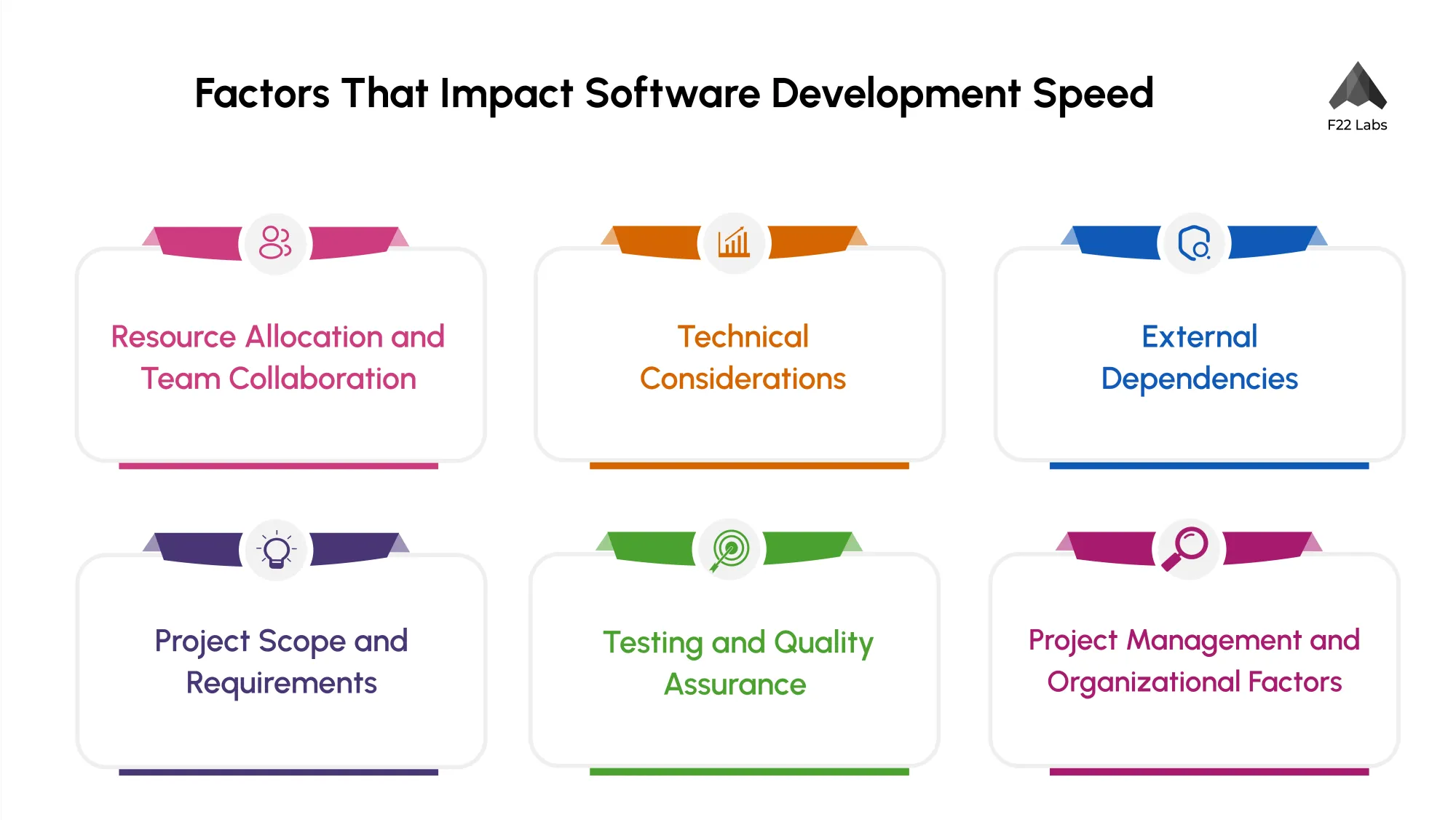
Project Scope and Requirements
The journey towards Minimum Viable Product can be bumpy if the project scope keeps changing or if the requirements are ambiguous. 52% of projects experience scope creep, which often leads to delays.
A clear and well-defined scope, coupled with complete and unambiguous requirements, can act as a catalyst, accelerating the MVP development speed.
Testing and Quality Assurance
Speed without structured quality assurance introduces rework costs, making disciplined acceleration essential. Test planning and execution are vital to ensuring that the product is free from defects and performs as expected. However, manual testing can be time-consuming.
According to a report by the World Quality Report, test automation helps organizations increase test execution speed, expand test coverage, and find more defects. Test automation tools can significantly speed up this process, thereby accelerating MVP development.
Build Lean. Learn Fast.
Launch an MVP that saves money while proving your concept works.
Project Management and Organizational Factors
Finally, the MVP development speed can be significantly influenced by project management practices and organizational culture. Efficient planning, prioritization, and a culture that encourages communication and innovation can speed up the development process, ensuring a swift and efficient journey to a Minimum Viable Product.
The MVP development speed is a crucial measure of this strategic, balanced approach, where speed and quality harmonize to create a symphony of success.
How Long Does It Take to Develop an MVP?
Most MVPs take 3 to 6 months to build, depending on complexity, the tech stack, and how much of the team is dedicated full-time versus split across other projects.
A simple, single-feature MVP, a landing page test, a Wizard-of-Oz service, or a narrow tool, can often ship in 6-8 weeks. A multi-feature product with integrations, payments, or compliance requirements typically needs 4-6 months, and platform-style MVPs with marketplace or multi-sided functionality can run longer.
The biggest swing factor isn't the build itself; it's how much time gets spent on planning and scoping upfront versus discovering requirements mid-build. Teams that lock scope early and treat changes as deliberate trade-offs, rather than free additions, tend to land closer to their original estimate.
If you want a timeline specific to your idea, MVP Development Services teams that have shipped a range of MVP types can usually give you a realistic estimate based on your actual feature list rather than a generic range.
Speedy Success Stories: Accelerated Development Case Studies
Let's take a look at some real-world case studies, illuminating the powerful impact of speed in MVP development.
Buffer: Joel Gascoigne, the founder of Buffer, initially developed a simple landing page explaining what the Buffer app would do, and offering plans for future users. This allowed him to gauge interest in his idea without building a full product.
The interest he garnered was enough to encourage him to proceed with the full application. The speed of this MVP development process minimized upfront costs and gave him confidence in the viability of his idea.
Product Hunt: Ryan Hoover started Product Hunt as an MVP via a simple email list where he shared interesting new products with subscribers. The list gained traction, confirming the need for a platform that curates and shares new tech products.
Hoover then developed the full-fledged Product Hunt platform, which became a go-to resource for tech enthusiasts and was eventually acquired by AngelList.
These stories demonstrate how speed in MVP development and a commitment to learning and iterating from user feedback can lead to astonishing success, even for startups that begin with limited resources.
Fail Fast. Fail Cheap: The Mantra of MVP Development Speed
In competitive startup ecosystems, speed functions as a survival mechanism, enabling early feedback, faster pivots, and controlled risk exposure.
Let's remember the words of Reid Hoffman, LinkedIn co-founder:
"If you're not embarrassed by the first version of your product, you've launched too late."
Reid Hoffman's point stands: speed here isn't about rushing, it's about learning what works before you've spent months building the wrong thing.
If you want a second opinion on your MVP timeline and how to move faster without cutting corners, we offer a free 1-hour consultation.
Frequently Asked Questions
1. Why is speed important in MVP development?
Speed enables faster validation, shorter feedback loops, and quicker product-market fit, reducing risk and conserving startup runway.
2. What is Time to Market (TTM) in MVP development?
Time to Market (TTM) measures how quickly a product moves from idea to launch. Faster TTM accelerates learning and competitive positioning.
3. Does faster MVP development reduce quality?
Not when structured correctly. Agile workflows, automation, and CI/CD ensure quality while maintaining development velocity.
4. How can startups accelerate MVP development?
Through agile sprints, automation, prioritizing core features, minimizing scope creep, and leveraging experienced MVP development teams.
5. What factors slow down MVP development?
Scope changes, unclear requirements, poor collaboration, external dependencies, and a lack of automation.
6. How long does it take to build an MVP?
Typical MVP development timelines range from 3 to 6 months, depending on complexity, tech stack, and resource allocation.