- Prompt engineering should be tested before using RAG or fine-tuning.
- Fine-tuning changes how a model behaves, including its tone, format, and domain-specific performance.
- RAG gives a model access to external, private, or frequently updated information at query time.
- Use fine-tuning when the problem is behavioural, such as inconsistent outputs or poor task specialization.
- Use RAG when the problem is factual, such as outdated knowledge, missing information, or hallucinations.
- RAG requires a retrieval pipeline, while fine-tuning requires quality training data and model training.
- When both behaviour and current knowledge matter, a hybrid approach such as RAFT may be appropriate.
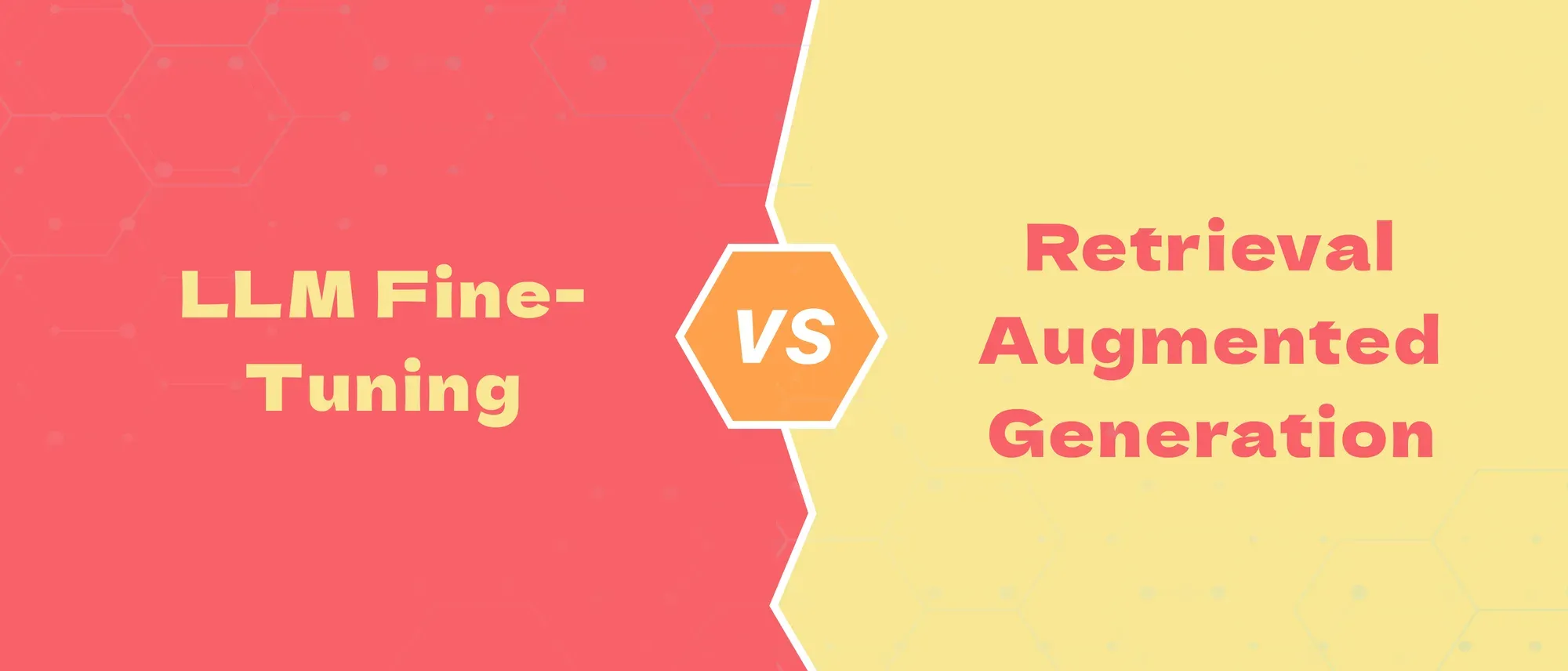
The RAG vs fine-tuning debate is one of the most common decisions teams face when building AI applications. Both approaches enhance what a language model can do, but they solve fundamentally different problems, carry different costs, and suit different scenarios.
Whether you are evaluating LLM RAG vs fine-tuning for a new project or reconsidering an existing architecture, this guide breaks down both methods, compares them directly, and gives you a clear framework to decide.
If you have heard the terms retrieval augmented generation vs fine-tuning and wondered where to start, this is the definitive answer.
The Three Options at a Glance
Before diving deep, it helps to understand where fine-tuning and RAG sit relative to your simplest option:
| Approach | What It Changes | Best Starting Point |
| Prompt Engineering | How you talk to the model | Always try this first |
| RAG | What the model can see at query time | When knowledge is dynamic or private |
| Fine-Tuning | How the model behaves permanently | When behavior and style need to change |
If prompt engineering alone solves your problem, neither fine-tuning nor RAG is necessary. Start there, and only move to RAG or fine-tuning when you hit a ceiling.
What Is LLM Fine-Tuning?
Fine-tuning is the process of training a pre-trained LLM on a smaller, specialized dataset to adjust its internal parameters. This shifts the model's behavior, tone, style, or domain knowledge permanently, without changing its underlying architecture.
A general-purpose model like Llama 3 or Mistral can be fine-tuned on legal documents to improve its understanding of legal terminology, or on customer support transcripts to match a brand's tone and response style.
Modern Fine-Tuning Techniques
Traditional fine-tuning required significant GPU resources and large datasets. In 2026, that barrier has dropped considerably thanks to parameter-efficient methods:
- LoRA (Low-Rank Adaptation) — fine-tunes only a small subset of model parameters, drastically reducing compute and memory requirements
- QLoRA — combines LoRA with 4-bit quantization, enabling fine-tuning on consumer-grade hardware
- PEFT (Parameter-Efficient Fine-Tuning) — a broader category of techniques, including LoRA and adapters, that avoid updating all model weights
These approaches have made fine-tuning far more accessible than the article you may have read even a year ago.
Key Features
- Task Specialization — adapts the model for a specific domain, ensuring high accuracy for targeted tasks
- Static Learning — knowledge is fixed after training; new information requires retraining
- Behavioral Control — controls tone, format, language style, and output structure consistently
What Is Retrieval-Augmented Generation (RAG)?
RAG combines a pre-trained LLM with a retrieval system. When a query is submitted, the system retrieves relevant content from an external knowledge base, such as a vector database, and injects it into the model's context window before generating a response.
This approach is dynamic. The model never needs to be retrained when your data changes. You update the knowledge base, and the model immediately benefits.

Walk away with actionable insights on AI adoption.
Limited seats available!

According to AWS, RAG is ideal when tasks require integration of external knowledge or real-time information retrieval, and when keeping the base model unchanged is a priority.
A Practical Example
Consider an LLM asked: "What are the current symptoms of the latest circulating flu variant?"
Without RAG — the model answers from its training data, which has a knowledge cutoff. The response is generic and potentially outdated.
With RAG — the system retrieves the latest entries from a connected medical knowledge base and generates a specific, current, and grounded response — without ever retraining the model.
Key Features
- Dynamic Knowledge — retrieves up-to-date information at query time from external sources
- No Retraining Required — update the knowledge base, not the model
- Grounded Responses — reduces hallucinations by anchoring outputs to retrieved facts
- Data Privacy — sensitive or proprietary data stays in your database; it is never baked into the model
RAG vs Fine-Tuning: Detailed Comparison
| Aspect | Fine-Tuning | RAG |
| Knowledge Type | Static, embedded in weights | Dynamic, retrieved at runtime |
| Update Mechanism | Requires retraining | Update the knowledge base |
| Latency | Low — no retrieval step | Slightly higher — retrieval adds overhead |
| Hallucination Risk | Moderate | Lower — grounded in retrieved facts |
| Setup Cost | Moderate (with LoRA/QLoRA) | Moderate — requires vector DB and pipeline |
| Inference Cost | Low | Higher — retrieval adds compute per query |
| Best For | Behavior, tone, style, domain expertise | Facts, up-to-date information, private data |
| Flexibility | Limited to trained knowledge | Broad — adapts to any connected data source |
Pros and Cons of LLM Fine-Tuning
Pros
- Behavioral Consistency — fine-tuned models reliably maintain a specific tone, format, or style across all responses
- Low Inference Latency — no retrieval step means faster responses at scale
- Cost-Efficient at Volume — once trained, serving is cheap for high-query workloads
- Custom Style and Voice — ideal for applications like brand-specific chatbots or automated document drafting
Cons
- Static Knowledge — cannot incorporate new information without retraining
- Catastrophic Forgetting — fine-tuning for one task can degrade performance on others
- Risk of Overfitting — models trained on narrow datasets may fail to generalize
- Training Overhead — even with LoRA/QLoRA, curating quality training data takes time
Retrieval-Augmented Generation (RAG)
Pros
- Always Current — connects to live or regularly updated data sources
- Reduces Hallucinations — responses are grounded in retrieved evidence, not generated from memory
- No Retraining — update the knowledge base and the model adapts immediately
- Data Privacy — proprietary or sensitive data stays external and controlled
Cons
- Higher Inference Cost — retrieval adds compute overhead on every query
- Retrieval Quality Matters — poor chunking or indexing leads to irrelevant context and degraded answers
- Context Window Limits — injecting too many retrieved chunks can exhaust the model's context window
- Integration Complexity — requires building and maintaining a vector database and retrieval pipeline
When to Use Fine-Tuning
Fine-tuning is the right choice when your failure mode is behavioural, not factual. If your model produces inconsistent formats, fails to follow a specific tone, struggles with domain terminology, or does not adhere to your output structure, fine-tuning is the fix.
Ideal scenarios:
- Legal, medical, or financial document generation requiring precise, controlled language
- Customer support bots that need to match a specific brand voice
- Classification tasks (e.g., routing, sentiment, intent detection) where a small fine-tuned model outperforms a large general one
- High-volume inference workloads where retrieval costs need to be minimized
When to Use RAG
RAG is the right choice when your failure mode is factual, the model does not know something, knows something outdated, or hallucinates information that exists in your knowledge base.
Walk away with actionable insights on AI adoption.
Limited seats available!
Ideal scenarios:
- Enterprise knowledge assistants answering questions over internal documents, wikis, or policies
- Customer support tools needing access to live product data, order status, or support tickets
- Research assistants connected to current literature or news
- Any application where data changes frequently and retraining is impractical
The Hybrid Approach: RAFT
For many production systems in 2026, the rag vs fine-tuning choice is a false dilemma, the real answer is both, combined into RAFT (Retrieval-Augmented Fine-Tuning).
In RAFT, a model is first fine-tuned on domain-specific data to encode behavior, tone, and specialized knowledge into its weights. That fine-tuned model is then deployed within a RAG architecture, giving it access to a dynamic, external knowledge base at query time.
The result: a model that both behaves correctly (fine-tuning) and knows what is current (RAG). According to IBM, this hybrid approach is increasingly the default for enterprise deployments where both precision and up-to-date knowledge are required.
When to go hybrid:
- You need consistent domain expertise and access to live or frequently updated data
- Your use case spans both behavioral consistency (fine-tuning's strength) and factual accuracy (RAG's strength)
- You are building a production system where both latency and accuracy are critical
How to Decide: A Simple Framework
Use this decision path before committing to either approach:
- Can prompt engineering solve it? → Yes → Stop here, no training needed
- Is the problem behavioral? (wrong format, wrong tone, poor classification) → Yes → Fine-tune
- Is the problem factual? (outdated info, missing knowledge, hallucinations) → Yes → RAG
- Is it both? → RAFT (Fine-Tuning + RAG)
Frequently Asked Questions
1. What is the main difference between RAG vs fine-tuning?
In the RAG vs fine-tuning comparison, the core difference is this: fine-tuning modifies the model's internal parameters to change how it behaves, its tone, style, and domain expertise. RAG does not change the model at all; instead, it gives the model access to external knowledge at query time. Fine-tuning changes the model permanently; RAG changes what the model can see temporarily.
2. Which approach is more cost-effective?
It depends on your workload. RAG has lower setup costs and no retraining expense, but higher per-query inference costs due to the retrieval step. Fine-tuning (especially with LoRA/QLoRA) has a moderate one-time training cost but very low ongoing inference cost, making it more economical at high query volumes.
3. When should I choose RAG over fine-tuning?
Choose RAG when your data changes frequently, when you need to reduce hallucinations by grounding answers in real sources, or when storing sensitive data inside a model is a privacy concern. If your problem is that the model does not know something, not that it behaves incorrectly, RAG is the right tool.

Walk away with actionable insights on AI adoption.
Limited seats available!