- Hire when the use case is clear enough to build, not before, too early wastes budget on a vague idea, too late slows down validation.
- Match the role to the work: ML engineer for prediction models, LLM engineer for chatbots/RAG, AI agent developer for workflow automation, full-stack AI developer for PoCs/MVPs.
- Freelancers suit small scoped experiments; an AI development company suits PoCs/MVPs needing multiple skills together; in-house makes sense once AI is core and you have runway.
- Cost ranges from $25–$100+/hour for freelancers to $15,000–$40,000+/month for a dedicated team, scope the use case first to estimate accurately.
- Test before committing: a small paid trial or PoC reveals more about a candidate's product thinking and data/security awareness than a resume ever will.
Hiring AI developers is different from hiring regular software developers. Startups are not just looking for someone who can write code. They need someone who understands data, models, product logic, integrations, and how to turn an AI idea into something users can actually use.
The challenge is that “AI developer” can mean many things. Some startups need an LLM engineer to build AI agents or chatbots. Some need an ML engineer for prediction models. Others need a full-stack AI developer who can connect AI features with the actual product.
In this guide, we’ll break down when startups should hire AI developers, what skills to look for, where to find them, how much it costs, and how to choose the right hiring model for your product stage.
When Should a Startup Hire AI Developers?
A startup should hire AI developers when the idea is clear enough to build, but the team needs technical help to test, launch, or scale it. Hiring too early can waste budget, especially if the use case is still vague. But waiting too long can slow down validation if AI is central to the product.
The right time to hire AI developers is when you need to:
- Build an AI PoC to test if the idea works
- Turn a validated PoC into an MVP
- Add AI features to an existing product
- Build an AI chatbot, agent, recommendation system, or automation workflow
- Work with custom data, LLMs, RAG, or model integrations
- Improve an AI feature that is already built but not performing well
For most startups, the best approach is to start with a focused AI use case instead of hiring for a broad “AI project.” Once the problem, users, data, and expected output are clear, it becomes much easier to find the right AI developer or development team.
What Type of AI Developer Does Your Startup Need?
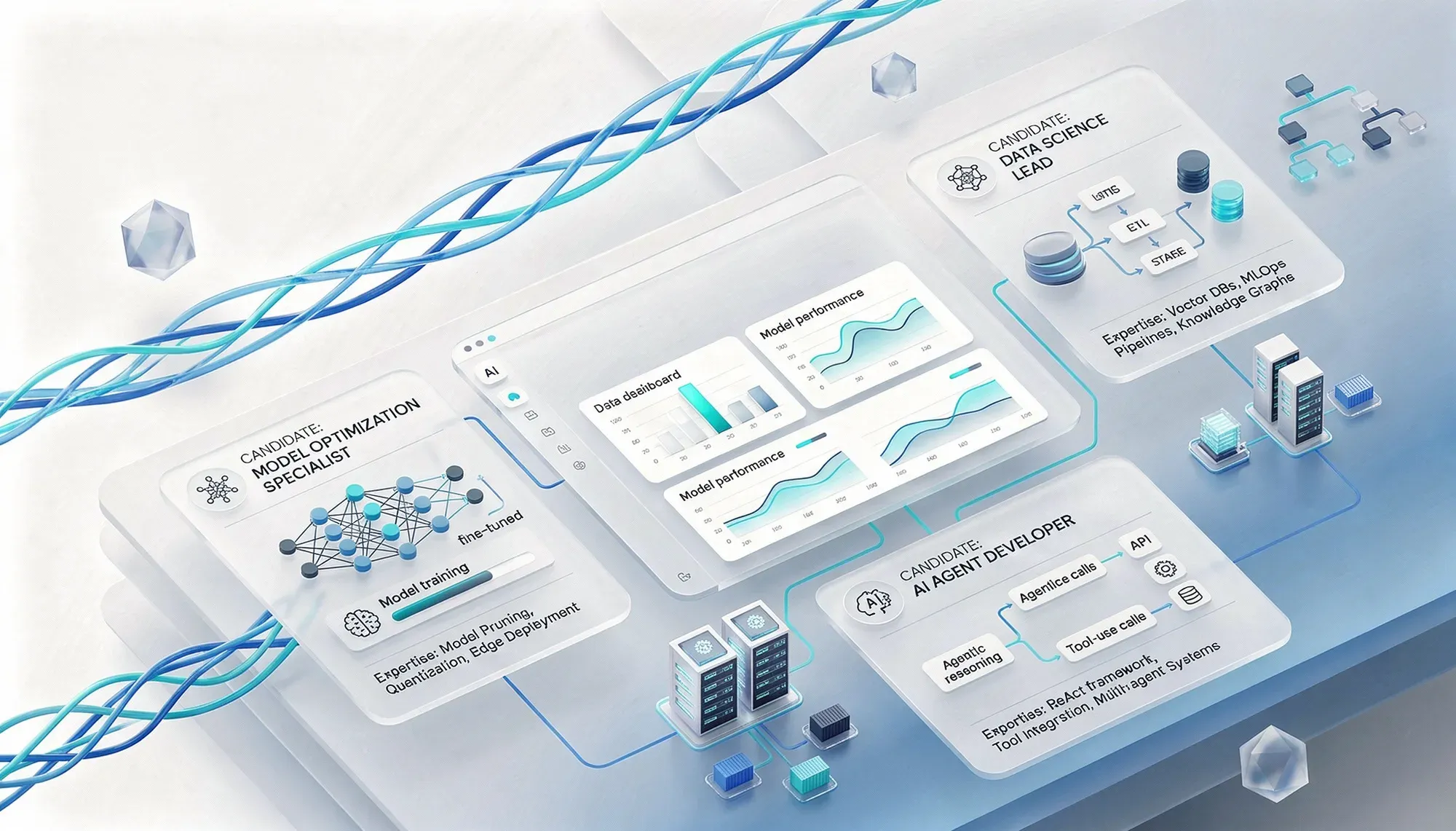
Not every startup needs the same kind of AI developer. The right choice depends on what you are building, how much AI complexity is involved, and whether you are still validating the idea or preparing for production.
| Type of AI Developer | Best For | What They Help With |
AI/ML Engineer | Prediction models, recommendation engines, fraud detection, forecasting, classification systems | Builds, trains, tests, and improves machine learning models |
LLM Engineer | AI chatbots, copilots, AI search, RAG systems, internal assistants | Works with large language models, prompt design, retrieval, context handling, and model evaluation |
AI Agent Developer | Sales agents, support agents, research agents, workflow automation, operations assistants | Builds AI agents that can use tools, call APIs, make decisions, and complete multi-step workflows |
Data Scientist | Data analysis, experiments, user behavior insights, early AI validation | Finds patterns in data, tests assumptions, and helps decide whether the data can support the AI idea |
MLOps Engineer | Production AI systems, model monitoring, scaling, reliability | Handles deployment, infrastructure, model monitoring, retraining pipelines, and performance tracking |
Full-Stack AI Developer | AI PoCs, MVPs, AI features inside a product | Connects AI models with frontend, backend, APIs, databases, and user-facing product features |
For most early-stage startups, a full-stack AI developer or an AI development team is usually the most practical option because they can help turn an AI idea into a working PoC or MVP without needing multiple separate hires.
Skills to Look for When Hiring AI Developers
The right AI developer should understand more than models. They should know how to work with data, connect AI features to real products, test outputs, and keep the system reliable after launch.
| Skill | Why It Matters |
Python and Backend Development | Most AI workflows use Python. Backend knowledge helps developers connect models with APIs, databases, and product logic. |
Machine Learning Basics | Even when using existing AI APIs, developers should understand model behavior, accuracy, training data, and limitations. |
LLMs and Prompt Engineering | Important for building chatbots, copilots, AI assistants, content tools, and reasoning-based workflows. |
RAG and Vector Databases | Useful when the AI product needs to search company data, documents, knowledge bases, or user-specific information. |
AI Agent Development | Needed for products where AI must use tools, call APIs, follow steps, and complete workflows instead of only generating text. |
Data Handling and Preparation | AI output depends heavily on data quality. Developers should know how to clean, structure, and prepare data for AI systems. |
Cloud and API Integrations | AI features often need to connect with CRMs, dashboards, payment systems, support tools, or internal databases. |
Testing and Evaluation | Developers should know how to measure accuracy, hallucinations, latency, output quality, and failure cases. |
Security and Privacy Awareness | Important when working with customer data, business documents, healthcare, fintech, HR, or enterprise workflows. |
Product Thinking | A good AI developer should understand the business problem, not just the model. This helps avoid building AI features that look impressive but do not solve anything useful. |
Where to Find AI Developers for Your Startup
Finding AI developers is not just about searching job boards. Startups need to look in places where developers have real experience with AI models, data workflows, product integrations, and production use cases.
| Source | Best For | What to Keep in Mind |
Freelance Platforms | Short AI experiments, small PoCs, quick prototypes | Good for speed, but you need a clear scope and strong technical review before hiring |
Full-time AI developers, senior engineers, AI leads | Useful for direct outreach, but hiring can take longer and competition is high |
|
GitHub and Open-Source Communities | Developers with real AI project experience | Check their actual contributions, not just profile keywords |
AI and ML Communities | LLM engineers, ML engineers, AI researchers, agent builders | Good for niche skills, but you still need to test product and delivery ability |
Startup Talent Networks | Developers familiar with fast-moving startup environments | Better fit if you need people who can work with limited scope and changing priorities |
AI Development Companies | AI PoCs, MVPs, product builds, and startup teams without internal AI expertise | Best when you need product thinking, AI engineering, backend, testing, and delivery support together |
For early-stage startups, the best source depends on the stage of the product. If you only need a small experiment, a freelancer may work.
If you need to build and launch an AI PoC or MVP, an AI development company or dedicated AI team is usually safer because you get broader skills without hiring multiple people separately.
Freelance vs In-House vs AI Development Company
Startups can hire AI developers in different ways, but the right option depends on your budget, timeline, product stage, and internal technical strength.
| Hiring Option | Best For | Pros | Cons |
Freelance AI Developer | Small experiments, quick prototypes, clearly scoped AI tasks | Flexible, affordable, faster to start | Limited ownership, harder to scale, quality depends on the individual |
In-House AI Developer | Long-term AI product development and ongoing model improvement | Strong product ownership, better long-term alignment | Expensive, slower to hire, may need more than one role |
AI Development Company | AI PoCs, MVPs, startup product builds, and teams without internal AI expertise | Access to product, AI, backend, data, and deployment skills together | Costs more than a freelancer, but reduces hiring and delivery risk |
For early-stage startups, freelancers can work well for small experiments. In-house hiring makes sense when AI is core to the product and you have enough runway to build a long-term team.
An AI development company is usually the better option when you need to move fast, validate an idea, build an AI PoC or MVP, and avoid hiring multiple specialists before the product direction is clear.
How Much Does It Cost to Hire AI Developers?
The cost to hire AI developers depends on their experience, location, skill set, and the type of work you need. A developer building a simple AI chatbot will usually cost less than someone building AI agents, RAG systems, recommendation engines, or production-ready ML workflows.
| Hiring Option | Estimated Cost |
Freelance AI Developer | $25–$100+/hour |
Junior AI Developer | $3,000–$6,000/month |
Mid-Level AI Developer | $6,000–$10,000/month |
Senior AI Developer | $10,000–$18,000+/month |
Dedicated AI Development Team | $15,000–$40,000+/month |
AI Development Company | Project-based, depending on PoC or MVP scope |
The best way to estimate cost is to define what you need to build first. A focused AI PoC will need a smaller budget, while a production-ready AI product or AI agent will require a larger team and longer engagement.
Step-by-Step Process to Hire AI Developers
Hiring AI developers becomes easier when you start with the product need instead of the job title. Before looking for candidates, define what you want the AI system to do, what data it will use, and what result you expect.
1. Define the AI Use Case First
Start by writing down the exact problem you want to solve. For example, do you want to build an AI chatbot, automate document processing, create an AI agent, add recommendations, or improve internal workflows?

Walk away with actionable insights on AI adoption.
Limited seats available!

A clear use case helps you avoid hiring someone too broad or too specialized for the actual work.
2. Decide Whether You Need a PoC, MVP, or Full Product
The hiring approach changes based on your product stage. A PoC needs someone who can validate the idea quickly. An MVP needs stronger product and backend skills. A production product may need AI engineering, MLOps, security, and ongoing monitoring.
This step helps you decide whether to hire one developer, a freelancer, or a full AI development team.
3. Choose the Right AI Role or Team Model
Once the scope is clear, decide what type of AI talent you need. You may need an LLM engineer, ML engineer, AI agent developer, full-stack AI developer, data scientist, or an AI development company.
The right choice depends on whether the work is model-heavy, product-heavy, data-heavy, or workflow-heavy.
4. Shortlist Developers With Relevant AI Experience
Do not shortlist candidates only because they mention AI, ML, or LLMs on their profile. Look for people who have built something similar to your use case.
For example, if you are building a RAG-based chatbot, check whether they have worked with vector databases, embeddings, retrieval quality, and model evaluation.
5. Review Their AI Portfolio and Past Projects
Look at what they have actually built. A good AI developer portfolio should show the problem solved, the AI approach used, the tools involved, and the result achieved.
Pay attention to projects with real workflows, integrations, measurable accuracy, deployment experience, or user-facing AI features.
6. Test Their Technical and Product Thinking
A good AI developer should not only explain the model. They should also ask about the user, the data, the workflow, the edge cases, and the success metric.
During the interview or trial task, check whether they can explain tradeoffs clearly, such as using an existing API versus fine-tuning a model, or building a simple PoC before a full AI product.
7. Ask About Data, Security, and Evaluation
AI development depends heavily on data quality and testing. Ask how they will prepare data, reduce hallucinations, measure output quality, handle user data, and monitor performance.
This is especially important if your product deals with customer data, documents, finance, healthcare, HR, legal, or enterprise workflows.
8. Start With a Small Paid Trial or PoC
Before committing to a long engagement, start with a focused task or PoC. This helps you test their speed, communication, technical ability, and problem-solving style.
The trial should have a clear goal, such as building a small prototype, testing a model, setting up a RAG workflow, or validating one AI feature.
9. Set Clear Milestones, Metrics, and Ownership
Once you hire, define what success looks like. Set milestones around output quality, accuracy, latency, cost, integrations, and delivery timeline.
Also clarify ownership of code, data, documentation, model setup, prompts, deployment files, and future maintenance. This avoids confusion when the project moves from PoC to MVP or production.
Interview Questions to Ask AI Developers
Interviewing AI developers should not be limited to coding questions. You need to understand how they think about data, models, product use cases, accuracy, cost, and deployment.
Technical Questions
1. How would you decide whether to use an existing AI API or build a custom model?
This shows whether they understand cost, speed, accuracy, and complexity tradeoffs.
2. How would you reduce hallucinations in an AI chatbot or assistant?
Look for answers around better prompts, RAG, source grounding, evaluation, guardrails, and human review.
3. How would you build a RAG system for a startup product?
They should explain embeddings, vector databases, retrieval quality, chunking, context handling, and output testing.
4. How would you evaluate the quality of AI outputs?
Good answers should include accuracy, consistency, error rate, user feedback, hallucination checks, and edge-case testing.
5. How would you handle sensitive user or business data in an AI product?
This helps you check their understanding of privacy, access control, data masking, and secure API usage.
Product and Startup Questions
1. How would you scope an AI PoC if we had only 4 weeks?
This shows whether they can prioritize and avoid overbuilding.
2. What would you build first if we had a limited budget?
Walk away with actionable insights on AI adoption.
Limited seats available!
A good AI developer should focus on the riskiest part of the product, not unnecessary features.
3. How would you decide if our product actually needs AI?
This reveals whether they think beyond hype and can recommend simpler solutions when needed.
4. What metrics would you track to know if the AI feature is working?
Look for practical metrics like accuracy, time saved, cost per task, response quality, latency, and user adoption.
5. What could go wrong when this AI feature moves into production?
Strong candidates should mention model drift, poor data quality, high API costs, hallucinations, latency, monitoring, and security risks.
How F22 Labs Helps Startups Build AI Products
If you're looking to hire AI developers for your startup, F22 Labs gives you access to pre-vetted talent who can support AI PoCs, MVPs, AI agents, chatbots, automation workflows, and AI-powered product features.
These developers are already screened, trained, and managed to handle startup-focused AI outsourcing needs. They can help with use case validation, data preparation, model integration, backend development, testing, and deployment, so you do not have to spend months finding and managing multiple AI specialists on your own.
Conclusion
Hiring AI developers for your startup is not just about finding someone with AI or machine learning experience. The right developer should understand your use case, data, product stage, and what needs to be validated before building further.
Start with a clear problem, choose the right hiring model, review relevant AI experience, and test both technical and product thinking before making a decision.
When done right, hiring AI developers can help your startup build faster, validate smarter, and move from idea to AI PoC, MVP, or production-ready product with fewer costly mistakes.
Frequently Asked Questions
How do I hire AI developers for my startup?
Start by defining your AI use case, product stage, required skills, and budget. Then shortlist developers with relevant AI project experience and test their technical and product thinking.
How much does it cost to hire AI developers?
Freelance AI developers may cost $25–$100+/hour, while full-time or dedicated AI developers can cost more depending on experience, location, and project complexity.
What skills should AI developers have?
AI developers should understand Python, machine learning basics, LLMs, RAG, APIs, data handling, cloud deployment, testing, security, and product problem-solving.
Should I hire a freelancer or an AI development company?
Hire a freelancer for small experiments or clearly scoped tasks. Choose an AI development company if you need a PoC, MVP, or full AI product with broader technical support.
Do startups need AI developers to build an AI PoC?
Yes, if the PoC involves AI models, data workflows, agents, integrations, or product logic. A focused AI developer can help validate the idea before full development.
How do I test an AI developer before hiring?
Give them a small paid task or PoC. Check how they approach data, model choice, output quality, edge cases, security, and product goals.
What is the difference between an AI developer and an ML engineer?
An AI developer may work with LLMs, APIs, agents, and product integrations. An ML engineer usually focuses more on model training, testing, and machine learning workflows.
Can a full-stack developer build AI features?
Yes, if the feature uses existing AI APIs and simple integrations. For complex AI agents, custom models, or RAG systems, you may need specialized AI expertise.

Walk away with actionable insights on AI adoption.
Limited seats available!