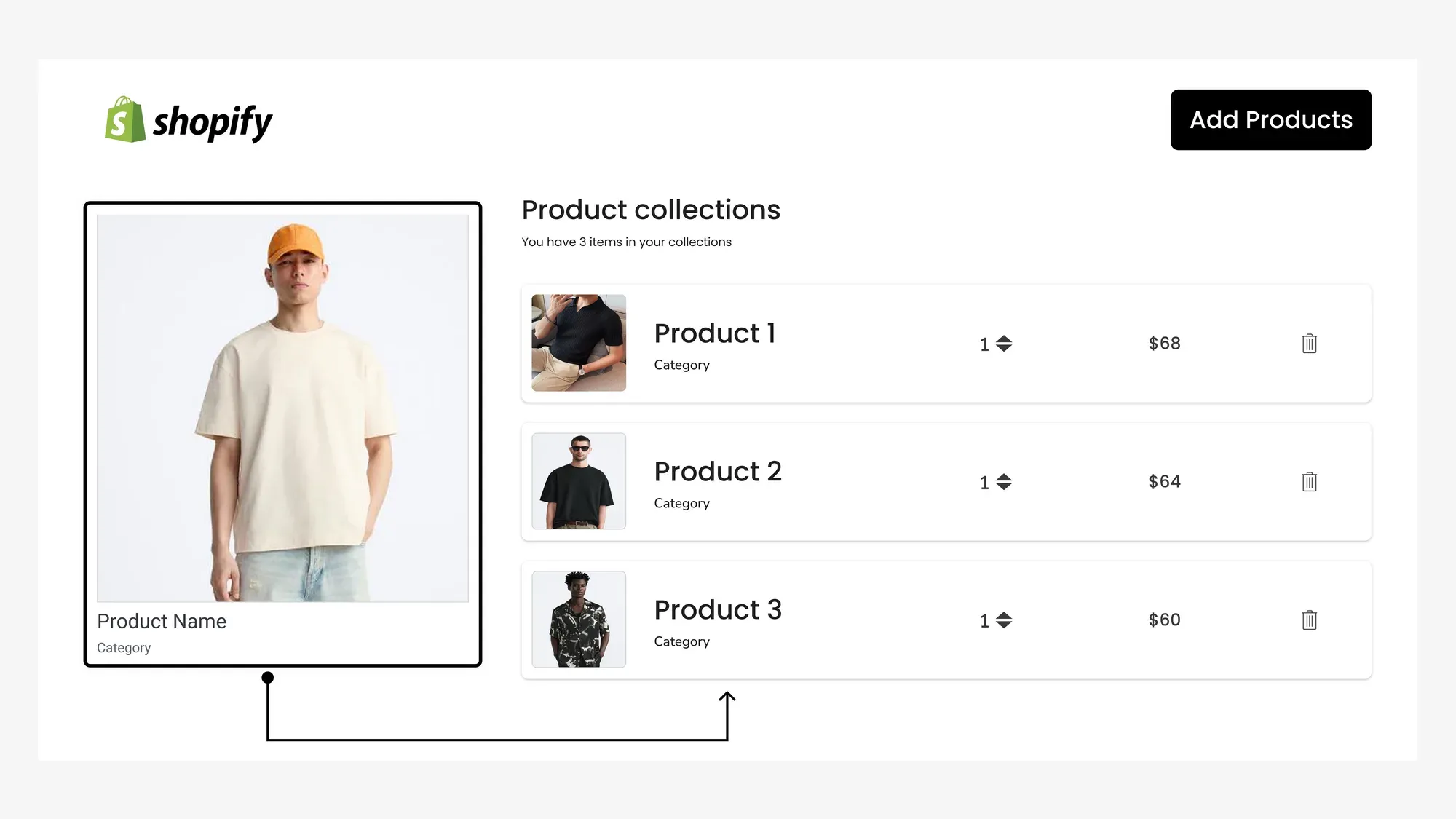
Shopify collections group related products into pages that customers can browse. You might create collections for new arrivals, sale items, product categories, seasonal ranges or particular audiences.
A product can belong to several different collections. For example, a graphic T-shirt could appear in Summer Clothing, Graphic Tees and New Arrivals. However, it appears only once within each collection.
Shopify supports two collection types: manual collections and smart collections. The correct way to add a product depends on which type you choose.
- Go to Products > Collections to create or manage Shopify collections.
- Manual collections let you select individual products.
- Smart collections automatically include products that match defined conditions.
- You can add one product to several different collections.
- A product cannot appear more than once in the same collection.
- Products cannot be manually added to or removed from a smart collection.
- After creating a collection, publish it to the required sales channel.
- Add the collection to a menu so customers can find it.
- Collection availability and product availability are managed separately.
- Shopify Starter does not support organising products into collections.
What Is a Shopify Collection?
A Shopify collection is a group of products displayed together on a dedicated storefront page.
Common examples include:
- New Arrivals
- Bestsellers
- Women’s Clothing
- Gifts Under ₹1,000
- Summer Collection
- Sale Products
- Organic Skincare
- Running Shoes
Collections help customers move from a broad category to a relevant group of products. They can appear in navigation menus, homepage sections, promotional campaigns and search-engine results.
The appearance of a collection page, including filters, product cards, image ratios and descriptions, depends on the Shopify theme.
Manual vs Smart Shopify Collections
Shopify provides two collection types.
Collection type | How products are added | Best suited to |
Manual collection | You select each product individually | Curated ranges, campaigns and small collections |
Smart collection | Shopify includes products that match conditions | Large catalogues, categories and frequently changing inventory |
Manual collections
A manual collection contains only the products you choose. Products remain in the collection until you remove them.
Manual collections work well for:
- Staff picks
- Gift guides
- Limited promotions
- Curated edits
- Campaign landing pages
- Small seasonal selections
Smart collections
A smart collection automatically includes products that meet its conditions.
Conditions can use information such as:
- Product title
- Product type
- Vendor
- Product tag
- Price
- Compare-at price
- Inventory
- Variant title
- Weight
- Metafields
You can require products to match either all conditions or any condition.
For example, a Summer Sale collection might use:
Product tag is equal to summer
AND
Compare-at price is not empty
Products enter or leave the collection when their information changes.
After creating a collection, Shopify does not let you switch it from manual to smart or from smart to manual. You must create another collection if you need a different type.
How to Create a Manual Collection on Shopify
Step 1: Open Collections
From your Shopify admin:
- Go to Products.
- Click Collections.
- Click Create collection.
Step 2: Enter the Collection Details
Add:
- Collection title
- Description
- Collection image, if required
- Search-engine title and description
- Sales-channel availability
Use a clear title that customers understand. A collection description can explain what the products share and help customers decide whether the range is relevant.
Step 3: Select Manual Collection
In the Collection type section, choose Manual.
Collection type cannot be changed after the collection is created, so verify the selection before continuing.
Step 4: Save the Collection
Click Save.
After saving, the Products section becomes available so you can begin adding products.
How to Add Products from a Manual Collection Page
To add one or several products:
- Go to Products > Collections.
- Open the manual collection.
- Find the Products section.
- Click Browse or use the product search field.
- Search for the required products.
- Select the checkbox beside each product.
- Click Add.
- Click Save if Shopify does not save the update automatically.
You can select several products during the same action.
Adding an existing product again does not create a duplicate. Each product can appear only once within a particular collection.
How to Add a Product from Its Product Page
You can also add an individual product to one or more manual collections while editing it:
- From Shopify admin, go to Products.
- Open the product.
- Find the Product organisation section.
- Locate the Collections field.
- Search for and select the required manual collections.
- Click Save.
Need Help With Shopify Development?
We build fast, custom Shopify stores designed to drive more sales.
The field can be used only to add the product directly to manual collections. A smart collection includes the product only when it matches the collection’s conditions.
This method is useful when creating a new product that belongs to several categories.
How to Create a Smart Collection
For a growing catalogue, smart collections can reduce repetitive product organisation.
To create one:
- Go to Products > Collections.
- Click Create collection.
- Enter the title and description.
- Under Collection type, select Smart.
- Choose whether products must match:
- All conditions
- Any condition
- Add the required conditions.
- Click Save.
- Review the products Shopify automatically includes.
- Select the required sales channels.
- Add a collection image if needed.
Shopify permits up to 60 conditions in one smart collection and up to 5,000 smart collections per store.
Avoid creating unnecessary conditions or thousands of overlapping collections. Excessive collection logic can make product organisation difficult to understand and maintain.
How to Add a Product to a Smart Collection
You cannot select a product and manually insert it into a smart collection.
Instead, edit the product so it meets the conditions.
Suppose the collection condition is:
Product tag is equal to summerTo add a product:
- Go to Products.
- Open the product.
- Add the
summertag. - Save the product.
- Check the smart collection.
Shopify should include the product after processing the update.
If the product does not appear, confirm:
- The condition value is correct.
- The collection uses all or any as intended.
- The product is active.
- The correct product field was updated.
- The price or inventory satisfies the condition.
- The collection and product are available on the relevant sales channel.
How to Remove Products from a Manual Collection
To remove a product from the collection page:
- Go to Products > Collections.
- Open the manual collection.
- Find the product in the Products section.
- Select or open the product’s available actions.
- Click Remove from collection.
- Save the collection if required.
You can also remove it from the product page:
- Go to Products.
- Open the product.
- Find the Collections field.
- Remove the relevant manual collection.
- Click Save.
Removing a product from a collection does not delete the product from Shopify.
How to Remove a Product from a Smart Collection
A product remains in a smart collection for as long as it matches the conditions.
To remove it, you must:
- Edit the product so it no longer matches, or
- Change the collection conditions
For example, if the collection includes products tagged summer, remove that tag from the product.
Be careful when changing collection conditions because the update can add or remove many products simultaneously.
How to Sort Products in a Shopify Collection
When products appear on the storefront, Shopify uses the collection’s selected sort order.
Available sorting options include:
- Most relevant
- Best selling
- Product title, A–Z
- Product title, Z–A
- Highest price
- Lowest price
- Newest
- Oldest
- Manual
New collections are currently sorted by Most relevant by default.
To change the order:
- Go to Products > Collections.
- Open the collection.
- Find the Products section.
- Open the Sort menu.
- Select the required option.
- Click Save.
If you choose Manual, drag products using the reorder handle or select products and use Move to position them.
Manual sorting is useful when you want to:
- Place bestsellers first
- Highlight high-margin products
- Lead with in-stock items
- Arrange products by colour
- Support a merchandising campaign
Review manual sorting regularly. Newly added products may not appear where expected unless you reposition them.
How to Make a Collection Visible on Your Store
Creating a collection does not guarantee that customers can find it.
Check sales-channel availability
- Go to Products > Collections.
- Open the collection.
- Find Sales channels.
- Click Manage.
- Select Online Store and any other required channels.
- Click Done.
- Save the collection.
Collection availability and product availability are separate. A visible collection can still contain products unavailable to that sales channel.
Add the collection to a menu
To add it to store navigation:
- Go to Content > Menus.
- Open the required menu.
- Click Add menu item.
- Enter the customer-facing label.
- In the Link field, select Collections.
- Choose the collection.
- Click Add.
- Save the menu.
You can also display a collection using a featured-collection section on the homepage if the theme supports it.
How to Add a Collection Image
To add or replace a collection image:
- Go to Products > Collections.
- Open the collection.
- Find the Collection image section.
- Click Add image or Upload image.
- Select the image.
- Add useful alt text where the interface permits it.
- Save the collection.
Shopify does not universally provide a button labelled Choose product image. If you want to use a product image, download or select the appropriate source file and upload it as the collection image.
Use a consistent aspect ratio across collection images to prevent irregular collection grids.
Collection Organisation Best Practices
Use customer-friendly names
Choose names based on how customers browse rather than internal inventory terminology.
Better: Women’s Running Shoes
Less helpful: Footwear Category 04
Avoid overlapping collections without a reason
A product can belong to many collections, but excessive duplication may create confusing navigation and repetitive search pages.
Each collection should serve a clear browsing or campaign purpose.
Use consistent product data
Smart collections depend on accurate product titles, types, vendors, tags, prices and metafields. Create a naming system before using these fields as conditions.
Need Help With Shopify Development?
We build fast, custom Shopify stores designed to drive more sales.
For example:
season:summer
audience:women
material:linen
A documented system helps staff avoid variations such as summer, Summer 2026 and summer-range unintentionally creating different groups.
Do not use tags only for SEO keywords
Product tags should support organisation, filters, workflows or smart collections. Adding unrelated keyword variations can create difficult-to-maintain product data.
Review sales-channel availability
Publishing a collection does not automatically publish every product inside it. Confirm that products and collections are available in the required markets and channels.
Monitor out-of-stock products
Smart collections can use inventory conditions to exclude unavailable items. For manual collections, products must be reviewed or managed through an appropriate workflow.
Optimise the collection page
A useful collection page should include:
- Clear title
- Short description
- Relevant image
- Logical product order
- Product filters
- Consistent product cards
- Accurate availability
- Useful internal links
- Unique search-engine metadata
Common Problems and Fixes
The product does not appear in the manual collection
Confirm that you saved the collection and that the product is active. Also check the product’s sales-channel and market availability.
The product does not appear in the smart collection
Review every condition and whether the collection requires all or any conditions. Price, inventory, tags and metafields must match the rule exactly as configured.
The collection exists but is not visible
Make the collection available to the Online Store and add it to a menu or theme section. Creating a collection does not automatically add a navigation link.
The collection page is empty
Check both the collection membership and individual product availability. Products hidden from the Online Store will not appear simply because the collection itself is published.
Products appear in the wrong order
Open the collection and review its sort setting. Choose Manual if you want precise merchandising control and then move products into the required positions.
A product keeps returning after removal
It is probably part of a smart collection. Change the product data or collection conditions so that the product no longer matches the inclusion rules.
Frequently Asked Questions
Can one product be added to multiple Shopify collections?
Yes. A product can belong to several manual and smart collections simultaneously, allowing customers to discover it through different categories. It can appear only once within each individual collection.
What is the difference between manual and smart collections?
Manual collections contain products selected by a store administrator. Smart collections automatically include products that match conditions based on fields such as tags, vendor, product type, price, inventory, or metafields.
Can I manually add a product to a smart collection?
No. The product must meet the smart collection’s conditions. Edit the relevant product data or modify the collection rules, then allow Shopify to update the included products.
Can I change a manual collection into a smart collection?
No. Shopify does not allow the collection type to be changed after creation. Create a new collection with the desired type and then configure its products, conditions and links.
How do I change the product order in a collection?
Open the collection and select a sorting method. Choose Manual to drag products into specific positions, or use options such as most relevant, bestselling, price, title or creation date.
Why is my Shopify collection not showing in the menu?
Publishing a collection does not automatically add it to navigation. Go to Content > Menus, open the appropriate menu and add a new item linking directly to the collection.
Can I choose a product image as the collection image?
You can use the same image file, but Shopify may require it to be uploaded through the Collection image section. The available image-selection interface can vary across admin versions and devices.
Are Shopify collections available on the Starter plan?
No. Shopify Starter does not support organising products into collections for customer browsing. You need Basic, Grow, Advanced or Shopify Plus to create and publish collection pages.
Conclusion
Adding products to a Shopify collection is straightforward once you identify the collection type.
Use a manual collection when you want precise control over a small or curated product group. Use a smart collection when products can be organised consistently using conditions such as tags, price, product type or inventory.
After adding products, check the collection’s sorting, sales-channel availability and menu links. A collection is useful only when it contains the right products, and customers can find it easily.
Stores with complex category structures or extensive catalogue requirements can hire Shopify experts to plan smart collection rules, filters and navigation without creating overlapping or difficult-to-maintain pages.