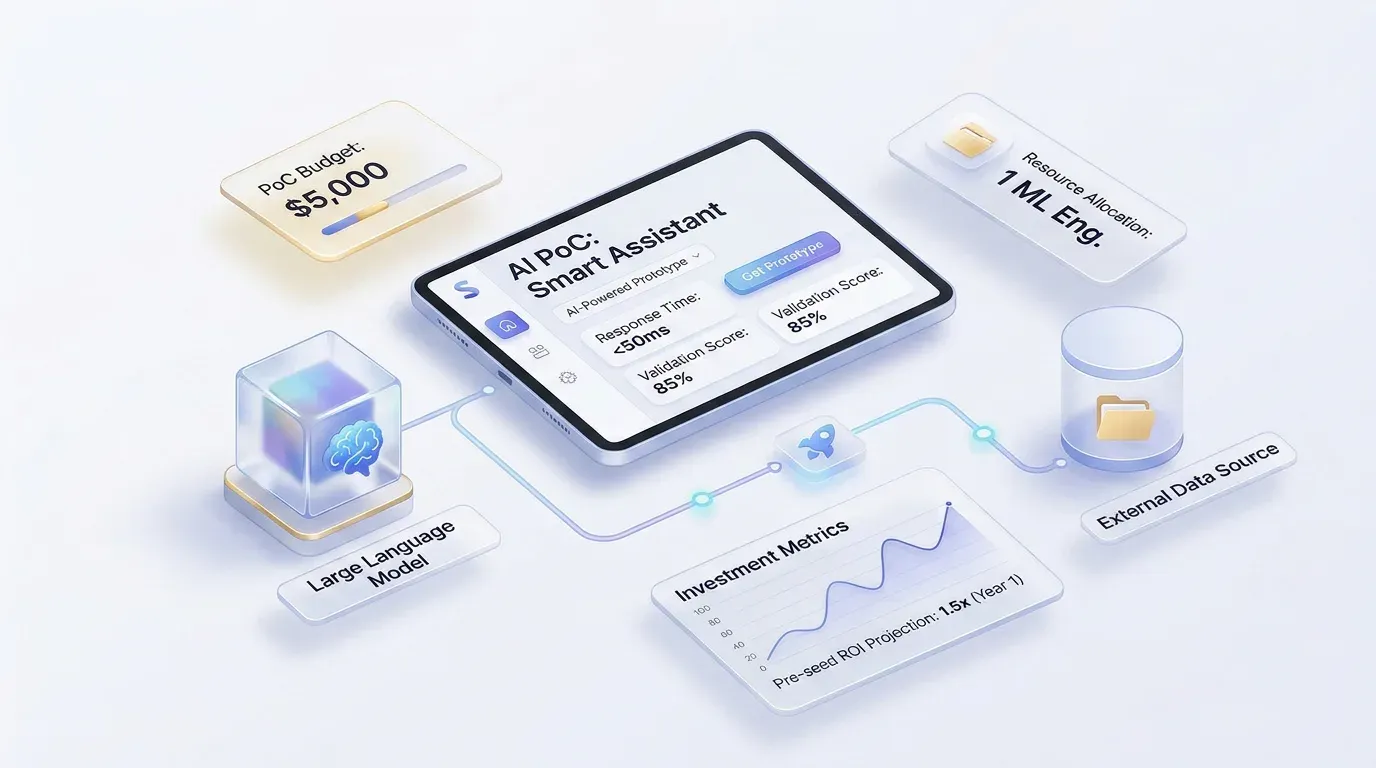
- AI PoC costs range from $3,000 (basic chatbot/content tool) to $75,000+ (enterprise, compliance-heavy), with most landing at $8,000–$30,000.
- Cost scales with use-case complexity, data readiness, number of integrations, and whether you need a custom model vs. an existing API.
- Build time is typically 2–6 weeks; keep it short by validating one use case, not five at once.
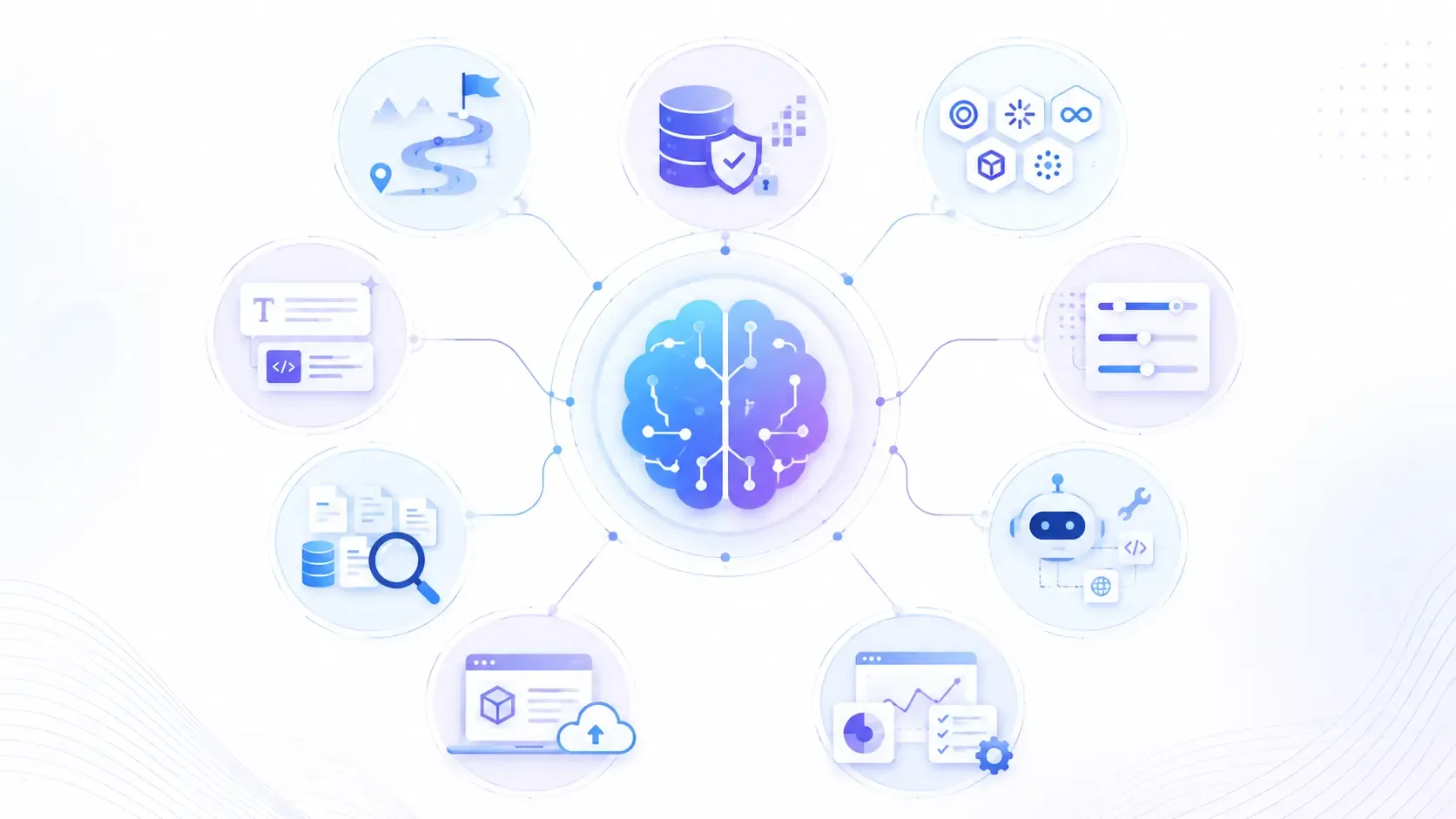
- A good PoC proves six things: technical feasibility, data readiness, output quality, business value, scalability potential, and a clear next step.
- Reduce cost without cutting corners: use existing models first, a small clean dataset over a large messy one, and skip the polished UI, which comes later.
AI PoCs are usually built when a team has a promising idea but is not ready to spend months building the full product. Maybe you want to test if your data is good enough, whether an AI agent can handle a workflow, or if the output is reliable enough for real users.
The cost depends on how complex the use case is. A simple AI chatbot PoC will not cost the same as a document processing system, voice agent, recommendation engine, or workflow automation tool with multiple integrations.
In this guide, we’ll break down how much an AI PoC usually costs, what affects the budget, what is included in development, and how to keep the scope clear before moving into a full MVP or production build.
How Much Does It Cost to Build an AI PoC?
An AI PoC usually costs between $3,000 and $30,000+ for most lean validation projects. The final cost depends on the use case, data quality, model choice, integrations, and level of testing required.
A simple PoC using existing AI APIs, such as a chatbot, internal assistant, or content generation workflow, may cost around $3,000 to $8,000. More advanced PoCs, such as AI agents, document processing tools, voice AI, or workflow automation systems, can range from $8,000 to $30,000+.
Enterprise PoCs can cost more if they involve sensitive data, compliance checks, security reviews, custom model work, or multiple internal systems.
The best way to estimate the cost is to look at what the PoC needs to prove. If the goal is only to test technical feasibility, the scope can stay lean. If the goal is to validate accuracy, workflow impact, integrations, and business value, the budget will naturally increase.
AI PoC Cost Breakdown by Complexity
These are lean PoC estimates, not full product development costs. A simple feature test can be built with a smaller budget, while costs increase when the PoC needs private data, accuracy testing, custom workflows, or integrations.
| AI PoC Type | Estimated Cost | Best For |
Basic AI PoC | $3,000–$8,000 | Testing a simple AI feature using existing APIs |
Mid-Level AI PoC | $8,000–$20,000 | Validating chatbots, internal tools, document workflows, or basic AI agents |
Advanced AI PoC | $20,000–$40,000+ | Complex data, custom workflows, accuracy testing, or multiple integrations |
Enterprise AI PoC | $40,000–$75,000+ | Sensitive data, compliance checks, security reviews, and production planning |
What Is Included in AI PoC Development Cost?
AI PoC development cost is not just for writing code or connecting an AI model. A good PoC includes the work needed to check if the idea is technically possible, useful for the business, and worth taking forward.
1. Use Case Discovery and Feasibility Analysis
The first step is to define what the PoC should actually prove. This includes understanding the business problem, the expected output, the target users, and the success criteria.
For example, if you are building an AI document processing PoC, the goal may not be to build a full product. The goal may simply be to check whether AI can extract the right information from invoices, contracts, or reports with acceptable accuracy.
This stage also helps answer an important question: does this problem really need AI, or can it be solved with simpler automation?
2. Data Collection and Data Preparation
Data preparation is one of the most important parts of an AI PoC. Even a simple PoC needs the right data to test whether the idea works in real conditions.
This may include collecting sample data, cleaning messy files, removing duplicates, formatting documents, labeling examples, anonymizing sensitive information, or structuring data so the AI model can use it properly.
If the data is already clean and available, the PoC becomes faster and cheaper. If the data is scattered, incomplete, or unstructured, the cost can increase.
3. Model Selection or API Integration
Not every AI PoC needs a custom model. In many cases, using existing models through APIs is enough to validate the idea quickly.
The development team may test models from OpenAI, Anthropic, Gemini, or open-source options depending on the use case, privacy needs, accuracy expectations, and budget. Using existing APIs is usually faster and more affordable. Fine-tuning or building a custom model can increase the cost, but it may be useful when the PoC needs domain-specific accuracy.
The goal at this stage is to choose the simplest model setup that can prove the idea.
4. AI Workflow or Prototype Development
This is where the actual PoC is built. It may include a basic interface, backend logic, AI workflow, automation layer, or agent flow depending on the use case.
For example, an AI agent PoC may need steps like receiving a user request, searching a knowledge base, making a decision, calling a tool, and returning a response. A document processing PoC may need file upload, data extraction, review, and output generation.
The prototype does not need to look like a finished product. It only needs to be functional enough to test the core idea.
5. Testing, Evaluation, and Accuracy Checks
An AI PoC should not be judged only by whether it works once in a demo. It needs to be tested across different examples, edge cases, and real-world scenarios.
This includes checking output accuracy, hallucinations, latency, reliability, failure cases, and how consistently the system performs. For business workflows, the team may also compare AI output with human-reviewed results to see if the PoC is actually useful.
This stage helps decide whether the AI solution is reliable enough to move forward.
6. Final Report and Production Roadmap
A good AI PoC should end with clear findings, not just a prototype. The final output should explain what worked, what did not, where the risks are, and what needs to improve before building the full product.
The roadmap may include recommendations on data improvements, model changes, integrations, security needs, estimated MVP cost, and the next development steps.
At the end of the PoC, the decision should be clear: continue with the idea, change the approach, or stop before spending more.
Key Factors That Affect AI PoC Development Cost
The cost of an AI PoC depends on how simple or complex the idea is. A small internal chatbot will cost much less than an AI agent that reads documents, connects with tools, and makes decisions across a workflow.
Complexity of the AI Use Case
The more the AI needs to do, the higher the cost. For example, testing a basic FAQ chatbot is usually simpler than building a document processing tool, recommendation engine, fraud detection system, or multi-step AI workflow.

Walk away with actionable insights on AI adoption.
Limited seats available!

If the PoC only needs to answer questions or summarize text, the scope stays lean. If it needs to understand context, pull data from different sources, take actions, or handle edge cases, the development effort increases.
Data Availability and Quality
AI works better when the data is clean, structured, and easy to access. If your team already has usable data, the PoC can move faster.
But if the data is messy, incomplete, scattered across tools, or stored in different formats, extra time will go into cleaning, formatting, and preparing it. This can increase the overall cost.
Model Choice
Using existing AI models through APIs is usually faster and more affordable for a PoC. This works well for chatbots, summaries, document extraction, and basic AI workflows.
Custom models or fine-tuning can increase the cost. They are usually needed when the PoC requires industry-specific accuracy, private data handling, or highly specialized outputs.
Number of Integrations
The cost also increases when the PoC needs to connect with other systems. This may include CRMs, ERPs, databases, payment tools, support platforms, dashboards, or internal software.
A standalone PoC is easier to build. A connected PoC takes more effort because the team needs to handle data flow, permissions, APIs, and testing across systems.
Security and Compliance Needs
Some AI PoCs need stronger security from the start. This is common in healthcare, fintech, legal, HR, insurance, and enterprise workflows.
If the PoC involves sensitive data, the team may need to add access controls, data masking, privacy checks, audit logs, or compliance-friendly processes. These requirements can increase the budget.
Development Team
The team you choose also affects the cost. Freelancers may be cheaper for simple experiments, but they may not cover product thinking, AI architecture, testing, and roadmap planning.
An AI development company usually costs more than a freelancer, but it can be a better fit when the PoC needs strategy, engineering, data handling, and a clear path toward MVP or production.
AI PoC Cost by Use Case
AI PoC costs vary by scope, but most lean PoCs can be planned within a smaller validation budget. The goal is not to build the full product, but to test whether the idea works well enough to move forward.
| AI PoC Use Case | Estimated Cost Range |
AI chatbot PoC | $3,000–$8,000 |
AI content generation PoC | $3,000–$7,000 |
AI document processing PoC | $5,000–$12,000 |
AI internal assistant PoC | $5,000–$15,000 |
AI agent PoC | $8,000–$18,000 |
AI workflow automation PoC | $8,000–$20,000 |
AI recommendation engine PoC | $10,000–$22,000 |
AI voice agent PoC | $10,000–$25,000 |
Custom ML PoC | $15,000–$30,000+ |
These are lean PoC estimates, not full product development costs. The goal of an AI PoC is to validate one clear use case with a limited dataset, a simple workflow, and measurable success criteria. Costs increase when the PoC needs custom model training, multiple integrations, compliance reviews, or production-level accuracy.
How Long Does It Take to Build an AI PoC?
Most AI PoCs take around 2 to 6 weeks to build, depending on the use case, data readiness, and number of integrations required.
A simple PoC using existing AI APIs, such as a chatbot, content generation tool, or internal assistant, can often be built in 1 to 3 weeks. More advanced PoCs, such as AI agents, document processing workflows, voice AI, or recommendation systems, may take 4 to 6 weeks.
Enterprise PoCs can take longer if they involve sensitive data, compliance checks, stakeholder approvals, or multiple internal systems.
| AI PoC Type | Estimated Timeline |
Basic AI PoC | 1–3 weeks |
Mid-Level AI PoC | 3–5 weeks |
Advanced AI PoC | 4–6 weeks |
Enterprise AI PoC | 6–10 weeks |
The timeline stays shorter when the use case is clear, sample data is ready, and the PoC focuses on one problem instead of trying to test too many AI features at once.
How to Reduce AI PoC Development Cost Without Reducing Quality
AI PoC costs can quickly increase when the scope is unclear. The best way to control the budget is to keep the PoC focused on one clear problem and avoid building more than what is needed for validation.
Start With One Clear Use Case
Do not try to test five AI ideas in one PoC. Pick one specific problem you want to validate.
For example, instead of building a full AI customer support system, start by testing whether AI can answer the top 50 customer queries accurately. A smaller scope makes the PoC faster, cheaper, and easier to evaluate.
Use Existing Models Before Custom Training
Most AI PoCs do not need a custom model in the beginning. Existing AI APIs or open-source models are often enough to test the idea.
Custom training or fine-tuning should come later if the PoC proves the use case but needs better accuracy, privacy, or domain-specific performance.
Use a Small but High-Quality Dataset
A large messy dataset can slow down the PoC and increase cost. A smaller, cleaner dataset is usually better for early validation.
For example, 100 well-prepared invoices, support tickets, resumes, or reports can be more useful than thousands of unstructured files that need heavy cleanup.
Define Success Metrics Before Development Starts
Before building the PoC, decide what success looks like. This could be accuracy, response quality, time saved, cost saved, error reduction, or user satisfaction.
Without clear success metrics, teams may keep adding features without knowing whether the PoC is actually working.
Avoid Overbuilding the Interface
An AI PoC does not need a polished UI. It needs to prove whether the core idea works.
A simple dashboard, internal tool, or basic workflow is usually enough. Once the PoC is validated, the design and user experience can be improved during MVP or full product development.
What Should a Good AI PoC Actually Prove?
A good AI PoC should not just show that AI can generate an output. It should prove whether the idea is useful, reliable, and worth building further.
Technical Feasibility
The first thing an AI PoC should prove is whether the idea can actually work with the available tools, models, and data.
For example, can the AI extract the right fields from documents? Can an AI agent complete a workflow? Can a chatbot answer user queries with enough accuracy?
Data Readiness
The PoC should also show whether your data is good enough for the AI system. If the data is incomplete, outdated, messy, or difficult to access, the final product may not perform well.
This helps teams understand whether they need better data collection, cleaning, labeling, or structuring before moving ahead.
Walk away with actionable insights on AI adoption.
Limited seats available!
Output Quality
AI output should be tested for accuracy, consistency, and usefulness. It is not enough for the system to respond; the response should be reliable enough for the intended use case.
This is especially important for document processing, customer support, compliance, healthcare, finance, and internal decision-making workflows.
Business Value
A PoC should prove whether the AI use case can create real business value. This could mean saving time, reducing manual work, improving response speed, lowering errors, or helping teams make better decisions.
If the PoC works technically but does not improve a business process, it may not be worth building further.
Scalability Potential
The PoC does not need to be production-ready, but it should give a clear idea of whether the solution can scale later.
This includes understanding future requirements such as integrations, infrastructure, security, user access, monitoring, and model performance at larger volumes.
Next-Step Clarity
At the end of the PoC, the team should know what to do next. The decision should be clear: move to MVP, improve the data, change the approach, or stop the idea before spending more.
Conclusion
The cost to build an AI PoC depends on the use case, data quality, model choice, integrations, and the level of validation needed. A simple PoC can be built with a lean budget, while more advanced workflows may need extra time for data preparation, testing, and security checks.
The goal of an AI PoC is not to build the full product. It is to answer one important question: Is this AI idea worth building further?
When scoped properly, an AI PoC helps you reduce risk, avoid unnecessary development costs, and make a clearer decision before moving into an MVP or production build. At F22 Labs, we help startups and businesses validate AI ideas through focused PoCs, so they can test feasibility, reduce development risk, and move forward with a clearer product roadmap.
How F22 Labs Helps You Build AI PoCs
At F22 Labs, we help startups and businesses turn early AI ideas into focused AI PoCs before they invest in full-scale development. Having worked on 50+ of these, we understand how to keep the scope lean, test the right use case, and validate whether the data, model, and workflow are strong enough to move forward.
Our team helps you define the PoC scope, build the prototype, test the output, and create a clear roadmap for MVP or production development. The goal is simple: reduce development risk, avoid unnecessary spending, and help you make a confident decision before building the full AI product.
Frequently Asked Questions
How much does it cost to build an AI PoC?
An AI PoC usually costs between $3,000 and $30,000+, depending on the use case, data quality, integrations, and level of testing required.
How long does it take to build an AI PoC?
Most AI PoCs take 2 to 6 weeks. Simple PoCs can be built faster, while complex workflows with data preparation and integrations may take longer.
Is an AI PoC cheaper than an AI MVP?
Yes. An AI PoC is usually cheaper because it focuses on testing feasibility, while an AI MVP is built for real users with broader features.
What is included in AI PoC development?
AI PoC development usually includes use case discovery, data preparation, model selection, prototype development, testing, evaluation, and a roadmap for the next step.
Can I build an AI PoC using existing AI APIs?
Yes. Many AI PoCs can be built using existing APIs from models like OpenAI, Anthropic, Gemini, or open-source alternatives.
What makes an AI PoC more expensive?
Costs increase when the PoC needs custom data preparation, fine-tuning, multiple integrations, compliance checks, security reviews, or advanced accuracy testing.
Do I need a custom AI model for a PoC?
Not always. Most PoCs can start with existing models. Custom models are needed only when the use case requires domain-specific accuracy or private model control.
How do I know if my AI PoC is successful?
An AI PoC is successful if it proves technical feasibility, delivers reliable outputs, solves a clear business problem, and shows whether the idea is worth building further.
Should startups build an AI PoC before an MVP?
Yes, if the biggest risk is technical feasibility. A PoC helps startups validate whether the AI idea works before investing in a full MVP.
What happens after an AI PoC is completed?
After the PoC, the team can decide whether to move into MVP development, improve the data, change the approach, or stop the idea before spending more.

Walk away with actionable insights on AI adoption.
Limited seats available!