
Build Your First MVP Canvas: A Step-by-Step Guide for Startup Founders
Did you know that nearly 90% of startups fail? One of the biggest reasons is not always poor execution. In many cases, founders build too much before proving that the idea solves a real problem for the right audience. I’m writing this to make that early stage clearer, because your first product decisions often shape everything that follows.
In today’s market, startups need focused, efficient solutions that solve a specific problem and resonate with a clearly defined audience.
That is where the Minimum Viable Product, or MVP, becomes valuable. An MVP helps you test the viability of your business idea in a real market environment without committing to full-scale development too early.
Defining MVP Canvas and Its Components
The MVP Canvas is a startup planning framework that helps founders visualize and define the most important parts of their Minimum Viable Product before development begins. For example, if you plan to launch an app for pet owners to find nearby dog walkers, the MVP Canvas helps you organize the core decisions that make the idea testable.
Your MVP Canvas typically includes components such as the value proposition, target customer segment, core features, user journey, and success metrics. This framework helps guide the MVP development process with more clarity and less guesswork.
Key components of the MVP Canvas
Before looking at the individual components, it is important to understand that an MVP is not just a reduced version of a final product. It is a focused version of your startup idea built to test the core value with the least amount of complexity.
Each part of the MVP Canvas exists to help you make better early-stage decisions. Together, these components shape a product that is easier to validate, improve, and scale.
Now, let’s look at the key components.

Value Proposition
The value proposition is at the center of your product. It explains why your solution matters and why your target audience should choose it over alternatives. When you build your MVP, focus on the problem you are solving and what makes your solution meaningfully different.
For example, if your product offers eco-friendly packaging, that becomes a value proposition for environmentally conscious consumers. A clear value proposition helps keep your MVP focused on what actually creates relevance in the market.
Target Customer Segment
Identifying the target customer segment gives direction to your MVP. A product built for busy professionals will require different priorities, features, and messaging than one designed for college students.
Understanding exactly who you are building for helps you shape the experience, feature set, and positioning more effectively. Without that clarity, even a useful product can struggle to connect with the right users.
Core Features and Functionality
When building your MVP, core features and functionality should remain the priority. These are the must-haves that allow the product to deliver its primary value without unnecessary complexity.
In MVP software development, this means stripping the product down to the essentials that support validation. The goal is not to launch with more features. The goal is to launch with the right features.
User Journey and Experience
The user journey and experience shape how your product feels in practice. Mapping the user’s path through the product helps ensure the experience is intuitive, relevant, and easy to complete.
This step matters because even a strong idea can lose momentum if users struggle to understand how to move from one action to the next. Looking at the product from the user’s perspective helps reveal friction early.
Key Metrics for Success
Metrics are what help you judge whether the MVP is working. They show whether users are engaging with the product, finding value in it, and moving in the direction you intended.
Tracking the right metrics early helps you measure how well your MVP resonates with your audience and where changes may be needed. A well-planned MVP is not just a starting point for development. It is the foundation for better product decisions as the startup grows.
Step-by-Step Guide to Building Your MVP Canvas
Building an MVP without a clear plan often leads to wasted effort, unclear priorities, and avoidable rework.
Build Lean. Learn Fast.
Launch an MVP that saves money while proving your concept works.
That is why an MVP Canvas matters. It acts as a roadmap that helps you define what the product should do, who it is for, and how success will be measured. With that clarity in place, you can move into development with stronger direction and fewer assumptions.
Let’s go step by step.
Step 1: Clearly define your value proposition
Why should anyone care about your product?
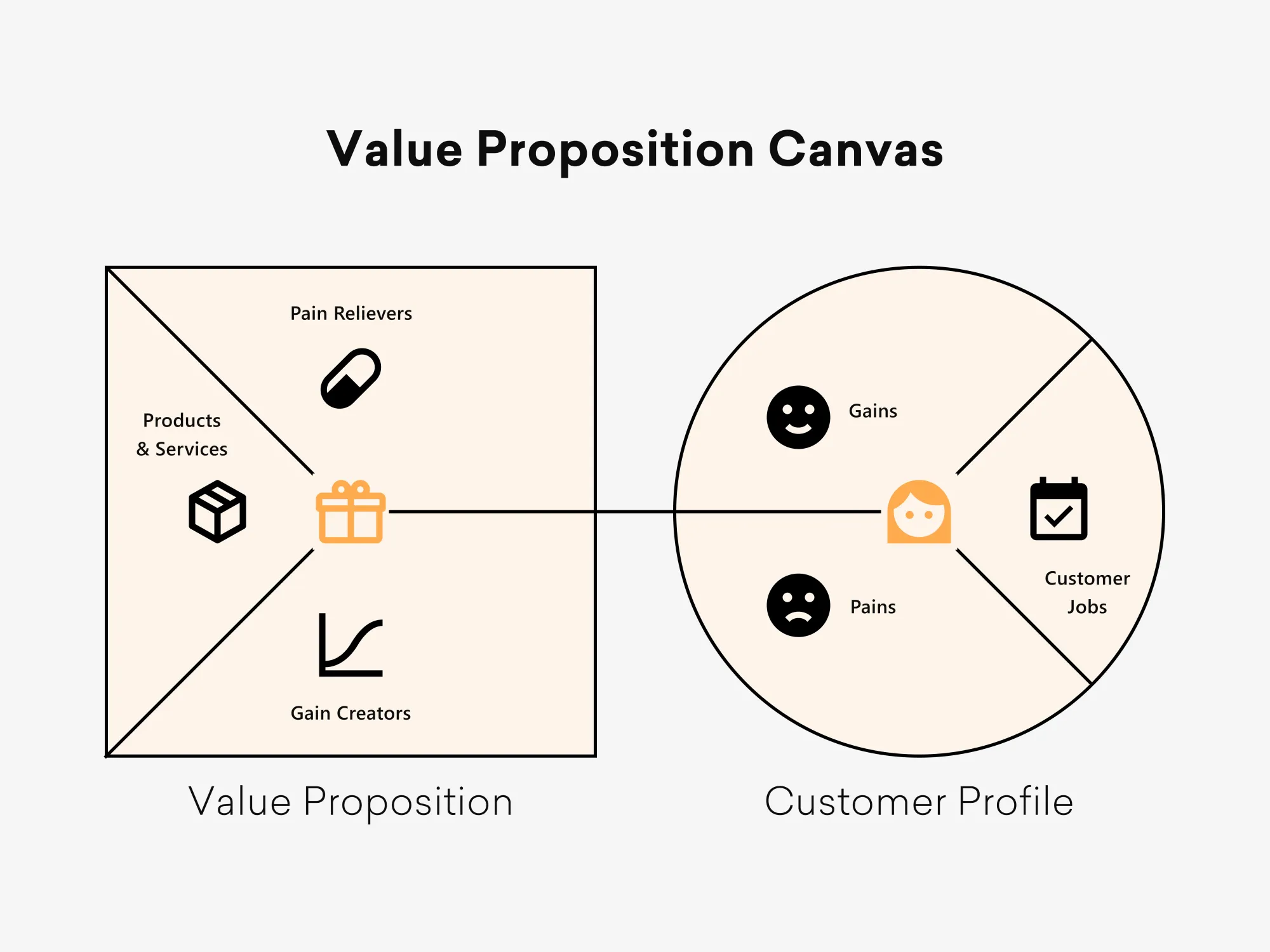
That question sits at the heart of your value proposition. It defines the problem you solve, the benefit you offer, and the reason someone should choose your product instead of an alternative.
A well-defined value proposition helps you focus the MVP on what matters most. It clarifies the pain points you address, the outcome users want, and the unique value your product brings to the market.
Only 22% of businesses are satisfied with their conversion rates. A well-defined value proposition can be the key to boosting these rates, by clearly communicating the unique value your product offers to the right audience.
Step 2: Identifying and understanding your target customer segment

The next step is to identify your ideal user, the person who stands to benefit the most from your product. That group becomes your target customer segment. For example, if your product helps people find tutors for kids, your target customer segment could be parents with school-going children.
The more clearly you understand this segment, the better you can shape the MVP around their real needs, behaviors, and expectations.
A strong understanding of the target customer segment improves product decisions, messaging, and prioritization from the start.
Step 3: Outlining the core features and functionality
This is where prioritization becomes critical. In MVP software development, you need to outline the core features and functionality that are essential to delivering the product’s primary value.
The goal is not to include everything users might want later. The goal is to identify the smallest feature set that allows the MVP to solve the intended problem clearly and effectively.
Here’s a simple table to guide you:
| Core Features | Functionality |
User Authentication | Allows users to create an account and log in |
Search Function | Lets users search for tutors based on various criteria |
Booking System | Enables users to book sessions with tutors |
Remember, the goal isn't to get in as many features as possible but to focus on the essentials that deliver the core value.
Step 4: Mapping out the user journey and experience
User experience is a critical part of any MVP. Mapping out the user journey helps ensure the product is easy to understand, easy to navigate, and aligned with what users are trying to achieve.
A clear journey also makes it easier to spot friction before launch. Follow these steps to map out the user journey:
- Start by identifying your user's goals.
- Outline the steps users need to take to achieve their goals.
- Identify potential pain points along the journey.
- Develop solutions to address these pain points.
Step 5: Establishing key metrics for measuring success
Lastly, you need a way to measure whether the MVP is actually working. The right metrics help you evaluate product effectiveness instead of relying on assumptions.
These metrics may include user engagement, customer satisfaction, activation, retention, or revenue. Choosing them early gives you a clearer way to judge performance and decide what should be improved next.
Companies that measure customer satisfaction are 33% more likely to describe themselves as successful than those who don’t.
Tips for Validating Your MVP Canvas
After you build your MVP Canvas, the next crucial step is validation. This is where you test whether your assumptions about the value proposition, target audience, and core product direction actually hold up in the real world.
Validation helps reduce the risk of investing further in a product that may not resonate with the market. It gives you practical signals about what works, what needs refinement, and what may need to change before you scale.
Let’s look at some effective ways to validate your MVP.
Conducting user interviews and feedback sessions
User feedback is one of the most valuable inputs in MVP validation. It helps you understand how people perceive the product, where they get confused, and what they actually find useful.
Build Lean. Learn Fast.
Launch an MVP that saves money while proving your concept works.
Well-run interviews and feedback sessions can reveal whether the MVP is solving the intended problem or simply reflecting internal assumptions. That clarity is essential before moving forward with more development. Consider a company like Slack; before becoming the popular team collaboration software we know today, it was a gaming company called Tiny Speck.
However, Tiny Speck's game didn't gain traction. Still, they noticed their internal tool for team communication was highly appreciated, leading to the pivot towards building Slack. They recognized the value of user feedback, which turned out to be a game-changer.
A/B Testing & Other Validation Techniques
A/B testing is another useful method for validating an MVP. It allows you to compare two versions of a webpage, product flow, or experience to see which one performs better.
For example, you might test two landing pages to understand which version drives more conversions. Combined with other validation methods, A/B testing helps you make sharper product decisions based on behavior rather than preference.
| Method | What it Does |
A/B Testing | Compares two versions of a web page or app |
Usability Testing | Tests how easy your product is to use |
Heatmap Analysis | Tracks user behavior on your webpage or app |
Each method provides a different perspective, helping you make your product as compelling as possible.
Making data-driven decisions and iterating based on results
When validating an MVP, data should guide the next move. It helps you understand whether the product is gaining traction, where users are dropping off, and which areas need improvement.
Data-driven decisions make iteration more effective because changes are tied to actual user behavior. That makes the MVP stronger with each round of refinement.
Here's a simple process for making data-driven decisions:
- Start by defining your key metrics. This could include metrics like conversion rate, user engagement, and churn rate.
- Next, measure these metrics using tools like Google Analytics or other data tracking tools.
- Analyze your data to gain insights into how your product is performing and where improvements can be made.
- Based on your analysis, make necessary adjustments to your product.
- Finally, measure the impact of these changes and continue to iterate based on results.
By following these tips, you'll be able to validate your MVP effectively. Remember, the ultimate goal is to build your MVP in a way that fulfills the needs of your target audience. And to do that, validating your assumptions is key. Good luck!
Common Mistakes to Avoid When Creating an MVP Canvas
Building an MVP comes with uncertainty, but some mistakes create avoidable setbacks from the beginning.
The most common issues usually come from weak prioritization, poor validation, unclear targeting, or a lack of focus on the product’s core value. Avoiding these mistakes helps preserve time, budget, and momentum during the earliest stage of product development.
Let’s look at the common pitfalls and how to avoid them.
| Common Mistake | Why it's a Problem | How to Avoid It |
Ignoring user feedback | Feedback is crucial for refining your MVP. Ignoring it could lead you to build something no one wants. | Regularly seek user feedback and implement it |
Including too many features | An MVP should be minimal. Too many features can distract from the core value proposition | Focus on features that directly deliver your value proposition |
Neglecting the user experience | A poor user experience can deter people from using your product | Work with an MVP development company or agency to ensure a smooth user experience |
Targeting the wrong audience | If you're not clear on who your product is for, it could end up appealing to no one | Conduct market research to define your target audience |
Lack of clear value proposition | Without a clear value proposition, users won't understand why they should choose your product | Define what makes your product unique and communicate it clearly |
Ignoring key metrics | Without tracking key metrics, you won't know how your product is performing | Identify your key metrics and monitor them closely |
Not validating the MVP | Failing to validate your MVP could lead to investing more in a product that won't resonate with the market | Use techniques like A/B testing, user interviews, and data analysis for validation |
Final Thoughts
Building a successful MVP takes more than a promising idea. It requires clear thinking, disciplined prioritization, and a structured way to test whether the product truly solves a meaningful problem.
That process can feel challenging, especially for first-time founders. But a well-built MVP Canvas gives you a practical starting point. It helps you clarify what to build, who to build it for, and how to measure whether it is working.
If you want expert support while planning and validating your product direction, partnering with an experienced MVP development team can make the process more focused and efficient.
Build your MVP with clarity, validate it early, and give your startup a stronger foundation for growth.

Murtuza Kutub
A product development and growth expert, helping founders and startups build and grow their products at lightning speed with a track record of success. Apart from work, I love to Network & Travel.