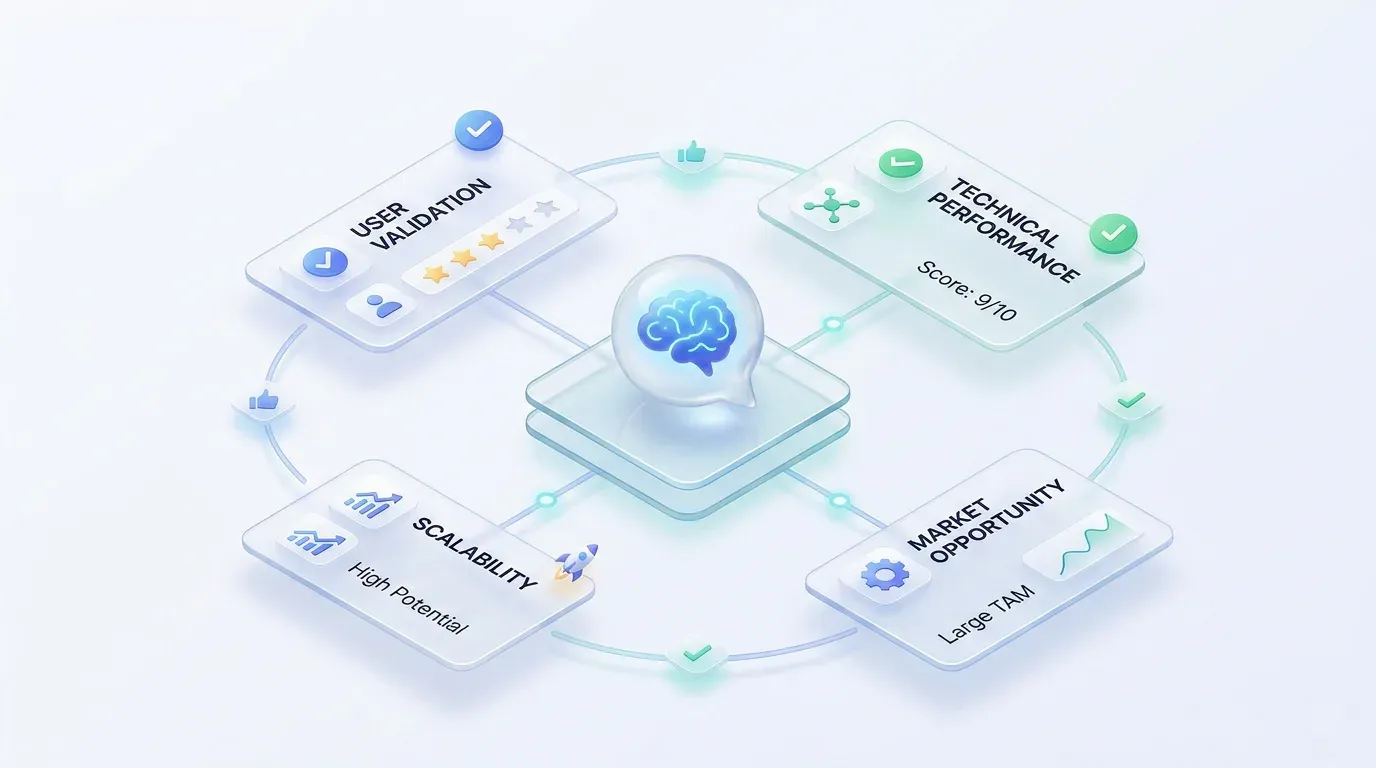
- Investors don't just want a working demo, they want proof the model performs on real data, in real conditions, not just curated examples.
- Key signals: a clear problem (not "AI for X"), measurable accuracy/output quality, low dependency on manual correction behind the scenes, and a real cost-to-scale estimate.
- A defensible data advantage matters more than the model itself, if any competitor could get the same results with the same public data, the product isn't defensible.
- Red flags: vague problem scope, demos that only work on perfect inputs, heavy manual workarounds, and no MVP roadmap after the PoC.
- Early validation (pilot interest, waitlist signups, a customer willing to pay) makes the PoC far more credible than technical polish alone.
Investors are not just looking for an AI idea that sounds exciting. They want to understand whether the startup is solving a real problem, whether the market is clear, and whether the product can become a scalable business.
For AI startups, this proof matters even more. A working AI PoC can show that the idea is technically possible, the data is usable, and the core workflow can deliver reliable results. It gives investors something more concrete than a pitch deck or product vision.
In this article, we’ll break down the key things investors look for in an AI PoC before funding a startup, from problem clarity and output quality to data advantage, scalability, and the path from PoC to MVP.
Why Investors Care About an AI PoC Before Funding
Investors care about an AI PoC because it reduces uncertainty. Instead of judging only the idea, they can see whether the product can actually work with real data, real workflows, and realistic constraints.
For AI startups, this matters because the biggest risk is often not the idea itself. It is whether the model can produce reliable outputs, whether the data is strong enough, and whether the product can solve the problem better than existing tools.
A good AI PoC gives investors early proof. It shows that the founder has tested the riskiest part of the product, understands the technical limits, and has a clearer path toward building an MVP or production-ready solution.
10 Things Investors Look for in an AI PoC
1. A Clear Business Problem
The first thing investors look for is whether the AI PoC solves a real business problem. A vague idea like “AI for hiring” or “AI for customer support” is not enough. The PoC should clearly show who the problem affects, why it matters, and what becomes faster, cheaper, or better when AI is used.
For example, instead of saying the product uses AI for sales teams, a stronger PoC would show how it helps sales reps qualify leads faster, summarize calls, update CRM fields, or identify high-intent prospects. The clearer the problem, the easier it is for investors to understand the value of the product.
2. Proof That the AI Actually Works
Investors want to see that the AI can do the core task it promises. The PoC does not need to be perfect, but it should show that the model, agent, or workflow can produce useful results in real conditions.
For example, if the startup is building an AI document processing tool, the PoC should show that it can extract the right fields from sample documents with reasonable accuracy. If it is an AI agent, it should show that the agent can complete a specific workflow, not just generate a response.
This proof helps investors understand that the product is not just an AI wrapper or a demo. It shows that the startup has tested the hardest part of the idea and knows what needs to improve next.
3. Clean and Usable Data
Investors know that AI products depend heavily on the quality of the data behind them. If the data is messy, limited, outdated, or difficult to access, the PoC may work in a controlled demo but fail when the product is built for real users.
A strong AI PoC should show that the startup has access to relevant data and can use it properly. This could include customer conversations, documents, transactions, product data, workflows, or internal knowledge bases.
Clean and usable data gives investors more confidence because it shows that the startup is not only building with AI, but also has the right foundation to improve accuracy, personalize outputs, and scale the product over time.
4. Measurable Accuracy or Output Quality
Investors want to see how well the AI performs, not just that it produces an output. The PoC should include measurable results such as accuracy, response quality, error rate, completion rate, or the percentage of outputs that need human review.
For example, if the PoC is built for invoice processing, investors may look at how many fields the AI extracts correctly. If it is a customer support assistant, they may look at answer quality, hallucination rate, and how often a human needs to step in.
Clear performance metrics make the PoC easier to trust. They also show that the founder understands the limits of the AI system and has a realistic plan to improve it before moving into MVP or production.
5. Real Workflow Impact
Investors want to know whether the AI PoC improves an actual workflow, not just whether it looks impressive in a demo. The PoC should show what changes for the user or business when the AI is introduced.

Walk away with actionable insights on AI adoption.
Limited seats available!

For example, does it reduce manual review time? Does it help a team complete tasks faster? Does it improve response quality, reduce errors, or remove repetitive work from the process?
A strong PoC connects the AI output to a clear workflow result. This helps investors see that the product is not just technically interesting but also useful enough for customers to adopt and pay for.
6. A Strong Data Advantage
Investors also look at whether the startup has a data advantage that can make the product harder to copy. If any company can connect the same model to the same public data and get similar results, the product may not feel defensible enough.
A strong AI PoC should show how the startup’s data improves the product. This could come from proprietary customer data, industry-specific datasets, user feedback loops, workflow history, or internal knowledge that becomes more valuable over time.
This matters because a good AI startup should not depend only on the model. The real advantage often comes from the data, context, and learning loop built around the product.
7. Low Dependency on Manual Work
Investors want to know how much of the workflow is actually handled by AI and how much still depends on people behind the scenes. If the PoC only works because a team is manually correcting outputs, preparing every input, or completing the final steps, it may not be scalable.
A strong AI PoC should show that the system can handle a meaningful part of the workflow on its own. Human review is fine in the early stage, especially for sensitive use cases, but it should not be the reason the product works.
Lower manual dependency gives investors more confidence that the startup can scale without increasing operational costs at the same pace.
8. Clear Cost to Scale
Investors want to understand what happens to the cost when the product moves beyond the PoC. An AI workflow may look good in a small test, but if model usage, infrastructure, human review, or integration costs become too high at scale, the business may be difficult to sustain.
A strong AI PoC should give a rough view of cost per task, cost per user, or cost per workflow. For example, if an AI agent handles customer support tickets, investors may want to know how much it costs to resolve each ticket compared to a human-led process.
Clear scaling costs show that the founder is thinking beyond the demo. It helps investors judge whether the AI product can grow without margins getting worse over time.
9. A Practical MVP Roadmap
Investors want to see what happens after the AI PoC works. A PoC proves the core idea, but the MVP roadmap shows how that idea can become a usable product for real customers.
A strong roadmap should explain the next features to build, the data improvements needed, the integrations required, and the estimated timeline for moving from PoC to MVP. It should also show what will be tested with early users and what success will look like.
This helps investors understand that the founder is not stopping at a demo. They have a clear plan to turn the PoC into a product that can be launched, tested, and scaled.
10. Early User or Customer Validation
Investors want to see that someone outside the founding team finds the AI PoC useful. Even a small signal from real users, pilot customers, internal teams, or design partners can make the PoC more credible.
This validation could be feedback from early users, letters of intent, pilot interest, waitlist signups, usage during a trial, or a customer saying they would pay if the product solved the problem well.
Early validation shows that the startup is not building AI in isolation. It proves there is real interest in the problem and gives investors more confidence that the PoC can turn into a product people actually want.
Common Red Flags Investors Notice in AI PoCs
Even if an AI PoC works in a demo, investors will look for signs that the idea may be hard to scale, hard to defend, or too risky to fund.
The Problem Is Too Broad
A PoC that tries to solve a large problem like “AI for sales” or “AI for healthcare” can feel unclear. Investors prefer focused use cases where the target user, workflow, and business value are easy to understand.
The Demo Works Only in Perfect Conditions
If the PoC works only with clean inputs, selected examples, or controlled test cases, investors may question how it will perform in real-world situations. A strong PoC should also show how it handles messy data, edge cases, and failures.
Too Much Manual Work Behind the Scenes
If humans are correcting most outputs, preparing every input, or completing the workflow manually, the AI may not be doing enough. This raises concerns about scalability and operating costs.
No Clear Data Advantage
If the product only uses generic models and generic data, investors may wonder what makes it hard to copy. A weak data strategy can make the startup look less defensible.
No Plan After the PoC
A PoC without a clear MVP roadmap can feel incomplete. Investors want to know what will be built next, how much it may cost, and how the startup plans to turn the PoC into a real product.
Walk away with actionable insights on AI adoption.
Limited seats available!
How F22 Labs Helps Startups Build Investor-Ready AI PoCs
At F22 Labs, we help startups turn early AI ideas into focused PoCs that are easier to validate, explain, and present to investors. Having worked on 50+ AI PoCs, we help founders test the right use case, measure output quality, and define the next step toward MVP development.
Our goal is to reduce technical uncertainty, avoid overbuilding, and help founders enter fundraising conversations with stronger proof, clearer metrics, and a practical product roadmap.
Conclusion
An AI PoC can make a fundraising conversation stronger because it gives investors something real to evaluate. It shows whether the idea works, whether the data is usable, and whether the product has a clear path beyond the demo.
The strongest AI PoCs do more than prove technical feasibility. They connect the AI output to a real business problem, measurable workflow impact, and a practical MVP roadmap.
For founders, the goal is simple: use the PoC to reduce doubt, show proof, and help investors understand why the startup is worth funding.
Frequently Asked Questions
Do investors expect AI startups to have a PoC?
Not always, but a working AI PoC can make the pitch stronger. It gives investors proof that the idea is technically possible and worth exploring further.
What should an AI PoC prove before fundraising?
An AI PoC should prove the core use case, data readiness, output quality, workflow impact, and whether the idea can move toward an MVP.
Is an AI PoC enough to raise funding?
It can help, especially at an early stage. But investors may also look at the team, market size, customer interest, business model, and MVP roadmap.
What metrics should an AI PoC include?
Useful metrics include accuracy, response quality, error rate, time saved, cost per task, workflow completion rate, and the amount of human review needed.
Should founders build an AI PoC or MVP before pitching investors?
Build an AI PoC first if the biggest risk is technical feasibility. Build an MVP if the core AI workflow is already validated and you need user traction.
What makes an AI PoC look weak to investors?
A weak AI PoC usually has a vague problem, poor data quality, no clear metrics, too much manual work, or no plan for turning it into an MVP.
How can startups make an AI PoC more investor-ready?
Startups can make an AI PoC investor-ready by focusing on one clear use case, testing real data, tracking measurable results, and preparing a practical MVP roadmap.

Walk away with actionable insights on AI adoption.
Limited seats available!