12 Technical Recruitment Tips to Hire the Best Developer
Most technical hiring processes are built around what is easy to measure: years of experience, educational credentials, algorithm test scores, rather than what actually determines whether a developer will perform well in a specific environment, on a specific stack, with a specific team.
The consequence is predictable. Candidates who meet every requirement on paper underperform in practice. Hiring cycles stretch long enough for strong candidates to accept offers elsewhere. And the same mistakes repeat across hiring rounds because the process itself was never the focus.
Technical recruitment is not inherently difficult; it is poorly structured in most organizations. A well-designed process consistently surfaces strong candidates, evaluates them accurately, and converts them into hires before the competition does.
This guide covers 12 technical recruitment tips that build exactly that. Let's get into it.
12 Technical Recruitment Tips to Hire the Best Developer
1. Define the Role Around Outcomes, Not Technologies
A job description built around a list of technologies tells candidates what tools to know. It says nothing about what they will build, what problems they will own, or what success looks like in the role.
Before writing a job post, define what the developer needs to accomplish in the first 90 days. What gets delivered? What decisions will they be responsible for? What does strong performance look like at the six-month mark?
Outcome-driven job descriptions attract candidates motivated by the work itself, and give the hiring team a clear benchmark to evaluate against throughout the process.
2. Remove Degree Requirements From the Screening Criteria
A significant portion of high-performing developers working today are self-taught, bootcamp-trained, or transitioned from adjacent fields without a formal computer science background. Using degree requirements as a filter does not screen for technical ability; it screens out candidates who may be better qualified than those who pass it.
Skills-based evaluation is a more accurate and more inclusive approach. What matters is what a developer can demonstrate, not where they studied. A candidate who filled out a basic resume template but shipped three production features tells you more than a polished CV backed by nothing verifiable.
Nearly 30% of tech job postings have already moved in this direction, and the quality of candidates surfaced consistently reflects that shift.
3. Source Proactively Rather Than Relying on Inbound Applications
A recruitment strategy that depends entirely on job board applications reaches a limited and often unrepresentative segment of the developer talent pool. The majority of strong candidates are currently employed and not actively searching; they respond to direct outreach, not job postings.
Proactive sourcing channels produce consistently better results: GitHub repositories allow direct assessment of code quality before any conversation begins; developer communities, forums, and professional groups reach candidates who are engaged and current in their field.
Employee referral programs generate high-quality introductions through trusted networks. Building a consistent sourcing practice is more effective than optimizing job post visibility.
4. Include AI Literacy as a Core Technical Criterion
AI-generated code now accounts for approximately 30% of developer output in 2026. This changes the competency profile of a strong developer hire.
The ability to write code independently remains important, but so does the ability to review AI-generated output critically, identify logic errors in generated code, prompt effectively, and integrate AI tooling into a maintainable workflow.
Developers who cannot evaluate AI output with rigor are a risk on any modern engineering team. AI literacy should appear explicitly in technical screening criteria and be assessed as part of the interview process.
5. Replace Algorithm Tests With Real-World Technical Assessments
Algorithm-based interview questions measure familiarity with a specific category of problem, not the ability to perform the actual job. A candidate who has prepared extensively for these tests will score higher than a more capable developer who has not, which produces an unreliable hiring signal.
Partner with Us for Success
Experience seamless collaboration and exceptional results.
More effective assessments involve tasks that reflect genuine job responsibilities: building a component from a specification, integrating an API and handling edge cases, debugging a failing function, or reviewing a pull request and providing substantive feedback. These tasks evaluate the same competencies the role requires and produce more accurate, comparable results across candidates.
6. Structure the Hiring Process Into Distinct, Time-Bounded Stages
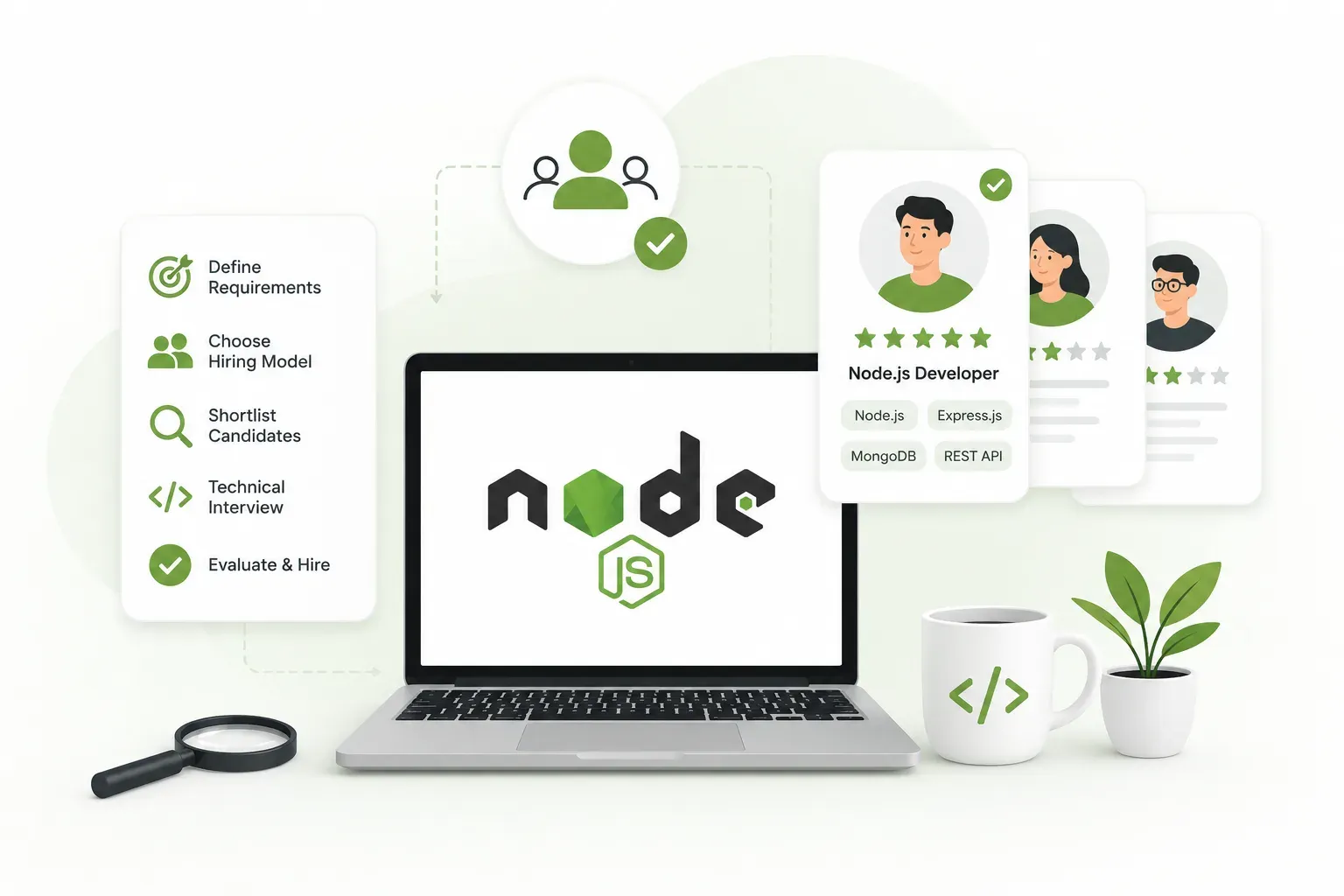
An unstructured hiring process wastes time on both sides and consistently loses strong candidates who accept offers elsewhere while waiting for the next steps. A well-structured technical recruitment process includes four defined stages:
Stage 1 — Portfolio and work review: Evaluate live projects, code contributions, and demonstrated output. Listed skills on a resume carry significantly less weight than evidence of actual delivery.
Stage 2 — Asynchronous technical screen (30–45 minutes): A focused, real-world task that confirms core technical competency without requiring extensive time from either party.
Stage 3 — Technical interview (45 minutes): One substantive problem with follow-up questions. Sufficient to assess technical depth, reasoning process, and communication clarity.
Stage 4 — Behavioral and cultural fit assessment (30 minutes): How the candidate handles ambiguity, communicates when blocked, approaches collaboration, and aligns with the team's working norms.
Each stage has a clear purpose, a defined time investment, and a specific evaluation output.
7. Calibrate the Interview Panel Before Evaluating Candidates
When interviewers apply different standards to the same evaluation criteria, the resulting scores are inconsistent and unreliable. One interviewer's definition of a strong technical response may differ significantly from another's, and hiring decisions based on misaligned scores produce inconsistent outcomes.
Before beginning a hiring cycle, conduct a calibration session with all panel members. Use anonymized examples from past candidates to align on what strong, adequate, and insufficient performance looks like for each evaluation dimension. Calibrated panels make faster decisions, more consistent offers, and fewer hiring reversals.
8. Reduce Time Between Hiring Stages
A delay of more than five business days between stages is sufficient for a strong candidate with competing offers to exit the process. Developer hiring is competitive, and companies that move decisively have a structural advantage over those with long internal decision cycles.
Reserve standing weekly interview slots so scheduling is not a bottleneck. Communicate evaluation outcomes within 24 hours of each stage. Provide clear status updates throughout. Candidates who do not hear from a hiring team within a reasonable window typically assume a negative outcome and move on.
9. Evaluate Technical Communication Alongside Technical Output
The quality of a developer's output is one dimension of a strong hire. Equally important, particularly in leaner teams, is the ability to communicate technical reasoning clearly, articulate trade-offs to non-technical stakeholders, ask precise clarifying questions before beginning work, and surface blockers without delay.
During technical interviews, observe how candidates explain their thinking as much as what they produce. A developer who reaches a correct solution but cannot explain the reasoning behind it, or who proceeds on flawed assumptions without asking questions, creates friction that affects the entire team. Technical communication should be evaluated as a deliberate criterion, not as a secondary observation.
10. Use Paid Trial Engagements for Senior or Long-Term Roles
For senior positions or engagements expected to extend beyond several months, a short paid trial task provides evaluation data that no interview process reliably captures. Assign a scoped, realistic piece of work, a small feature, a technical audit, or a single integration with a clear brief and fair compensation.
Assess the process as rigorously as the output: Did the candidate ask precise, clarifying questions before beginning? Did they communicate progress at appropriate intervals? Did they meet the agreed timeline?
Did the final code reflect sound judgment in addition to technical correctness? These behavioral signals at the small scale are consistent predictors of performance at the full engagement scale.
11. Prioritize Learning Velocity Over Current Stack Expertise
The technical landscape evolves faster than hiring cycles can track. Deep expertise in a specific framework is an asset today and may be less relevant within two to three years.
Developers who acquire new skills quickly, adapt to unfamiliar codebases efficiently, and apply sound engineering judgment across changing contexts deliver compounding value over time.
During the evaluation process, assess how candidates approach unfamiliar problems, not just problems they have solved before. Ask about technologies they have learned independently and how they approached that process.
Candidates who demonstrate intellectual curiosity and a structured approach to learning are consistently stronger long-term hires than those whose expertise is deep but narrow.
12. Present a Specific and Credible Employer Value Proposition
Senior developers evaluate a potential employer with the same rigor that employers apply to candidates. Generic statements about company culture and competitive compensation are insufficient; experienced candidates encounter these at every stage of a job search and discount them accordingly.
Be precise about what the role offers: the technical problems the developer will work on, the degree of ownership and autonomy they will have, the composition and caliber of the team they will join, and the realistic trajectory for professional growth.
Partner with Us for Success
Experience seamless collaboration and exceptional results.
Specificity signals organizational clarity and builds candidate confidence in ways that broad employer branding does not.
Technical Recruitment Process Summary
| Stage | Primary Focus | Recommended Duration |
Portfolio Review | Demonstrated output, live projects | 15–20 minutes |
Async Technical Screen | Core competency, real-world task | 30–45 minutes |
Technical Interview | Technical depth, reasoning, and communication | 45 minutes |
Behavioral Assessment | Collaboration, adaptability, culture fit | 30 minutes |
Paid Trial (senior roles) | Real output, process, and reliability | 2–3 days |
Recruitment Mistakes That Consistently Undermine Hiring Quality
Filtering on degree credentials — eliminates qualified candidates before any competency assessment occurs.
Relying exclusively on algorithm tests — measures test preparation, not job performance.
Extended timelines between stages — gaps exceeding five business days increase candidate drop-off significantly in competitive markets.
Underweighting communication skills — a technically proficient developer who communicates poorly creates coordination problems that compound over time.
Hiring for current stack depth over adaptability — in a rapidly evolving technical landscape, learning velocity is a more reliable long-term predictor than current specialization.
Frequently Asked Questions
What are the most effective technical recruitment tips for hiring developers?
Define roles around outcomes rather than technology lists, use skills-based screening over degree filters, source candidates proactively from developer communities and repositories, assess with real-world tasks, and maintain a fast, structured pipeline to minimize candidate drop-off.
How should technical skills be assessed without algorithm-based tests?
Assign real, paid tasks that reflect actual job responsibilities, a component build, a debugging exercise, or a pull request review. These assessments produce more accurate and comparable evaluation data than abstract problem-solving exercises.
Why is AI literacy important in developer hiring in 2026?
AI-generated code accounts for approximately 30% of developer output. The ability to review, validate, and integrate AI-generated code is now a functional job requirement across most engineering roles, not an optional skill.
What is the ideal length of a technical hiring process?
Seven to ten business days from initial contact to offer is a competitive target. Delays beyond five days between stages carry a meaningful risk of losing strong candidates to faster-moving organizations.
How can smaller companies compete for developer talent against larger organizations?
By offering specificity and clarity. Developers value technical challenge, ownership, and defined growth opportunities as heavily as compensation. A precise, credible value proposition consistently outperforms generic employer branding in attracting candidates who are the right long-term fit.