How to Scale a Software Development Team: A Practical Guide for 2026
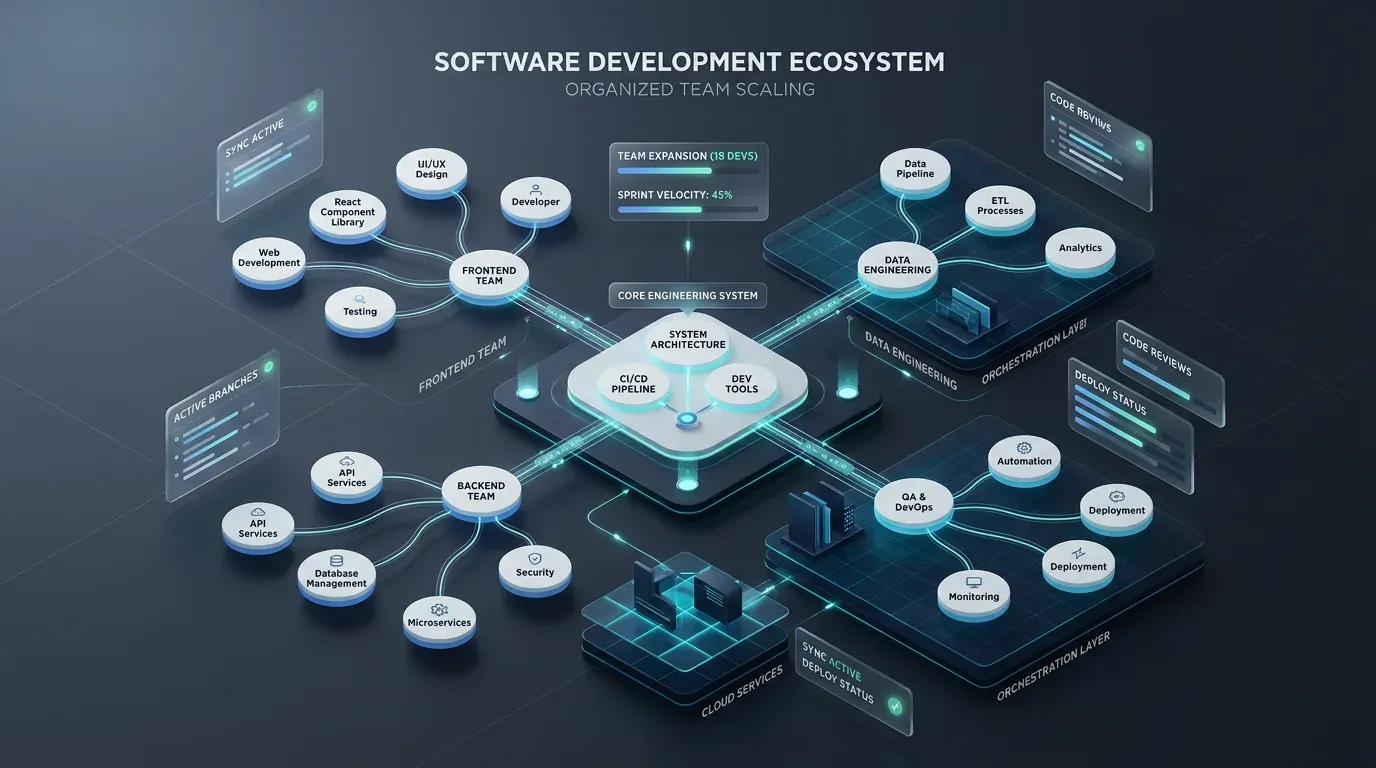
Most engineering teams don't fail because they lack talent. They fail because they scaled at the wrong time, in the wrong direction, without a clear structure to support the growth. Adding engineers to a broken process doesn't fix the process; it amplifies the problem.
Scaling a software development team is one of the most consequential decisions a technology company makes. Get it right, and you ship faster, maintain quality, and build a team that compounds over time. Get it wrong, and you accumulate technical debt, erode culture, and end up with a team that moves more slowly at 20 people than it did at 6.
This guide covers the full picture: when to scale, how to scale, what breaks when you do it wrong, and how to build a team structure that holds under growth. Let's dive in.
How Do You Know It's Time to Scale?
Scaling before you're ready is as dangerous as scaling too late. These are the clearest signals that your team has hit a genuine capacity ceiling, not just a temporary crunch:
Consistent sprint overflow
When your team carries a significant backlog into every sprint, and this pattern holds for 8–12 weeks, it's a structural capacity issue, not a planning issue.
Delivery timelines are lengthening
If features that used to take two weeks now take six, and the cause isn't complexity, it's queue depth, that's a scaling signal.
Your best engineers are doing triage, not building
Senior engineers spending more than 30% of their time on support, hotfixes, or unblocking junior teammates signals a staffing imbalance, not just a skills gap.
Product decisions are blocked by engineering availability
When your product roadmap is being compressed because engineering can't keep up, the cost of not scaling has become visible to the business.
Key-person dependencies are everywhere
If more than two critical systems are understood by only one engineer, the team is too thin for the complexity it's managing.
Three Paths to Scale Your Dev Team
There is no single right way to scale. The right path depends on your timeline, budget, and what you're scaling for.
1. Full-Time In-House Hiring
The highest-quality, highest-cost, slowest path. Building an in-house team is the right move when you're hiring for core product roles, people who will own critical systems for years, contribute to technical architecture, and represent your engineering culture.
The average time-to-hire for a senior software engineer in the US is 45–90 days. Factor in onboarding and ramp time, and in-house hiring is a 3–6 month investment before you see meaningful output from a new engineer.
Best for: Core long-term roles, engineering leadership, systems requiring deep product context.
2. Staff Augmentation
You bring in external engineers, typically through a staffing partner, to fill specific roles within your existing team.
They work inside your workflows, tools, and sprints. Staff augmentation is faster than full-time hiring (typically 1–3 weeks to onboard) and gives you flexibility to scale up and down without the overhead of permanent headcount.
Best for: Filling skill gaps quickly, covering a short-to-medium term capacity surge, adding specialists your team doesn't have permanently.
3. Dedicated Offshore or Remote Team
A group of engineers, typically in a lower-cost market like India, Eastern Europe, or Southeast Asia, assigned exclusively to your product under your direction. This model can deliver 60–70% cost savings versus equivalent US hiring, and skilled offshore teams can be assembled in 2–4 weeks. The key is treating this as an integrated team, not an outsourced unit; they work in your standups, follow your coding standards, and own their product areas.
Best for: Scaling cost-effectively, building a parallel engineering capability, executing long-term product development without US-level overhead.
Partner with Us for Success
Experience seamless collaboration and exceptional results.
How to Scale by Company Stage
The right scaling approach changes significantly depending on where your company is.
Pre-Seed / Seed Stage (Team of 1–5 Engineers)
At this stage, your priority is speed and learning, not scale. Keep the team as small as possible for as long as possible. Every person you add increases communication overhead exponentially. A 3-person team has 3 communication channels. A 7-person team has 21.
Use contractors and staff augmentation to handle specific deliverables; don't build full-time headcount until your product-market fit signal is clear. The expensive mistake at this stage is hiring full-time engineers based on a roadmap that will change.
Series A (Team of 5–20 Engineers)
This is where most scaling challenges originate. You've validated the product, raised capital, and now need to move fast. The temptation is to hire aggressively across every function simultaneously. Companies that hire developers too early across multiple teams often create coordination issues. The smarter approach is to scale in structured waves.
Define your team topology first. Most Series A products are well-served by 2–3 cross-functional squads of 4–6 engineers each, organized around product areas , not technical layers. Each squad owns a vertical from front-end to database, with a clear product owner and a senior engineer as technical lead.
At this stage, offshore or remote teams work well as a second squad or as specialists embedded in an existing squad. The cost efficiency creates more runway while maintaining output.
Series B and Beyond (Team of 20+ Engineers)
Scaling past 20 engineers requires deliberate structure. Communication that worked informally breaks down. Ownership becomes ambiguous. The critical investments at this stage are:
A platform team that owns internal tooling, CI/CD pipelines, infrastructure, and developer experience, freeing product squads from operational overhead.
A clear technical leadership layer, engineering managers who focus on people and process, with staff engineers who focus on architecture and technical standards.
Documented engineering processes, code review standards, incident response protocols, and onboarding playbooks. What your founding engineers knew implicitly must be written down as the team grows.
Team Size and Structure Benchmarks
Sizing and structuring teams correctly prevents the organizational drag that slows most scaling efforts.
| Team Size | Recommended Structure | Max Parallel Streams |
1–5 engineers | Single team, flat | 1–2 |
6–12 engineers | 2 squads, shared lead | 2–3 |
13–25 engineers | 3–4 squads + platform | 3–5 |
25–50 engineers | Squads + platform + enablement | 5–8 |
Amazon's "two-pizza rule", no team larger than can be fed by two pizzas, exists for a reason. Teams of 5–8 engineers maintain communication density, decision speed, and accountability in ways that larger groups cannot.
What Breaks When You Scale Too Fast
Scaling without the right foundations creates problems that compound. These are the most common failure modes:
Technical debt accelerates
New engineers adding code to an undocumented codebase with no review standards will create more problems than they solve. Before you scale, invest in code documentation, testing coverage, and review processes.
Onboarding becomes a bottleneck
If it takes a new engineer 6–8 weeks to become productive, and you're hiring 4 engineers in a quarter, your senior team spends most of that quarter mentoring rather than building. Build a structured onboarding process with clear milestones before you scale hiring.
Communication overhead compounds
Every engineer you add increases the number of communication paths in the team. Without clear async communication norms, meeting culture expands to fill the gap. Define your tools, async-first defaults, and documentation standards before headcount grows.
Ownership becomes unclear
As teams grow, who owns what becomes ambiguous. Systems that everyone can touch are systems no one is accountable for. Define ownership boundaries, both at the team level and the individual engineer level, as part of your scaling plan.
The Process Infrastructure You Need Before You Scale
Scaling without this infrastructure produces teams that are larger but not faster:
Version control and branching strategy
Every engineer needs to work from the same playbook. Git Flow or trunk-based development , both work, but everyone must follow the same model.
CI/CD pipeline
Automated testing and deployment is table stakes before you scale. Manual release processes break under volume.
Incident and on-call management
Define who gets paged, how escalation works, and what the SLA is for response and resolution before you have more than one team.
Sprint and backlog hygiene
Ungroomed backlogs become unmanageable at scale. A weekly backlog refinement session with a clear owner is not optional for 10+ engineers.
Partner with Us for Success
Experience seamless collaboration and exceptional results.
Async communication standards
Define what goes in Slack, what goes in Notion or Confluence, and what gets a ticket. Ambiguity here creates noise that drowns the signal as teams grow.
Common Mistakes When Scaling Dev Teams
Hiring for headcount rather than for gaps
Adding engineers without a clear role definition and ownership area creates redundancy and confusion. Every hire should close a specific, identified gap.
Scaling before stabilizing
If your current team is struggling with quality, delivery predictability, or ownership clarity, adding engineers makes those problems worse. Fix the process before you scale the people.
Treating offshore teams as a separate entity
Offshore or remote teams that are kept at arm's length from your core engineering culture consistently underperform. Integrated teams, same standups, same code reviews, same standards, consistently outperform arm's-length arrangements.
Promoting engineers into management without preparing them
Your best engineer is not automatically your best engineering manager. Management is a different discipline. Provide explicit training and mentoring before putting senior engineers in people management roles.
Scale Your Development Team with F22 Labs
F22 Labs builds dedicated development teams that integrate directly into your engineering org, your sprint cycles, your standards, and your culture.
Whether you need to add a specialized squad, fill a critical senior role, or build a parallel offshore team at 60–70% of US cost, we structure the engagement around your stage and your goals.
If your team is at a capacity ceiling and you need to scale fast without compromising quality, let's talk.
Frequently Asked Questions
When should a startup start scaling its development team?
Scale when you see consistent sprint overflow for 8–12 weeks, lengthening delivery timelines, or key-person dependencies becoming a business risk , not just when the roadmap is ambitious.
What is the fastest way to scale a software development team?
Staff augmentation or a dedicated offshore team. Both can onboard in 1–4 weeks versus 45–90 days for full-time hiring. Use these for capacity gaps; use in-house hiring for core long-term roles.
How large should a software development team be?
Most product squads function best at 5–8 engineers. Beyond that, communication overhead increases significantly. Scale by adding squads, not by expanding individual teams beyond 8–10 people.
What is staff augmentation in software development?
Bringing in external engineers to work inside your existing team, same tools, same sprints, same standards. Faster and more flexible than permanent hiring; best for filling specific skill gaps or short-to-medium term capacity needs.
How do you maintain quality when scaling a dev team quickly?
Invest in code review standards, automated testing coverage, and onboarding documentation before scaling. Quality degrades when new engineers enter codebases without clear standards, not simply because of team size.