Hotel Booking App Development Cost Guide
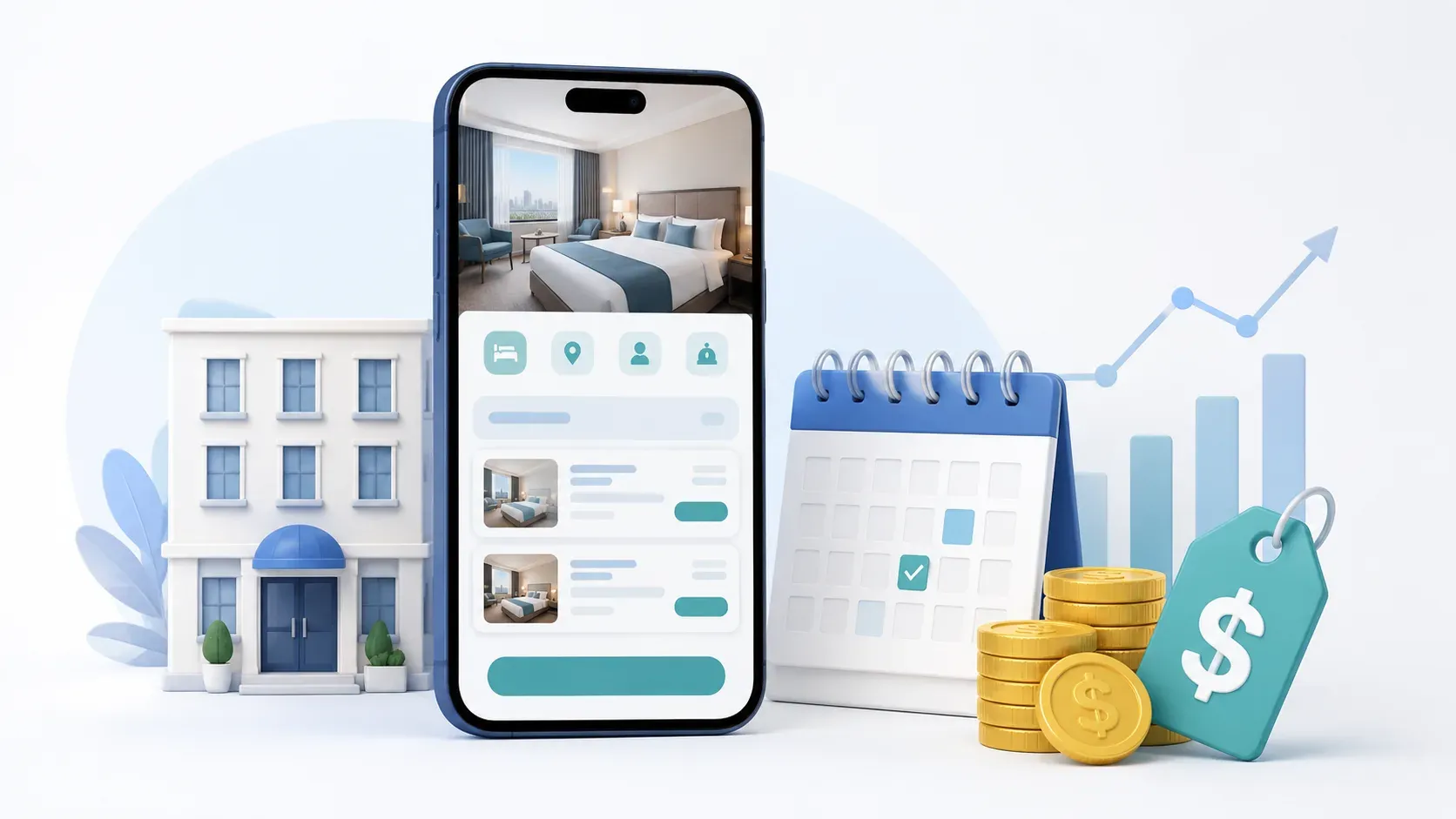
Online hotel bookings are now a major revenue channel for hotels, resorts, serviced apartments, and travel startups. The global online travel market is expected to reach $761.5 billion in 2026, showing how strongly travelers rely on digital platforms to book stays.
Hotel booking app development cost in 2026 usually starts from $10,000 to $20,000 for a lean MVP and can go beyond $100,000+ for a custom platform with real-time availability, payments, vendor dashboards, reviews, PMS integrations, and third-party integrations.
This guide breaks down hotel booking app development costs by app type, features, platform, timeline, hidden costs, and practical ways to reduce your budget.
How Much Does Hotel Booking App Development Cost?
Hotel booking app development cost in 2026 starts from $10,000 for a lean MVP and can go beyond $400,000+ for a full-scale marketplace. The difference comes down to complexity. A single-property app needs search, booking, payment, and admin features, while a marketplace needs vendor dashboards, commissions, multi-property management, and a backend built to scale.
These estimates are based on average hourly rates of $25–$50 for offshore teams and $80–$150 for US/EU teams, mapped against typical feature scopes we've seen across hotel booking projects.
| Hotel Booking App Type | Estimated Cost |
Lean MVP hotel booking app | $10,000–$20,000 |
Basic custom hotel booking app | $20,000–$40,000 |
Mid-level hotel booking app | $40,000–$80,000 |
Advanced hotel booking platform | $80,000–$150,000+ |
Booking.com-style marketplace | $150,000–$400,000+ |
The final cost depends on app features, platform, design, backend complexity, third-party integrations, and the development team's location.
Hotel Booking App Cost by App Type
Hotel booking app cost changes based on the type of product you want to build. A single-hotel app is usually cheaper because it has one booking flow, while a marketplace app needs hotel onboarding, vendor dashboards, reviews, commissions, and stronger backend systems.
| Hotel Booking App Type | Estimated Cost |
Single hotel booking app | $10,000–$40,000 |
Hotel chain booking app | $40,000–$100,000 |
Hotel booking marketplace | $80,000–$200,000+ |
Booking.com-style platform | $150,000–$400,000+ |
These ranges are estimates. The final cost depends on features, platforms, design complexity, backend architecture, PMS integrations, payment workflows, and the development team’s location.
Key Factors That Affect Hotel Booking App Development Cost
Hotel booking app development cost depends on how complex the product is, how many platforms you build for, and how many systems the app needs to connect with. A simple booking app costs less, while a custom platform with real-time availability, payments, dashboards, and integrations needs more development time.
| Cost Factor | How It Affects Cost |
App complexity | More user roles, booking flows, dashboards, and automation increase development cost. |
Platform choice | Building for Android, iOS, and web costs more than starting with one platform or cross-platform development. |
UI/UX design | Custom layouts, advanced filters, maps, and smooth booking flows require more design and testing time. |
Booking features | Room search, availability, pricing, cancellation, refunds, and booking history add backend complexity. |
Payment integration | Payment gateways, split payments, refunds, taxes, and invoices increase development and testing effort. |
Third-party integrations | PMS, channel managers, CRM, maps, SMS, email, and analytics tools can increase cost. |
Admin dashboard | Managing rooms, bookings, users, offers, payments, and reports requires a strong admin panel. |
Security and compliance | Secure payments, user data protection, access control, and transaction safety add extra development effort. |
Development team location | Hourly rates vary by region, which directly affects the final project cost. |
Maintenance needs | Bug fixes, updates, server costs, API changes, and new features continue after launch. |
For most hotel booking apps, the biggest cost drivers are real-time availability, payment workflows, admin dashboards, PMS integrations, and marketplace features. These areas need careful planning because they directly affect the booking experience and long-term scalability.
Hotel Booking App Cost by Features
The hotel booking app cost also depends on the features you add. Basic features help users search and book rooms, while advanced features like real-time availability, PMS integration, loyalty programs, and AI recommendations increase development time and cost.
| Feature Type | Features Included | Estimated Cost Impact |
Basic features | Login, hotel listings, room details, search, booking form, payment gateway, admin panel | $10,000–$30,000 |
Standard features | Reviews, filters, booking history, push notifications, coupons, cancellation flow | $30,000–$60,000 |
Advanced features | Real-time availability, dynamic pricing, loyalty program, analytics, multi-property dashboard | $60,000–$120,000+ |
Marketplace features | Vendor dashboard, hotel onboarding, commissions, payment splitting, multi-property management | $100,000–$250,000+ |
Enterprise features | PMS integration, channel manager integration, AI recommendations, CRM, custom reporting | $150,000–$400,000+ |
For a lean MVP, focus on the features that complete the booking journey: search, room details, availability, booking, payment, confirmation, and admin management. Features like AI recommendations, loyalty programs, vendor dashboards, and PMS integrations can be added after the core booking flow is validated.
Cost to Build a Hotel Booking App Like Booking.com
The cost to build a hotel booking app like Booking.com usually starts from $150,000 and can go beyond $400,000+, depending on the number of platforms, features, integrations, and scale.
A Booking.com-style platform costs more than a regular hotel booking app because it works like a marketplace. It needs hotel onboarding, vendor dashboards, advanced search, real-time room availability, reviews, commissions, payment handling, cancellation rules, offers, and a scalable backend.
| Platform Type | Estimated Cost |
Basic Booking.com-style MVP | $80,000–$150,000 |
Mid-level hotel marketplace | $150,000–$250,000 |
Advanced booking marketplace | $250,000–$400,000+ |
The cost can increase further if you add PMS integrations, channel manager integration, AI-based recommendations, loyalty programs, multi-currency payments, advanced analytics, or support for multiple countries.
Build Lean. Learn Fast.
Launch an MVP that saves money while proving your concept works.
Hotel Booking App Development Cost Breakdown
Hotel booking app development cost is usually split across planning, design, development, integrations, testing, and launch. Backend development and third-party integrations often take the largest share because hotel apps need secure bookings, payments, availability management, and admin controls.
| Development Stage | Estimated Cost Share | What It Includes |
Discovery and planning | 5–10% | Requirements, feature list, user roles, booking flow, technical scope |
UI/UX design | 10–15% | App screens, user journey, wireframes, booking flow design |
Frontend development | 20–25% | Customer app, web app, search screens, room pages, booking screens |
Backend development | 25–35% | Database, booking logic, availability, payments, admin panel, APIs |
Third-party integrations | 10–20% | Payment gateway, maps, PMS, CRM, email, SMS, analytics |
QA and testing | 10–15% | Functional testing, payment testing, booking flow testing, bug fixes |
Deployment and launch | 5–10% | App store setup, server setup, production release, monitoring |
For most hotel booking apps, the highest cost usually goes into backend development, integrations, and testing because these directly affect booking accuracy, payment reliability, and user experience.
Hidden Costs in Hotel Booking App Development
Hotel booking app development cost does not end with design and development. Some expenses appear during launch or after the app goes live, especially when the app depends on payments, APIs, cloud hosting, and regular updates.
| Hidden Cost | What It Includes |
Cloud hosting | Server, database, storage, CDN, backups, and scaling costs |
App store fees | Apple Developer Program and Google Play Console charges |
Payment gateway charges | Transaction fees, refund charges, currency conversion, and settlement fees |
Third-party API fees | Maps, SMS, email, analytics, CRM, PMS, and channel manager usage |
Maintenance and bug fixes | Fixing booking errors, payment issues, crashes, and performance problems |
Security updates | Data protection, access control, payment security, and vulnerability fixes |
Content management | Updating hotel details, room images, pricing, offers, and policies |
Customer support tools | Live chat, helpdesk, chatbot, ticketing, and guest communication tools |
Marketing setup | App analytics, tracking pixels, attribution tools, SEO pages, and campaigns |
Feature upgrades | Loyalty programs, AI recommendations, multi-currency support, and advanced reports |
These hidden costs are important to plan early because they affect the long-term budget. For most hotel booking apps, businesses should keep a separate budget for hosting, maintenance, API usage, and post-launch improvements.
Hotel Booking App Development Timeline
Hotel booking app development usually takes 3 to 9 months, depending on the app type, number of platforms, features, integrations, and testing needs. A lean MVP can be built faster, while a marketplace or Booking.com-style platform needs more time because of vendor dashboards, real-time availability, payment flows, and backend complexity.
| Hotel Booking App Type | Estimated Timeline |
Lean MVP hotel booking app | 3–4 months |
Basic custom hotel booking app | 4–5 months |
Mid-level hotel booking app | 5–7 months |
Advanced hotel booking platform | 7–9+ months |
Booking.com-style marketplace | 9–12+ months |
The timeline can increase if the app needs PMS integrations, channel manager integration, multi-currency payments, advanced search, loyalty programs, or AI-based recommendations.
How to Reduce Hotel Booking App Development Cost
You can reduce hotel booking app development cost by starting with a focused MVP. The first version should help users search, book, pay, and manage reservations without adding every advanced feature from day one.
Start With Core MVP Features
Focus on hotel listings, room details, search, availability, booking, payment, confirmation, and admin management. Add loyalty programs, AI recommendations, and analytics later.
Choose Cross-Platform Development
Cross-platform development helps you build one app for both iOS and Android. This reduces development time compared to building two separate native apps.
Use Ready-Made Integrations
Use existing tools for payments, maps, SMS, email, analytics, and chat instead of building everything from scratch. This can reduce both cost and launch time.
Limit Complex Integrations Early
PMS, channel manager, CRM, and multi-property automation can increase cost. Add them after the core booking flow is validated.
Keep the Booking Flow Simple
Start with search, room selection, booking details, payment, and confirmation. A simple booking journey is easier to build, test, and improve.
Plan the Backend Properly
A well-planned backend helps manage bookings, payments, users, admin controls, and future features without expensive rebuilds.
The best way to control cost is to launch the core booking experience first and add advanced features once users start booking through the app.
How F22 Labs Helps Build Hotel Booking Apps
F22 Labs has built booking apps for hotels, resorts, and travel startups, from single-property MVPs to multi-vendor marketplace platforms. Each project is different, but the common challenge is scoping the first release correctly: what to build, what to defer, and how to keep the budget in check without cutting features that matter to users.
Build Lean. Learn Fast.
Launch an MVP that saves money while proving your concept works.
If you want to see how we've approached similar builds, the case studies walk through the process in detail.
Conclusion
Hotel booking app development cost depends on the app type, features, platform, integrations, and backend complexity. A lean MVP can start from $10,000 to $20,000, while a full-scale booking platform can go beyond $100,000+.
The best approach is to start with the core booking flow, validate demand, and add advanced features like PMS integrations, loyalty programs, AI recommendations, and marketplace tools later.
If you are planning to build a hotel booking app, F22 Labs can help you define the right scope, reduce unnecessary costs, and launch a scalable product.
Frequently Asked Questions
How much does hotel booking app development cost?
It starts from $10,000–$20,000 for a lean MVP. A full-featured platform with real-time availability, PMS integrations, and multi-property support can go beyond $100,000+.
How long does it take to build a hotel booking app?
A focused MVP typically takes 3–4 months. A more complex platform with marketplace features, dashboards, and integrations can take 7–12+ months depending on scope.
What should a hotel booking app MVP include?
The core flow covers hotel listings, room details, search, availability, booking, payment, confirmation, and a basic admin panel. Everything else can be added once the booking experience is validated.
How much does it cost to build something like Booking.com?
A marketplace-style platform typically costs $150,000–$400,000+. The higher cost comes from hotel onboarding, vendor dashboards, commission handling, real-time availability across properties, and the backend infrastructure needed to support scale.
What drives hotel booking app development costs the most?
Real-time availability, payment workflows, admin dashboards, and third-party integrations like PMS or channel managers. These are the areas that take the most time to build and test correctly.
Can AI help reduce development costs?
AI tools can speed up design, testing, and documentation. But the core booking logic, payment handling, security, and integrations still require proper engineering, AI doesn't replace that.
Is cross-platform development a good choice for hotel apps?
For most projects, yes. A single codebase that runs on both iOS and Android reduces development time and cost without a significant tradeoff in user experience.
What does hotel booking app maintenance cost?
Typically 15–25% of the initial build cost per year. This covers bug fixes, hosting, API updates, security patches, and incremental feature improvements.