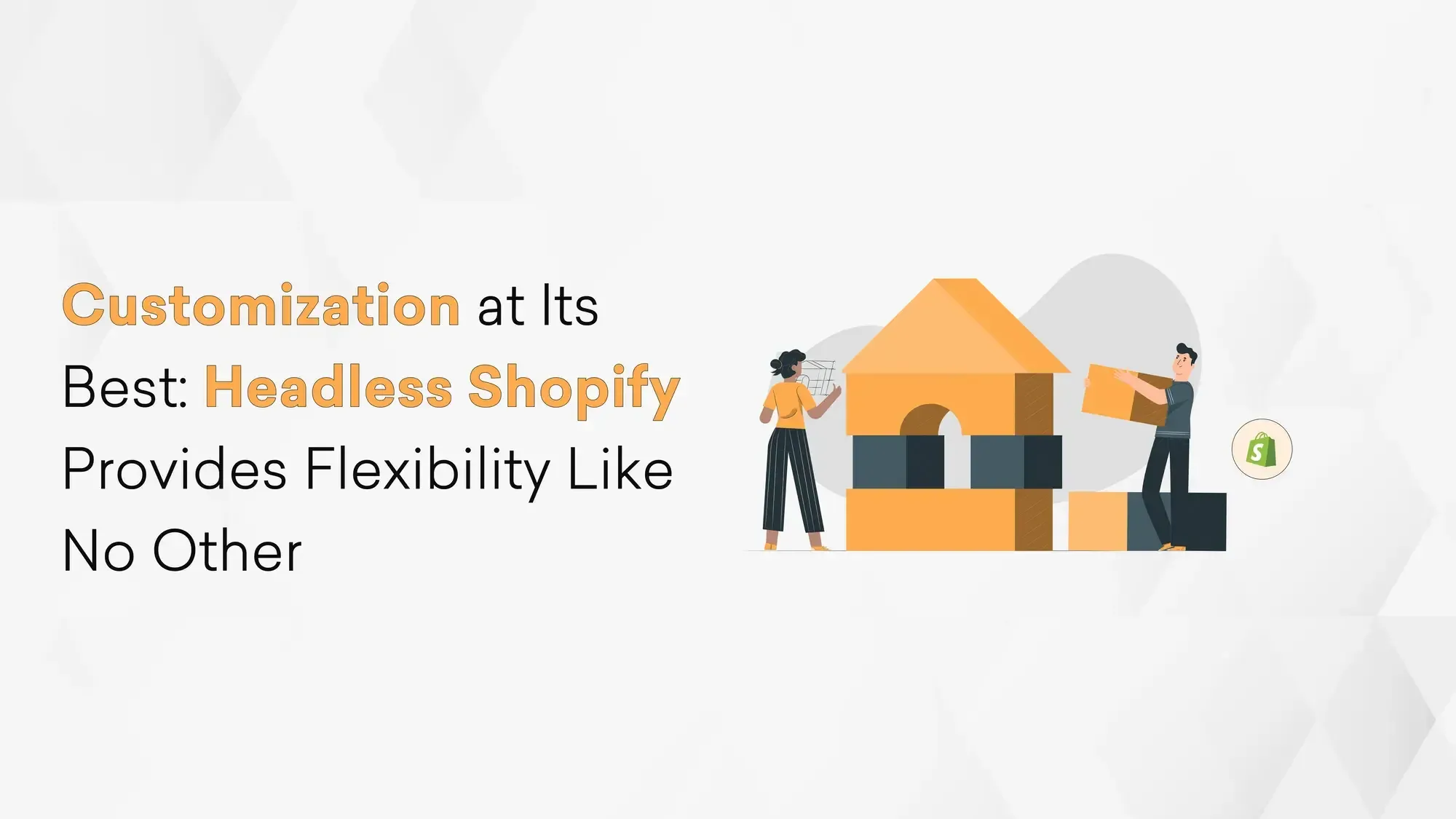
- Headless Shopify separates the storefront from Shopify’s commerce backend.
- Developers gain greater control over layouts, interactions, content, product discovery, and customer journeys.
- Shopify continues managing products, carts, inventory, orders, customers, and checkout.
- Headless can support websites, applications, regional storefronts, and other customer touchpoints using shared commerce data.
- Shopify theme applications do not necessarily work automatically in a custom storefront.
- Greater flexibility also means greater development, testing, and maintenance responsibility.
- Headless is most valuable when a business has requirements that cannot be solved efficiently with a Shopify theme.
Shopify themes can support attractive, high-converting stores for businesses of almost every size. However, some brands eventually need an experience that cannot be expressed comfortably through theme templates, app blocks, and conventional product pages.
A furniture retailer may need a visual product configurator. A beauty brand may want a guided routine builder. A global business may require different content, navigation, merchandising, and product availability for every market.
Headless Shopify gives developers greater control over these experiences by separating the storefront from Shopify’s commerce backend.
That flexibility can be powerful, but it is not unlimited or automatically valuable. A custom storefront still needs to work with Shopify’s APIs, checkout, product data, applications, customer accounts, analytics, and operational systems.
The real benefit of headless Shopify customization is therefore not the ability to change everything. It is the ability to customize the parts of the customer experience that can create meaningful differentiation while continuing to use Shopify for core commerce.
What Does Headless Shopify Customization Mean?
In a traditional Shopify store, the frontend is built within Shopify’s Online Store environment. Liquid templates, theme sections, app blocks, CSS, and JavaScript determine how the store looks and behaves.
This model provides substantial customization. Merchants can change layouts, create templates, add applications, build custom sections, use metaobjects, and modify theme code.
Headless Shopify removes the requirement to use a Shopify theme as the storefront.
The frontend is developed separately using Shopify Hydrogen or another compatible framework. It retrieves commerce information through Shopify’s Storefront API and sends customers to Shopify checkout when they are ready to purchase.
This division creates two distinct layers:
Layer | Primary responsibility |
Custom storefront | Design, navigation, content, search, product interactions, personalization, and presentation |
Shopify backend | Products, collections, pricing, inventory, carts, customers, orders, markets, and checkout |
Shopify describes Hydrogen as its React Router-based toolkit for building custom storefronts with Storefront API data. Merchants can also use another frontend stack when their requirements justify it. Shopify’s headless build-options documentation explains the available approaches.
Where Headless Shopify Provides Greater Flexibility
1. Custom Storefront Design
The most visible advantage is control over the interface.
A headless storefront does not need to follow the structural assumptions of a Shopify theme. Developers can create layouts and interactions around the product, audience, and buying journey.
A fashion retailer might introduce an editorial storefront in which products appear within stories, videos, and seasonal collections. A furniture brand could allow customers to explore room layouts and view products in context. A technical supplier could build compatibility tools that help buyers identify the correct component.
These experiences are possible because the frontend can be treated as a custom software product rather than a collection of modified theme templates.
However, design freedom should remain disciplined. Familiar patterns such as navigation, product selection, cart access, and checkout entry exist because customers understand them. Replacing every convention for the sake of originality can make the store harder to use.
The objective is not to create the most unusual interface. It is to create the most appropriate interface for the customer’s decision.
2. Product Pages Built Around the Product
Standard product pages usually follow a recognizable structure: media, title, price, variants, description, and purchase controls.
That structure works for straightforward products. It becomes restrictive when the product requires education, configuration, comparison, or several dependent choices.
With headless Shopify, a product page can function as a guided buying tool.
A jewellery store might allow customers to choose a diamond, setting, metal, size, and engraving while continuously updating the price. A skincare brand could recommend a routine after asking about skin type and concerns. A computer retailer could prevent customers from selecting incompatible parts.
Shopify still supplies products, variants, pricing, and cart functions. The custom frontend determines how those choices are explained and connected.
This is one of the strongest reasons to adopt headless: the ability to design the buying process around the complexity of the product rather than forcing the product into a generic purchasing flow.
3. More Flexible Content Management
Some brands depend on content almost as much as products.
Buying guides, recipes, editorial campaigns, product education, interviews, lookbooks, and regional stories may all contribute to product discovery. When content requirements become complex, merchants may connect Shopify to a dedicated headless content management system.
Shopify remains the source for commerce information, while the CMS manages editorial content. The storefront combines both sources into one customer experience.
This can give content teams more control over scheduling, localization, reusable modules, approval workflows, and structured content.
The architecture must still define where information belongs. Product titles, prices, variants, and availability should not be copied manually into the CMS when Shopify already owns that information. Duplication creates inconsistency and makes routine updates more difficult.
The strongest setup assigns every type of data an authoritative source and allows the frontend to assemble it when the page is rendered.
4. Advanced Search and Product Discovery
Large or specialized catalogues often need more than keyword search and basic collection filters.
A custom storefront can connect Shopify with a dedicated search platform or build a discovery experience around structured product attributes.
This can support typo tolerance, synonyms, visual filters, compatibility rules, personalized ranking, product comparison, and intent-based recommendations.
Consider a store selling thousands of industrial components. A customer may need to filter by dimensions, material, certification, voltage, compatibility, availability, and delivery location. A conventional filter drawer may be technically possible but difficult to use.
Need Help With Shopify Development?
We build fast, custom Shopify stores designed to drive more sales.
A headless storefront can turn that process into a guided sequence. It can ask customers what they are trying to accomplish, narrow the valid options, and explain why each result is relevant.
The flexibility creates value only when product data is accurate. A sophisticated search interface cannot compensate for inconsistent tags, missing attributes, duplicate products, or unreliable availability.
5. Personalized Customer Experiences
Headless Shopify provides room to personalize what customers see based on useful and permitted information.
A returning customer might receive recommendations related to previous purchases. A trade buyer may see an account-specific catalogue. A visitor arriving from a campaign could land on a tailored product journey. Customers in different markets may see relevant content, products, prices, and delivery information.
Personalization should make decisions easier rather than merely make the page different.
For example, showing replacement filters for a previously purchased appliance is useful. Rearranging an entire homepage based on uncertain assumptions may create an inconsistent experience.
Personalization also affects privacy, consent, caching, analytics, and performance. Customer-specific information should not be cached or exposed as if it were public catalogue data.
The business should therefore define which personalizations have a clear customer benefit, which data they require, and how success will be measured.
6. Multi-Market and Localized Experiences
International commerce involves more than translating words and changing currencies.
Customers may need different products, pricing, payment methods, delivery information, imagery, size conventions, policies, promotions, and cultural context depending on their market.
Headless Shopify can give businesses more control over these regional experiences while Shopify Markets and commerce data continue supporting the underlying operation.
One region might require a content-rich homepage, while another emphasizes store pickup. Product education may differ between new and established markets. Navigation may also change when category demand varies by country.
A flexible frontend can accommodate these differences without requiring every market to use an identical presentation.
That flexibility must be supported by a sustainable publishing process. If every region becomes an entirely independent storefront, content updates, quality assurance, analytics, and releases may become expensive.
The architecture should reuse what can remain global while allowing controlled regional differences where they create value.
7. Commerce Across Multiple Channels
Headless architecture allows Shopify data to support more than one customer-facing interface.
A business might use the same commerce backend for a primary website, mobile application, campaign microsite, in-store interface, or specialized purchasing portal.
Each channel can present products differently while drawing from shared product, price, inventory, and cart information.
This is often described as omnichannel flexibility, but a shared API does not automatically create a unified customer experience. Customer identity, cart continuity, promotions, inventory, analytics, and content must still be coordinated.
The advantage is architectural: the business does not need to rebuild its complete commerce backend whenever it introduces a new interface.
8. Third-Party and Enterprise Integrations
Headless Shopify can bring information from several systems into the storefront.
Depending on the business, these systems may include a CMS, search platform, CRM, ERP, PIM, OMS, loyalty service, subscription platform, review provider, or personalization engine.
A B2B storefront, for example, might combine Shopify products with account information from a CRM and customer-specific pricing from an ERP. A retailer might combine Shopify availability with store-level inventory and delivery estimates from another service.
These integrations should run through secure server-side services. Administrative credentials and private business logic must not be exposed in browser code.
Headless provides more ways to connect systems, but it does not make every integration simple. Each service has its own API limitations, data model, latency, permissions, and failure conditions.
The storefront must remain usable when a non-essential service becomes unavailable. A delayed recommendation platform should not prevent the product page or add-to-cart form from loading.
9. Faster Experimentation and Controlled Releases
A headless storefront can use development workflows common to modern software products.
Teams can work in feature branches, generate preview environments, run automated tests, review changes, and deploy independently from Shopify’s backend.
Hydrogen storefronts support production, custom, and preview environments linked to Git branches. This lets teams evaluate a new product experience or campaign without immediately exposing it to every customer. Shopify’s Hydrogen environment documentation details this model.
This is useful for organizations that improve their storefront continuously.
It offers less value when the business does not have designers, developers, product ownership, or a reliable release process. Technical flexibility becomes useful only when the team can operate it.
10. Custom Post-Purchase and Account Experiences
Customization does not need to stop after checkout.
A headless customer-account experience can present order information alongside shipment status, product instructions, warranties, subscriptions, loyalty information, return eligibility, or support options.
A customer who purchased furniture might see assembly instructions and care guidance. A cosmetics buyer might receive advice on using the products in sequence. A business customer might see order history organized by team, project, or purchase reference.
These additions can make the customer account more useful than a simple order list.
Customer authentication and private information must be implemented carefully. Account data should use Shopify’s supported customer-account capabilities and should never be treated like publicly cacheable storefront content.
Does Headless Shopify Guarantee Better Performance?
No.
Headless provides control over server rendering, caching, resource loading, images, and JavaScript. Hydrogen also includes Storefront API caching patterns and can extend them to suitable third-party requests.
These capabilities can support a fast storefront, but flexibility can produce the opposite result when used without discipline.
A headless store can become slow because of excessive client-side JavaScript, large media files, sequential API requests, uncached catalogue queries, complex personalization, or too many third-party services.
The performance objective should not be to add every possible feature. It should be to deliver the information and interaction customers need with the least unnecessary work.
Performance must be measured across collection browsing, search, product configuration, cart interaction, authentication, and checkout entry—not only on the homepage.
Does Headless Shopify Make SEO Easier?
Headless provides detailed control over SEO, but it also removes some theme-level defaults.
Titles, descriptions, canonical URLs, structured data, sitemaps, robots directives, internal links, pagination, redirects, and localized URLs must all be implemented intentionally.
Hydrogen includes utilities for metadata, JSON-LD, sitemaps, and robots routes, but the development team remains responsible for supplying accurate information and testing the final rendered pages. Shopify’s Hydrogen SEO guide documents these capabilities.
A well-built headless storefront can perform strongly in organic search. A poorly configured one can lose valuable URLs, product information, internal links, and structured data during migration.
SEO flexibility should therefore be treated as control, not as an automatic ranking advantage.
What Headless Shopify Cannot Freely Customize
Headless does not remove every Shopify boundary.
Shopify’s data models, APIs, permissions, rate limits, customer-account systems, checkout architecture, and platform policies still apply.
The storefront can customize how customers reach checkout, but the purchase must continue through Shopify’s supported checkout flow. Applications designed only for Liquid themes or theme app blocks may also require separate API integrations or replacements.
Need Help With Shopify Development?
We build fast, custom Shopify stores designed to drive more sales.
The business remains dependent on its selected frontend framework, hosting platform, CMS, integrations, and development team. Changing the storefront technology later may be possible, but it still involves engineering work.
“Future-proof” should therefore be used carefully. Headless makes parts of the architecture replaceable; it does not eliminate future migrations or maintenance.
The Cost of Greater Flexibility
A conventional Shopify theme packages many capabilities into one managed environment. Headless separates those responsibilities.
The business may need to fund custom frontend development, content modelling, API integration, hosting, monitoring, analytics, accessibility, SEO implementation, testing, security, and ongoing maintenance.
Theme applications may also require custom work. An app that appears after being installed on a Shopify theme may need its interface rebuilt for the headless storefront.
This does not make headless poor value. It means the flexibility should solve a problem valuable enough to justify the total cost.
A complex product configurator that materially improves purchasing confidence may justify the investment. Rebuilding a straightforward catalogue solely to achieve a different homepage layout probably will not.
Headless Shopify vs Theme Customization
The most responsible decision is to use the least complex architecture that satisfies the business requirements.
A Shopify theme is usually the better option when the store has a conventional buying journey, relies on theme applications, changes infrequently, and needs non-technical staff to control layouts through the theme editor.
Headless becomes more appropriate when the business requires advanced product configuration, content-led commerce, several customer channels, highly customized regional experiences, deep integrations, or continuous frontend development.
Before choosing headless, define the limitation clearly:
What valuable customer or operational experience can we not deliver effectively with our current Shopify implementation?
If the answer is unclear, headless is probably premature.
How to Plan a Headless Shopify Customization Project
Begin by mapping the customer journey, not by choosing a frontend framework.
Document how customers discover products, compare options, select variants, use search, add to cart, authenticate, enter checkout, and return after purchase. Identify where the existing experience creates measurable friction.
Next, audit the current technology. Every application, data source, tracking tool, market, customer-account feature, and operational integration should be classified according to whether it can support a headless storefront.
The design phase should prototype the most valuable and risky interactions first. If the store requires a product builder, guided search, or personalized account area, validate those experiences before developing routine pages.
Finally, build and release the storefront in controlled stages. Test real products, unavailable variants, discounts, multiple markets, customer states, application failures, analytics, SEO, accessibility, and performance before switching traffic.
Customization is successful when it improves how customers shop and how teams operate—not merely when the interface looks different.
Frequently Asked Questions
What can be customized in Headless Shopify?
Businesses can customize layouts, navigation, product discovery, content, personalization, regional experiences, accounts, and integrations. Shopify continues managing core commerce functions such as products, carts, orders, inventory, and checkout.
Can I use any frontend framework with Shopify?
Shopify supports custom storefronts through its APIs. Hydrogen is Shopify’s React Router-based toolkit, while other compatible frameworks can be used when the team can implement commerce, security, performance, and SEO correctly.
Do Shopify apps work with a headless storefront?
Some apps provide APIs, SDKs, or compatible components. Apps dependent on Liquid, theme app blocks, or injected scripts may require custom frontend development, alternative applications, or changes to existing workflows.
Is Headless Shopify always faster than a theme?
No. Headless allows greater control over rendering, caching, images, and JavaScript, but speed depends on implementation quality. A poorly designed headless storefront can be slower than an optimized Shopify theme.
Is Headless Shopify more cost-effective?
It can create strong returns when customization solves a valuable business problem. However, initial development and ongoing maintenance generally cost more than a theme, so total ownership cost must be evaluated.
Can marketers update a headless Shopify store without developers?
Yes, when the storefront includes well-designed content models and editable components through Shopify or a CMS. Poorly planned implementations can make routine marketing updates unnecessarily dependent on developers.
Is Headless Shopify suitable for small businesses?
It can be, but only when the required custom experience justifies the investment. Most smaller stores receive better value from a well-built Shopify theme and selective custom development.
Conclusion
Headless Shopify provides extensive flexibility where it matters most: the customer-facing experience.
It allows businesses to design product journeys around how customers make decisions, combine commerce with richer content, introduce advanced search and personalization, support multiple markets and channels, integrate specialized systems, and release storefront improvements independently.
That freedom is accompanied by greater responsibility. SEO, application compatibility, customer accounts, analytics, performance, security, content workflows, and maintenance must all be implemented deliberately.
Headless is therefore not the default upgrade for every Shopify store. It is an architectural choice for businesses whose customer experience has moved beyond what a theme can support efficiently.
Businesses evaluating a custom product experience or storefront architecture can work with experienced Headless Shopify developers to determine which customizations create real value and which add unnecessary complexity.