Customers rarely discover and purchase products through one predictable route.
Someone may encounter a product on Instagram, compare it on Google, visit the brand’s mobile storefront, ask a question through chat, and complete the purchase later on a laptop. Other customers may prefer Amazon, TikTok Shop, a physical store, or a native mobile application.
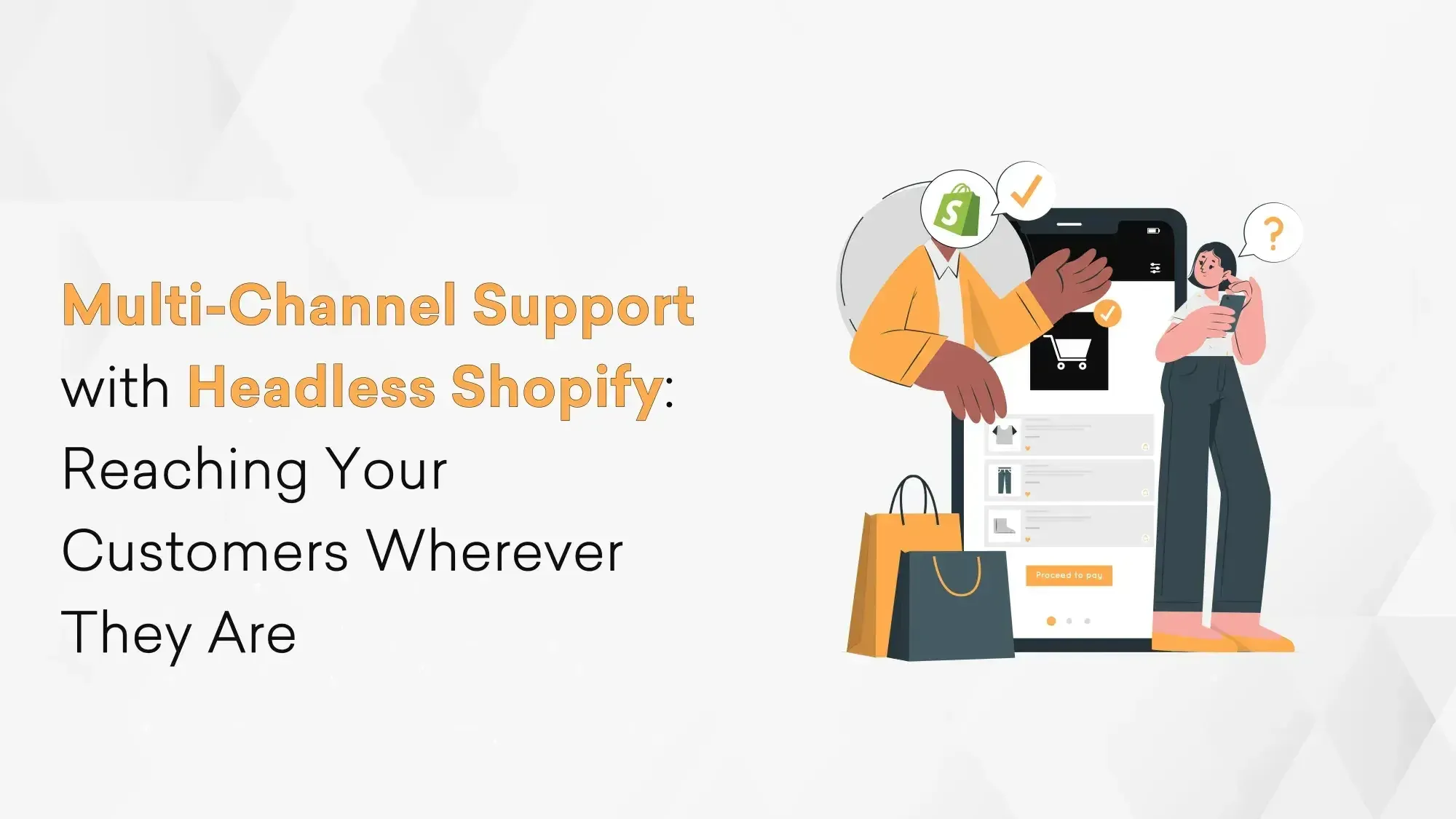
Shopify can support many of these touchpoints, but headless architecture plays a specific role within the wider channel strategy. It gives a business greater control over custom storefronts, such as websites, mobile applications, kiosks, and other interfaces connected through Shopify’s APIs.
It does not automatically connect Amazon, eBay, social shops, messaging applications, or physical stores. Those channels still require Shopify sales channels, marketplace connectors, APIs, applications, or custom middleware.
A successful multi-channel strategy therefore combines headless Shopify with reliable product data, inventory management, order routing, customer-service systems, analytics, and channel-specific integrations.
- Multi-channel commerce means selling through more than one customer touchpoint.
- Headless Shopify provides greater control over custom storefronts but does not automatically integrate every marketplace or social platform.
- Shopify sales channels can connect platforms such as Facebook, Instagram, TikTok, Google, Shop, and selected marketplaces.
- Shopify Marketplace Connect currently supports Amazon, eBay, Walmart in the United States, and Target Plus for eligible US merchants.
- Product, inventory, price, order, and fulfilment data need clear systems of record.
- Customers do not expect every channel to look identical, but product claims, prices, policies, and service should remain consistent.
- A multi-channel presence becomes omnichannel only when customer journeys and operational data are connected across touchpoints.
- Headless architecture is worthwhile only when the required channel experiences justify its additional development and maintenance.
What Is Multi-Channel eCommerce?
Multi-channel eCommerce means making products available through several sales or engagement channels.
Depending on the business, these channels may include:
- A Shopify online store
- A custom headless website
- Native mobile applications
- Facebook and Instagram
- TikTok Shop
- Google Shopping and YouTube
- Amazon, eBay, Walmart, or other marketplaces
- Shopify’s Shop application
- Physical stores using Shopify POS
- Wholesale portals
- Customer-service chat
- Embedded commerce experiences
- Kiosks or interactive retail displays
Each channel gives customers another way to discover, evaluate, or purchase products. However, adding a channel also introduces another place where product data, stock, pricing, orders, promotions, content, and customer communication must be managed.
The goal is not simply to appear on as many platforms as possible. The business should choose channels based on where its customers shop, whether its products suit the channel, and whether the expected commercial value exceeds the operational cost.
Multi-Channel vs Omnichannel Commerce
The terms multi-channel and omnichannel are frequently used interchangeably, but they describe different levels of coordination.
Multi-channel commerce | Omnichannel commerce |
Products are available through several channels | Channels are connected around the customer journey |
Each channel may operate relatively independently | Customer context can move between touchpoints |
Inventory and orders may be managed separately | Inventory, orders, service, and fulfilment are coordinated |
Channel performance is often measured individually | Performance is evaluated across the complete journey |
The priority is customer reach | The priority is customer continuity |
For example, a business selling through its website, Amazon, and a physical store has a multi-channel presence.
The experience becomes more omnichannel when a customer can check local inventory online, collect the purchase in a store, return it through an accepted location, and receive informed support without repeatedly explaining the order’s history.
Headless Shopify can support this connected experience, but only when it is integrated with the systems managing customer identity, inventory, orders, fulfilment, returns, content, and analytics.
What Role Does Headless Shopify Play?
In a conventional Shopify store, the frontend is normally rendered through a Shopify theme using Liquid. Shopify manages both the commerce platform and the primary storefront environment.
In a headless architecture, the customer-facing frontend is developed separately. It communicates with Shopify through APIs such as the Storefront API and Customer Account API.
This separation gives developers control over the experience presented through custom channels.
A business might use the same Shopify commerce foundation to support:
- A responsive web storefront
- An iOS or Android application
- A region-specific website
- A product configurator
- An in-store kiosk
- A customer portal
- An editorial commerce experience
- An interface embedded inside another service
Each interface can be designed around the needs of its audience while Shopify remains responsible for core commerce data and operations.
However, headless Shopify should not be mistaken for a universal channel synchronization tool. A custom storefront can retrieve Shopify data through the Storefront API, but an Amazon listing must still follow Amazon’s catalogue, pricing, fulfilment, advertising, and customer-service requirements.
How a Multi-Channel Shopify Architecture Works
A practical multi-channel architecture may contain several layers.
Layer | Typical responsibility |
Shopify | Products, variants, orders, inventory, discounts, checkout, and commerce administration |
Custom storefront | Website, mobile app, kiosk, portal, or another customer-facing interface |
Storefront API | Published product data, collections, search, carts, pricing, and availability |
Customer Account API | Authenticated customer accounts, order history, profile information, and returns where supported |
Sales channels | Social commerce, Google, Shop, POS, and channel-specific Shopify integrations |
Marketplace connector | Marketplace listings, prices, inventory, and order synchronization |
CMS | Editorial content, landing pages, buying guides, and reusable campaign content |
PIM | Enriched and governed product information across channels |
OMS or ERP | Order routing, inventory coordination, fulfilment, finance, and operational workflows |
CRM and support system | Customer communication, segmentation, support history, and service workflows |
Analytics layer | Channel attribution, customer journeys, conversion, revenue, and profitability |
Not every merchant requires all these systems. A smaller business may manage products, inventory, orders, and channels directly through Shopify.
Need Help With Shopify Development?
We build fast, custom Shopify stores designed to drive more sales.
Larger operations may need a product information management system, order management system, enterprise resource planning platform, warehouse system, or middleware layer to keep data synchronized.
Headless architecture makes it easier to connect these services to custom experiences. It does not remove the need to decide which system owns each type of data.
Establish a Clear System of Record
Multi-channel problems often begin when several systems are allowed to independently edit the same information.
For example, a product price may exist in Shopify, an ERP, a marketplace connector, a PIM, and a promotional platform. If ownership is unclear, one update can overwrite another or reach channels at different times.
A channel architecture should define an authoritative source for:
- Product names and descriptions
- SKUs and product identifiers
- Images and media
- Base prices
- Channel-specific prices
- Inventory quantities
- Availability
- Orders
- Fulfilment status
- Returns
- Customer records
- Tax information
- Delivery promises
- Promotional content
Shopify can act as the system of record for many growing merchants. More complex businesses may maintain products in a PIM, stock and fulfilment logic in an ERP or OMS, and published commerce information in Shopify.
The correct arrangement depends on the company’s existing systems. What matters is that every integration knows where information originates and which system is permitted to change it.
Supporting Custom Websites and Mobile Applications
Custom storefronts are where headless Shopify provides its most direct multi-channel advantage.
Developers can create several buyer-facing applications that retrieve published commerce data from Shopify. Each storefront can have its own API credentials and frontend while sharing Shopify’s underlying product and operational environment.
For example, a fashion brand could operate:
- A content-rich website for product discovery
- A mobile application designed for repeat buyers
- A simplified regional storefront
- An in-store tablet experience for products unavailable locally
The Storefront API can supply product information, collections, search results, prices, availability, and cart functionality. Customers can then proceed to Shopify’s checkout through the cart’s checkout URL.
Shopify’s Headless channel allows businesses to create and manage multiple custom storefronts and their API credentials. Shopify’s headless-stack documentation explains the current setup and permission model.
The frontends can differ, but the experience should not contradict the commerce backend. A mobile application should not show an item as available when Shopify considers it unavailable, and a custom website should not display a price that differs unexpectedly at checkout.
Selling Through Social Commerce Channels
Social platforms can move customers from product discovery to purchase with fewer steps.
Shopify currently documents social-commerce channels including:
- Facebook and Instagram by Meta
- TikTok Shop
- Roblox
The Facebook and Instagram sales channel can synchronize eligible Shopify products to Meta’s catalogue, allowing merchants to create Facebook and Instagram shopping experiences and tag products in supported posts and stories.
TikTok Shop can support product promotion through shoppable content and live selling where the channel and merchant are eligible.
These connections are not created by making the Shopify website headless. They are configured through the appropriate Shopify sales channel and the external platform’s merchant requirements.
Headless architecture can still support the wider strategy by providing optimized landing pages when social traffic leaves the platform. A campaign link can lead to a fast, customized product collection that reflects the message, audience, and products featured in the social content.
The social platform controls the experience inside its own application. The headless frontend controls the brand-owned experience after the customer reaches it.
Shopify’s social-commerce documentation lists the presently supported channel options and their setup requirements.
Expanding to Online Marketplaces
Marketplaces provide access to established audiences, but each one has its own listing rules, fees, product categories, advertising systems, fulfilment requirements, customer expectations, and performance standards.
Shopify Marketplace Connect currently supports connections to:
- Amazon
- eBay
- Walmart for US merchants
- Target Plus for eligible US merchants
New Etsy connections are not currently supported through Marketplace Connect, although merchants with an existing Etsy connection may be able to continue using it.
Marketplace Connect can synchronize listings, inventory, and orders with Shopify. Product and order changes can then be managed from the Shopify environment instead of being updated manually on each supported marketplace. Shopify Marketplace Connect documentation provides the current platform list and limitations.
This functionality comes from Marketplace Connect, not from the headless storefront itself.
A custom frontend normally has no control over how an Amazon or eBay product page is designed. The marketplace owns that interface. Merchants can optimize the information permitted by the marketplace, including titles, images, attributes, pricing, fulfilment, and advertising.
Managing Inventory Across Channels
Inventory synchronization is one of the most commercially important parts of multi-channel commerce.
Suppose a business has ten units available and sells through its website, mobile application, Amazon, and a physical store. Every purchase must reduce the sellable quantity quickly enough to prevent the same units being promised to several customers.
The architecture must account for:
- Shopify inventory locations
- Physical stores
- Warehouses
- Reserved inventory
- Marketplace fulfilment stock
- Returns awaiting inspection
- Safety-stock rules
- Bundles and product components
- Back orders and pre-orders
- Delayed marketplace updates
A headless website and mobile application can read Shopify availability from the same commerce backend. Marketplace inventory requires the selected connector to exchange updates with Shopify and the marketplace.
“Real-time inventory” should be used carefully. Many integrations synchronize quickly, but not every external platform updates instantaneously. Businesses should understand the connector’s update behaviour and maintain safety stock when synchronization delays could create overselling.
Centralizing Multi-Channel Orders
A centralized Shopify environment can make orders from supported channels easier to review and fulfil.
Marketplace Connect can import orders from connected marketplaces into Shopify. It can also synchronize relevant cancellation and return information, although the behaviour and fulfilment restrictions vary by platform.
Orders may still require different workflows based on:
- Where the order was placed
- Which warehouse holds the inventory
- Whether the marketplace controls fulfilment
- The promised delivery service
- Marketplace-specific packaging rules
- Tax responsibilities
- Return eligibility
- Cross-border restrictions
- Service-level agreements
An OMS or ERP may become necessary when Shopify’s native routing and fulfilment processes cannot represent the operation’s complexity.
Headless architecture can present order information in customer-facing applications, but it does not replace the operational system responsible for routing and fulfilling those orders.
Using Messaging and Chat Applications
Messaging channels can support product questions, delivery enquiries, order updates, and assisted sales.
Shopify Inbox provides chat for a merchant’s online store. Businesses may also connect WhatsApp, Messenger, or other communication platforms through approved third-party applications, platform APIs, CRM systems, or custom integrations.
The Storefront API alone does not turn WhatsApp or Messenger into complete Shopify sales channels.
A messaging implementation may need to coordinate:
- Customer consent
- Platform-approved message templates
- Identity matching
- Product links
- Cart creation
- Order lookup
- Support history
- Agent handover
- Working hours
- Regional privacy requirements
Automated responses should be limited to situations where the system has reliable information. A chatbot should not invent availability, delivery dates, return eligibility, or order status.
When a customer needs human assistance, the conversation should transfer to an agent with the relevant context instead of forcing the customer to start again.
Maintaining Brand Consistency
Brand consistency does not require every channel to look identical.
An Amazon listing cannot reproduce a custom headless website. A TikTok product video should not behave like a detailed desktop product page. A retail kiosk has different interaction requirements from a mobile application.
Consistency should focus on the elements that must remain trustworthy:
- Product identity
- Core product claims
- Visual style
- Tone of voice
- Size and compatibility information
- Prices and promotional terms
- Availability
- Delivery expectations
- Return policies
- Customer-service quality
Channel-specific design is valuable when it respects how customers use that platform.
A mobile application may prioritize reordering and account access. Instagram may emphasize visual discovery. A marketplace listing may prioritize product attributes and delivery. The custom website may provide the deepest brand and product information.
Headless Shopify enables greater control over brand-owned channels. Marketplace and social integrations require the business to work within each platform’s design and content rules.
Managing Customer Identity Across Channels
A multi-channel strategy does not automatically produce one universal customer profile.
A customer may use different email addresses, marketplace identities, guest checkouts, social accounts, and in-store payment methods. Some platforms also restrict the customer information they share with merchants.
Customer data should therefore not be merged solely because two people have similar names or contact details.
A reliable identity strategy may involve:
- Shopify customer records
- Shopify’s Customer Account API
- CRM profiles
- Consent records
- Loyalty identifiers
- POS customer profiles
- Marketplace-provided data
- Secure identity-resolution rules
The business must respect the purpose for which customer data was collected. Permission to process an order does not automatically provide permission to send unrelated marketing messages across every channel.
Headless architecture gives developers more control over authentication and customer interfaces, but it also increases their responsibility for session handling, access controls, privacy, and secure API usage.
Protecting Customer and Commerce Data
Every added integration expands the number of systems that can access business or customer information.
Before connecting a channel, review:
- The data the integration can read
- The data it can change
- How access is authenticated
- Where data is stored
- How long it is retained
- Which employees can access it
- Whether access can be revoked
- How failures and breaches are reported
- Applicable privacy and consumer-protection requirements
Private Storefront access tokens and Admin API tokens must remain on a secure server. An Admin API token should never be placed in browser JavaScript, mobile application code, or a public repository.
Need Help With Shopify Development?
We build fast, custom Shopify stores designed to drive more sales.
Integrations should receive only the permissions they need. Unused applications and channel credentials should be removed rather than left connected indefinitely.
Creating a Reliable Content Workflow
Multi-channel publishing becomes difficult when every platform requires teams to rewrite and manually copy the same information.
Structured product data can reduce that duplication.
A well-governed product model may contain:
- A canonical product name
- Short and long descriptions
- Feature lists
- Technical specifications
- Materials
- Dimensions
- Variant attributes
- Product identifiers
- Images and videos
- Accessibility text
- Regional restrictions
- Channel-specific copy
- Legal or safety information
Some fields should remain consistent everywhere, while others should be adapted to the format and audience of each channel.
A headless CMS or PIM can help manage channel-specific content, but it should not create conflicting versions of prices, stock, or other commerce data already managed by Shopify or another authoritative system.
Measuring Multi-Channel Performance
A channel should be evaluated using commercial contribution rather than reach alone.
Useful measures include:
- Revenue by channel
- Gross margin
- Marketplace and payment fees
- Customer-acquisition cost
- Conversion rate
- Revenue per visitor
- Return and cancellation rate
- Fulfilment cost
- Delivery performance
- Inventory accuracy
- Customer-service volume
- Repeat purchase rate
- Contribution profit
Attribution across channels will rarely be perfect. A customer may discover a product on social media and later buy it through a marketplace or physical store.
Instead of forcing every purchase into one acquisition source, combine platform reporting, Shopify order data, analytics, campaign parameters, customer research, and controlled experiments.
The objective is to understand whether each channel creates incremental value or simply shifts existing customers into a more expensive purchasing route.
A Practical Multi-Channel Implementation Plan
1. Map the Current Customer Journey
Identify where customers discover products, compare options, ask questions, purchase, request support, and return orders.
Do not add a channel simply because competitors use it.
2. Define the Role of Each Channel
Decide whether a channel is intended for discovery, direct sales, repeat purchasing, support, wholesale, or physical retail.
This determines the products, content, integrations, and success metrics it requires.
3. Establish Data Ownership
Document which system controls products, inventory, prices, content, orders, fulfilment, customer profiles, and analytics.
Resolve conflicts before adding more integrations.
4. Select the Appropriate Connection
Use Shopify sales channels where they meet the requirement. Use Marketplace Connect for its supported marketplaces and assess third-party integrations carefully for other platforms.
Use the Storefront API for custom buyer-facing experiences rather than assuming it replaces marketplace connectors.
5. Launch One Channel at a Time
Test product publishing, stock updates, pricing, orders, taxes, fulfilment, cancellations, returns, and reporting before expanding.
A small controlled launch is easier to diagnose than a simultaneous release across several platforms.
6. Monitor the Complete Order Lifecycle
A channel is not successfully integrated merely because products appear on it.
Place real test orders and confirm every step through cancellation, fulfilment, delivery, return, refund, restocking, and financial reconciliation.
Common Multi-Channel Mistakes
The first mistake is assuming headless Shopify automatically provides marketplace integration. The Storefront API powers custom storefronts; Amazon, eBay, Meta, TikTok, and other channels need their own supported connections.
Another mistake is publishing the complete catalogue everywhere. Products with difficult fulfilment, low margins, regional restrictions, or high return rates may not suit every marketplace.
Businesses also underestimate data conflicts. Allowing Shopify, a PIM, an ERP, and marketplace software to change the same price or stock field can create unreliable information.
Finally, many teams evaluate revenue without deducting marketplace fees, advertising, returns, support, fulfilment, and integration costs. A channel with high sales can still produce weak contribution profit.
Frequently Asked Questions
What is multi-channel commerce in Shopify?
Multi-channel commerce means selling or engaging through several touchpoints, such as a website, mobile application, social platform, marketplace, physical store, or chat service connected to the wider Shopify operation.
Does headless Shopify automatically connect marketplaces?
No. Headless Shopify powers custom storefronts through APIs. Marketplaces require Shopify Marketplace Connect, another supported sales channel, a third-party application, or a custom integration appropriate to that marketplace.
Which marketplaces does Shopify Marketplace Connect support?
Shopify currently lists Amazon, eBay, Walmart for US merchants, and Target Plus for eligible US merchants. New Etsy connections are unavailable, although existing connected Etsy sellers may continue.
Can Shopify synchronize inventory across sales channels?
Shopify and supported channel integrations can synchronize inventory and orders. Update timing and limitations vary between platforms, so merchants should test synchronization and consider safety stock where overselling carries significant risk.
What is the difference between headless and omnichannel Shopify?
Headless describes an architecture separating custom frontends from Shopify’s backend. Omnichannel describes a connected customer experience across channels. A headless build can support omnichannel commerce but does not create it automatically.
Is headless Shopify necessary for multi-channel selling?
No. Merchants can use Shopify sales channels and marketplace integrations without adopting headless architecture. Headless becomes relevant when custom websites, applications, kiosks, or other owned experiences require greater frontend control.
Conclusion
Multi-channel commerce is not simply the process of placing the same catalogue on several platforms.
Every channel introduces its own customer expectations, product rules, costs, data flows, fulfilment requirements, and operational risks. Reaching more customers is valuable only when the business can keep products accurate, stock synchronized, orders manageable, service dependable, and channel economics sustainable.
Headless Shopify supports this strategy by giving businesses greater control over their custom storefronts. The same Shopify commerce foundation can power websites, mobile applications, portals, kiosks, and other brand-owned interfaces through APIs.
Marketplace and social commerce capabilities come from a different part of the architecture. They require Shopify sales channels, Marketplace Connect, external applications, or custom integrations. Messaging, customer identity, fulfilment, and analytics may require additional systems.
The strongest approach begins with the customer journey and operating model. Select the channels that serve a clear purpose, establish authoritative data sources, test the complete order lifecycle, and measure profit rather than visibility alone.
Businesses planning custom sales experiences or a connected channel architecture can work with experienced Headless Shopify developers to define the role of Shopify, its APIs, marketplace connectors, content systems, and operational integrations.