A Complete Guide on Regression Testing
- Regression testing checks whether a change has broken functionality that previously worked.
- Retesting confirms that a particular defect was fixed; regression testing checks for unintended effects elsewhere.
- Run fast, targeted regression tests after each code change and broader suites before high-risk releases.
- Select tests using change impact, business risk, dependency information, and historical defects.
- Automate stable, repetitive checks, but retain manual and exploratory testing where human judgement is valuable.
- Treat flaky tests as defects because unreliable results weaken confidence in the entire suite.
- Add a regression test whenever a production defect or important bug is fixed.
- A larger regression suite is not automatically better; it must remain relevant, maintainable, and fast enough to provide useful feedback.
A developer changes the discount calculation for one product category. The new calculation works correctly, but the checkout total is now wrong when a customer combines that discount with a gift card.
The gift-card code was never edited. It broke because both features depended on shared pricing logic.
This is the problem regression testing is designed to detect. Software components rarely operate independently, and even a small change can produce unexpected effects in previously stable functionality. Regression testing rechecks existing behaviour after a change so that teams can identify those effects before users do.
This guide explains how regression testing works, when it should be performed, how to select and prioritise test cases, where automation adds value, and how regression testing fits into modern CI/CD pipelines.
What Is Regression Testing?
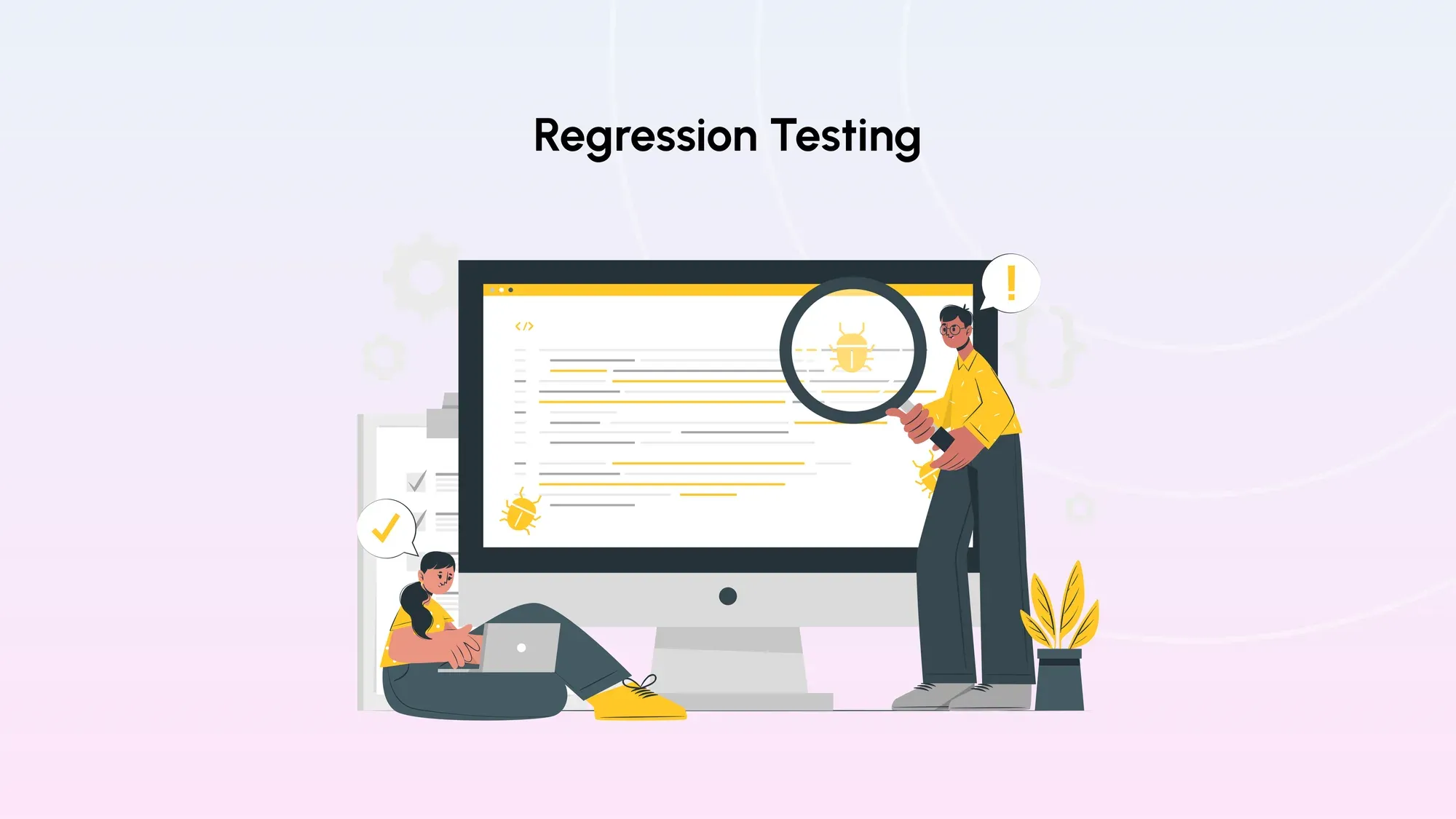
Regression testing is the process of checking previously tested software after a change to ensure existing functionality continues to behave correctly.
The change may be a new feature, defect fix, refactoring, dependency update, configuration modification, database migration, infrastructure change, operating-system update, or third-party integration update.
Regression testing is not limited to rerunning old test cases mechanically. A useful regression process also identifies which existing behaviours may be affected, updates coverage when requirements change, and adds new tests for risks revealed by the modification.
Consider an online banking application. A team changes the account-locking mechanism to strengthen login security. The updated feature passes its direct tests, but the same authentication service is used by biometric login, password recovery, mobile sessions, and customer-support access.
Regression testing evaluates those related behaviours to confirm that the security improvement has not disrupted another valid access path.
Why Is Regression Testing Important?
Software develops through change. Every new capability builds on code, data, services, and configuration that already exist. This creates the possibility that a correct change in one area will have an unintended effect elsewhere.
1. It protects existing customer journeys
Users expect features they already depend on to continue working after an update. A new reporting feature should not break login, exports, permissions, or existing reports.
2. It reduces production risk
Regression defects can be difficult to anticipate because they often appear outside the component that was modified. A structured regression suite catches these indirect effects before release.
3. It supports frequent delivery
Agile and CI/CD teams may integrate changes several times a day. Automated regression checks provide repeatable feedback without requiring testers to revalidate the complete application manually after every commit.
4. It preserves knowledge
A regression test records an expectation about the product. When a defect is discovered and converted into a permanent automated test, the team retains knowledge of that failure mode even after the people involved have moved to other work.
Martin Fowler describes automated tests as regression sensors that make a codebase safer to change. He also argues that a defect is not properly protected against recurrence unless a regression test accompanies its fix.
5. It exposes hidden dependencies
Regression failures can reveal that components are more tightly connected than the team realised. This information can improve architecture, documentation, ownership, and future change-impact analysis.
Regression Testing Example
Suppose an e-commerce company adds a new “buy now, pay later” payment option.
The team must test the new payment method itself, but its regression scope should extend beyond the newly added screens. The change may affect:
- Cart totals
- Discounts and gift cards
- Tax calculations
- Order creation
- Inventory reservation
- Payment failure handling
- Refunds and cancellations
- Invoices
- Transaction history
- Confirmation messages
- Finance reports
- Fraud checks
A complete regression test is not necessarily required for every part of the application. The team should first identify the shared services, data, integrations, and workflows touched by the change, then select tests based on impact and risk.
Regression Testing vs Retesting
Regression testing and retesting are related but serve different purposes.
| Area | Retesting or confirmation testing | Regression testing |
| Primary question | Has the reported defect been fixed? | Has the change broken existing behaviour? |
| Scope | The specific failed scenario | Related and existing functionality |
| Test basis | The original defect and reproduction steps | Change impact, dependencies, risk, and existing coverage |
| Expected result | The previously failing test now passes | Previously passing tests continue to pass |
| Example | Confirm a corrected coupon now applies properly | Verify the coupon fix has not broken totals, taxes, refunds, or gift cards |
When a developer fixes an incorrect shipping fee, the tester first repeats the failed scenario to confirm the calculation is corrected. That is retesting.
The tester then checks related address rules, free-shipping thresholds, taxes, cart totals, and refunds. That is regression testing.
Both activities are necessary. Retesting without regression testing may confirm the fix while missing its side effects.
Regression Testing vs Smoke Testing
Smoke testing is a fast, broad check that determines whether a build is stable enough for deeper testing. It usually covers essential functions such as startup, login, important navigation, data access, and one critical transaction.
Regression testing is broader and more detailed. It checks whether a change has damaged existing behaviour across affected and important areas.
A smoke test should normally run before an expensive regression suite. If users cannot log in or the application cannot connect to its database, there is little value in executing several hours of detailed checks.
Regression Testing vs Sanity Testing
Sanity testing is a narrow validation of a specific change, enhancement, or defect fix. It determines whether the modified area appears stable enough for broader testing.
For example, after an invoice-export fix, a sanity test may confirm that invoices can be generated and downloaded. Regression testing then checks related reports, file formats, permissions, storage, and historical invoices.
In simple terms:
Smoke testing: Is the build broadly testable?
Sanity testing: Does this particular change appear to work?
Retesting: Has the reported defect been fixed?
Regression testing: Did the change break anything that already worked?
What Changes Should Trigger Regression Testing?
Regression testing should be considered whenever the behaviour, dependencies, configuration, or operating environment of the software changes.
New Features
A new feature may reuse shared components or modify existing workflows. The team should test both the new capability and the established behaviour it could affect.
Defect Fixes
A fix can introduce a new defect or expose a previously hidden dependency. Confirm the fix and run regression tests around the modified component.
Refactoring
Refactoring is intended to change internal structure without changing external behaviour. Regression tests provide evidence that the behaviour remained stable.
Dependency and SDK Updates
Library, framework, browser, operating-system, payment SDK, and third-party API updates can affect functionality without changing the application’s own business code.
Configuration Changes
Feature flags, environment variables, timeouts, permissions, routing, and infrastructure configuration can produce application-level regressions.
Database Changes
Schema changes, data migrations, indexing, stored procedures, and query updates can affect correctness, compatibility, and performance.
Performance Improvements
A change intended to improve speed may modify caching, concurrency, batching, queries, or data loading. Functional and performance regression tests are both appropriate.
Security Updates
Authentication, authorisation, encryption, session handling, and input validation changes can accidentally block legitimate users or create new access paths.
Production Incidents
Every important escaped defect should lead the team to ask whether a permanent regression test can prevent the same failure from returning.
Levels of Regression Testing
Regression testing can be applied at several test levels. These are not separate competing types; they protect different layers of the product.
Unit Regression Testing
Unit regression tests check functions, classes, and small components after code changes. They provide the fastest feedback and usually run on every commit or pull request.
They are particularly valuable for business rules, calculations, validation, transformations, and error handling.
Integration Regression Testing
Integration regression tests verify interactions between components, databases, message queues, APIs, caches, and external services.
They detect problems such as changed data formats, incorrect timeouts, transaction failures, and incompatible service contracts.
API Regression Testing
API regression tests validate endpoints, request and response schemas, status codes, authentication, error handling, and business behaviour.
API suites are often faster and more stable than interface-driven tests, making them useful for protecting significant functionality without depending on the entire user interface.
User-Interface Regression Testing
UI regression testing checks navigation, forms, visual behaviour, client-side interactions, and complete workflows.
Because UI automation can be slower and more fragile, reserve it for behaviours that genuinely require the interface. Validate detailed business rules at unit, component, or API levels where possible.
System and End-to-End Regression Testing
System-level regression tests validate complete user journeys across the application and its dependencies. Examples include registration, checkout, document approval, account recovery, and refunds.
These tests provide broad confidence but should remain focused on critical journeys rather than reproducing the complete lower-level suite through the interface.
Non-Functional Regression Testing
Regression is not limited to functionality. A change can also affect:
- Response time
- Throughput
- Memory consumption
- Scalability
- Security
- Accessibility
- Compatibility
- Reliability
- Battery or resource usage
Performance, security, accessibility, and compatibility baselines should be revalidated when a change could affect those characteristics.
Sleep Easy Before Launch
We'll stress-test your app so users don't have to.
Regression Testing Approaches
The right regression scope depends on the size and risk of the change.
Selective Regression Testing
Selective regression testing runs only the tests relevant to the modified code and its dependencies.
It is suitable for frequent, relatively isolated changes where the team understands the architecture and has reliable traceability between code, components, requirements, and tests.
The main risk is incorrect impact analysis. A dependency that is not recognised may remain untested.
Partial Regression Testing
Partial regression testing includes the changed area, directly connected components, and important related workflows.
It provides broader protection than highly selective testing without incurring the cost of rerunning every available test.
This is often appropriate for moderate feature changes, defect fixes, and component updates.
Complete Regression Testing
Complete regression testing executes the full maintained regression suite. It is appropriate when a change has broad system impact or the affected boundaries are difficult to determine.
Examples include:
- Major architectural changes
- Platform migrations
- Large framework upgrades
- Significant database migrations
- Changes to shared authentication or payment services
- Major releases
- High-risk regulatory or security updates
Complete regression should not mean running every test ever written. Obsolete, duplicate, or irrelevant tests should not remain in the maintained suite.
Progressive Regression Testing
Progressive regression testing is used when existing requirements change or new functionality alters expected behaviour. Existing tests may need to be updated, and new cases must be created to represent the revised product.
For example, adding partial refunds changes the expected behaviour of payments, invoices, order status, and finance reporting. Simply rerunning the old tests would not provide adequate coverage.
Retest-All
A retest-all approach executes every available test across all relevant levels and configurations.
It provides broad coverage but is expensive and may delay feedback significantly. It is most defensible for exceptionally high-risk releases or when the team cannot determine the impact of a systemic change.
In most continuous-delivery environments, a layered approach is more practical: fast targeted tests run for each change, while broader suites run later or on a schedule.
The Regression Testing Process
Step 1: Understand the Change
Review the requirement, code change, defect report, architecture, dependencies, database modifications, configuration, and deployment plan.
Testing should not begin with a blind rerun of the suite. The team must understand what changed and why.
Step 2: Perform Change-Impact Analysis
Identify which components, workflows, integrations, data, platforms, and quality characteristics may be affected.
Impact analysis should consider direct dependencies and downstream consumers. A shared address service, for example, may affect registration, delivery, billing, tax, fraud detection, and account management.
Step 3: Assess the Risk
Estimate the likelihood and consequence of failure.
Give greater priority to:
- High-usage functionality
- Revenue-generating journeys
- Security and privacy controls
- Data-changing operations
- Shared services
- Historically unstable areas
- Failures that are difficult to recover from
- Features affected by complex changes
Step 4: Select the Regression Scope
Choose selective, partial, complete, progressive, or retest-all coverage based on the impact and risk assessment.
Document important exclusions. Knowing what was not tested is necessary for an informed release decision.
Step 5: Prepare the Environment and Data
Use a stable environment with appropriate application versions, configuration, dependencies, accounts, and test data.
Regression results become unreliable when tests compete for shared records, depend on execution order, or run against inconsistent environments.
Step 6: Run Smoke and Confirmation Tests
Confirm that the build is usable and that the intended change works before beginning broader regression execution.
This avoids spending time on a suite when the build or fix has already failed its most direct validation.
Step 7: Execute the Regression Tests
Run faster and higher-priority tests first. Parallelise independent tests where safe, but avoid creating data collisions or environmental contention.
Preserve logs, screenshots, traces, videos, network captures, and reports needed to investigate failures.
Step 8: Analyse Failures
A failed test does not automatically mean the application contains a regression. It may result from:
- A genuine product defect
- An outdated expected result
- A test-script defect
- Flaky timing
- Invalid test data
- An environmental failure
- An unavailable dependency
- An intentional requirement change
Classify the failure before assigning it to development.
Step 9: Report, Fix, and Rerun
Report confirmed defects with the application version, environment, data, steps, expected result, actual result, and diagnostic evidence.
After correction, retest the defect and rerun the appropriate regression scope.
Step 10: Update the Suite
Add coverage for newly discovered failure modes, update tests for approved requirement changes, and remove obsolete or redundant cases.
Regression testing should strengthen after each meaningful defect, not merely repeat the same suite indefinitely.
How to Select Regression Test Cases
Test selection is one of the most important regression-testing decisions. Running too few tests leaves risk unaddressed; running everything after every change creates slow feedback and high maintenance costs.
Select cases using several signals together.
1. Change Proximity
Include tests that directly exercise modified functions, components, APIs, screens, schemas, and configuration.
2. Dependency Impact
Include upstream and downstream workflows that consume the changed component.
3. Business Criticality
Prioritise features that generate revenue, protect data, fulfil contractual obligations, or support essential customer tasks.
4. Usage Frequency
Frequently used workflows expose more users when they fail.
5. Defect History
Components with repeated or severe defects deserve stronger regression coverage.
6. Complexity
Highly connected, conditional, concurrent, or data-intensive areas have greater regression potential.
7. Recent Failures
Tests that recently detected problems may deserve higher priority until the affected area demonstrates stability.
8. Recovery Difficulty
Give greater attention to failures that cause irreversible data loss, security exposure, financial errors, or extended downtime.
How to Prioritise a Regression Suite
Even after tests are selected, their execution order matters. A six-hour suite provides poor feedback if its most important failure appears in the final ten minutes.
A practical order is:
- Build and environment health checks
- Authentication and essential access
- Direct tests of the change
- Critical business journeys
- High-risk dependencies
- Historically unstable areas
- Broader functional coverage
- Lower-risk compatibility and edge cases
Run independent high-priority groups in parallel where infrastructure permits.
Test Impact Analysis can make selection more precise by mapping production-code changes to the tests that exercise them. Martin Fowler describes this as an approach that analyses code relationships to determine which automated tests should run after a change.
Impact analysis is useful, but it should not become the only selection method. Code mapping may miss configuration, data, infrastructure, third-party, and business-process risks.
Manual vs Automated Regression Testing
Neither approach is universally better. The choice depends on repetition, stability, testability, and the need for human judgement.
| Factor | Automated regression testing | Manual regression testing |
| Best suited to | Stable and repetitive checks | Exploratory, visual, usability, and rapidly changing behaviour |
| Execution speed | Fast after implementation | Slower for large suites |
| Repeatability | High | Can vary between testers |
| Initial investment | Higher | Lower |
| Ongoing maintenance | Script and framework maintenance | Test documentation and execution effort |
| Human judgement | Limited to encoded assertions | Strong |
| CI/CD integration | Well suited | Limited |
| Broad configuration coverage | Scalable with infrastructure | Expensive |
Good Automation Candidates
Automate tests that:
- Run frequently
- Have stable requirements
- Produce deterministic results
- Use repeatable data
- Protect critical workflows
- Must run across several configurations
- Are expensive to repeat manually
- Provide clear pass-or-fail assertions
Tests Better Kept Manual
Manual testing is useful when:
- The feature changes frequently
- Visual or usability judgement is required
- The scenario is difficult to automate reliably
- The test is performed rarely
- Exploratory investigation is the objective
- Automation would cost more than repeated execution
- Physical interaction or unusual hardware is involved
Regression automation should not eliminate human testing. Automated tests protect known expectations, while human exploration can uncover unexpected regressions.
Regression Testing in CI/CD
Regression testing is most effective when divided into layers according to speed and scope.
Before Commit
Developers run unit tests, static checks, and focused component tests locally.
Pull Request
The pipeline runs fast unit, API, component, and targeted regression tests related to the change. Required checks prevent failed changes from merging.
Main Branch
A broader integration and regression suite validates the combined codebase. Independent jobs can run in parallel.
Test or Staging Environment
Critical end-to-end, database, compatibility, security, and selected performance regression tests run against a production-like deployment.
Before Production
High-risk releases may require a comprehensive regression suite, manual exploration, acceptance testing, and explicit approval.
After Deployment
Smoke tests and synthetic critical journeys confirm that the deployed system remains healthy. Canary or staged rollouts limit exposure while the team monitors technical and business signals.
In fast pipelines, the goal is not to run less testing indiscriminately. It is to run the most relevant checks early and progressively increase coverage as the change approaches production.
Building an Effective Regression Test Suite
A regression suite should protect important behaviour without becoming too slow or fragile to use.
Include Critical User Journeys
Protect login, account recovery, checkout, payment, data submission, reporting, and other essential workflows relevant to the product.
Place Tests at the Lowest Reliable Level
If a pricing rule can be validated thoroughly through fast unit or API tests, do not reproduce every combination through the user interface.
Keep a smaller number of end-to-end tests to validate that components connect correctly.
Make Tests Independent
One test should not depend on another test creating the required data. Order-dependent suites are harder to parallelise and diagnose.
Control Test Data
Create or reset data predictably. Shared records, expired accounts, and manually altered environments are common causes of false failures.
Keep Assertions Meaningful
A test that checks only whether a page loaded may miss an incorrect total, missing record, or unauthorised response. Assertions should validate the behaviour the test claims to protect.
Sleep Easy Before Launch
We'll stress-test your app so users don't have to.
Tag and Categorise Tests
Useful categories include:
- Smoke
- Critical
- Component
- Feature
- API
- UI
- Performance
- Security
- Manual
- Full regression
Tags allow the pipeline to choose an appropriate suite for each trigger.
Remove Obsolete Coverage
Review tests when requirements, workflows, or architecture change. More test cases do not necessarily mean more useful protection.
Regression Testing Tools
There is no universal regression-testing tool because regression coverage can exist at different layers.
| Purpose | Common tools |
| Unit testing | JUnit, pytest, Jest, NUnit, PHPUnit |
| API testing | Postman/Newman, REST Assured, Karate, Pact |
| Web UI testing | Playwright, Cypress, Selenium, WebdriverIO |
| Mobile testing | Appium, Espresso, XCUITest |
| Performance regression | k6, JMeter, Gatling, Locust |
| Security regression | OWASP ZAP, Semgrep, CodeQL, dependency scanners |
| Test management | TestRail, Zephyr, Xray, Qase |
| CI/CD execution | GitHub Actions, GitLab CI/CD, Jenkins, Azure Pipelines |
| Reporting | Allure, ReportPortal, native CI test reports |
| Visual regression | Percy, Applitools, Chromatic |
Select tools based on the application architecture, team skills, target platforms, pipeline, maintenance needs, and diagnostic quality.
TestRail, for example, helps organise and report cases but does not execute UI automation by itself. Cucumber defines executable scenarios but still requires supporting automation code. Tools should be described according to their actual role rather than all being labelled “regression testing tools.”
Common Regression Testing Challenges
The Suite Takes Too Long
A growing suite may delay releases and cause developers to avoid running it.
Reduce duplication, move coverage to lower levels, parallelise safe tests, select according to change impact, and separate fast commit checks from scheduled comprehensive coverage.
Tests Become Flaky
A flaky test passes and fails without a relevant application change. Common causes include timing assumptions, shared data, unstable dependencies, environmental contention, and incomplete cleanup.
Track flaky-test rates, assign ownership, collect diagnostics, and quarantine tests only temporarily. Repeatedly rerunning failures until they pass hides risk.
Tests Require Constant Maintenance
UI tests tied closely to page structure often break during harmless design changes. Prefer stable selectors, reusable components, clear abstractions, and API-level coverage where the interface is not essential.
The Environment Is Unreliable
Infrastructure failures, unavailable dependencies, expired credentials, and mismatched configuration can produce false regression results.
Version environments through infrastructure as code where practical, monitor test-environment health, and distinguish environment failures from product defects.
Test Data Is Inconsistent
Shared or manually prepared data causes collisions and order dependence.
Generate isolated data, reset state, use unique identifiers, mask sensitive production-derived data, and remove dependency on execution order.
The Team Does Not Know What Changed
Poor communication between development and QA leads either to excessive testing or dangerous gaps.
Connect requirements, code changes, components, tests, and releases. Include testers in refinement and technical change discussions.
Metrics for Regression Testing
Metrics should help improve decisions rather than reward test volume.
Useful measures include:
| Metric | What it indicates |
| Regression pass rate | Overall result of the selected suite |
| Time to first meaningful failure | How quickly the suite provides useful feedback |
| Total execution time | Whether feedback remains fast enough |
| Regression defect rate | How often changes break existing behaviour |
| Escaped regression defects | Failures reaching production |
| Flaky-test rate | Trustworthiness of the suite |
| Failure-classification time | Investigation efficiency |
| Automation coverage by risk | Whether important repeatable checks are automated |
| Defect detection by test level | Where regressions are being caught |
| Test maintenance effort | Cost of sustaining the suite |
| Repeated-defect rate | Whether corrective actions are preventing recurrence |
Do not interpret pass rate alone as product quality. A suite can pass completely while missing the affected workflow.
Best Practices for Regression Testing
Add a Test for Every Important Defect
Reproduce the defect in a test, confirm that it fails, apply the fix, and verify that the test passes. Keep that test in the relevant suite to prevent recurrence.
Combine Risk and Change Impact
Code proximity alone is not enough. Prioritise tests using business impact, dependencies, usage, defect history, and recovery difficulty.
Keep Feedback Fast
Run the cheapest and most informative checks first. Developers should not wait hours to learn that a basic unit or API contract failed.
Maintain Traceability
Connect tests with requirements, risks, components, defects, and releases. This makes selection more informed and gaps easier to identify.
Review the Suite Regularly
Remove obsolete tests, consolidate duplication, repair flaky checks, update changed expectations, and examine whether production defects reveal missing coverage.
Test Beyond Functionality
Performance, security, compatibility, accessibility, and reliability can regress after change even when functional tests continue to pass.
Preserve Diagnostic Evidence
Logs, screenshots, traces, videos, network requests, test data, and environment information make failures faster to classify and reproduce.
Keep Ownership Clear
Every automated suite and failing test needs an accountable team. Tests without ownership gradually become ignored.
A Practical Regression Strategy Example
Consider a team changing the address service used by registration, billing, delivery, and tax calculation.
For each pull request, it runs unit tests for address validation and targeted API tests for the changed service. Contract tests confirm that dependent services still receive the expected fields.
After merge, the pipeline runs integration tests for registration, billing, delivery, tax, and saved addresses. It also executes critical checkout regression tests because address information influences fulfilment and tax.
In staging, the team tests representative international addresses, invalid formats, address edits, and third-party lookup failures. A smaller number of end-to-end tests validates complete registration and checkout journeys.
Before production, the team reviews compatibility, performance, and data-migration risk. After deployment, smoke tests verify that users can register and complete checkout, while monitoring tracks address validation errors and order-completion rates.
This is more effective than choosing between “run five tests” and “run everything.” Coverage expands according to change proximity and business risk.
Frequently Asked Questions
What is regression testing in simple terms?
Regression testing checks whether a software change has broken functionality that worked previously. It protects existing behaviour after features, fixes, updates, refactoring, configuration changes, or other modifications.
When should regression testing be performed?
Perform it after any change that could affect existing behaviour, including new features, defect fixes, refactoring, dependency updates, database migrations, security changes, infrastructure modifications, and production incidents.
Is regression testing the same as retesting?
No. Retesting confirms that a specific defect has been corrected. Regression testing checks whether the correction or other change caused unintended problems in previously working areas.
Can regression testing be completely automated?
Many stable and repetitive regression checks can be automated, but complete automation is rarely practical. Exploratory, usability, visual, and rapidly changing scenarios may still require human judgement.
How do you choose regression test cases?
Combine change-impact analysis with business risk, dependencies, usage frequency, defect history, technical complexity, security sensitivity, and recovery difficulty. Do not select tests using code proximity alone.
Should regression testing happen after every code change?
Fast and targeted regression tests should run after most meaningful changes. Broader suites can run after merges, on schedules, in staging, or before release according to risk and delivery cadence.
How often should the full regression suite run?
There is no fixed schedule. High-risk or major releases may require full regression, while frequent low-risk changes can use targeted suites. Many teams also run comprehensive tests nightly or before production.
What is the difference between smoke and regression testing?
Smoke testing quickly confirms that a build’s essential functions work and that deeper testing can begin. Regression testing provides broader validation that recent changes have not damaged existing functionality.
What makes a good regression test case?
A good regression test protects valuable existing behaviour, has clear expected results, uses controlled data, runs reliably, produces useful diagnostics, and is placed at the lowest appropriate test level.
What should happen when a regression test fails?
First determine whether the failure is a product defect, outdated expectation, test defect, environmental issue, flaky result, or data problem. Report confirmed regressions, fix them, retest, and rerun affected coverage.
Conclusion
Regression testing protects software from one of the unavoidable risks of development: the possibility that improving one part of a system will damage another.
An effective regression process does not blindly rerun every available test. It begins by understanding the change, identifying affected dependencies, assessing business and technical risk, and selecting the appropriate scope.
Fast unit, component, API, and targeted regression tests provide early feedback. Broader integration and end-to-end suites build confidence before release. Manual exploration, performance checks, security validation, and production monitoring address risks that conventional functional automation may not reveal.
The regression suite must also evolve with the product. Important defects should become permanent tests, obsolete coverage should be removed, flaky checks should be repaired, and execution should remain fast enough to influence development decisions.
When regression testing is selective, layered, maintained, and integrated into CI/CD, it becomes more than a pre-release checklist. It provides the safety net teams need to change software confidently without sacrificing the behaviour users already trust.

Rabbani Shaik
AI enthusiast who loves building cool stuff by leveraging AI. I explore new tools, experiment with ideas, and share what I learn along the way. Always curious, always building!