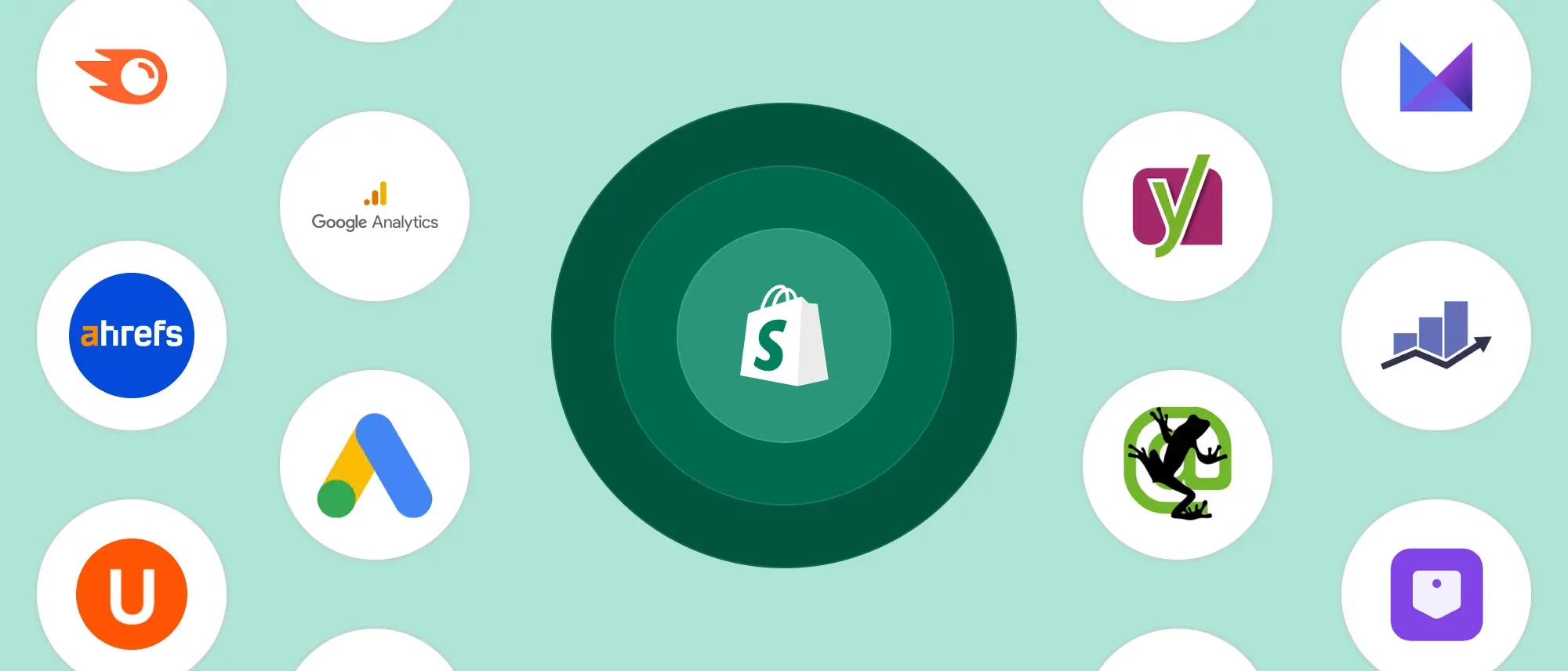
- Google Search Console is the essential free tool for monitoring Shopify search performance and indexing.
- Google Analytics 4 connects SEO traffic with product views, cart activity and purchases.
- Semrush and Ahrefs are most useful for keyword, competitor and backlink research.
- Screaming Frog provides deeper technical audits but has a steeper learning curve.
- PageSpeed Insights and GTmetrix help investigate Shopify performance problems.
- Shopify SEO apps can automate metadata, structured data, redirects and image optimisation.
- Rank Math is designed for WordPress and should not be installed or recommended for Shopify.
- Avoid installing multiple SEO apps that modify the same metadata or structured data.
- Verify every automated change before applying it across a large product catalogue.
- Tools identify opportunities; they do not guarantee rankings, traffic or revenue.
Shopify includes foundational SEO features, but larger stores often need additional tools for keyword research, technical auditing, structured data, page-speed analysis and performance reporting.
Based on our experience building and optimising more than 30 D2C Shopify stores, the most useful SEO setup is rarely the one with the most applications. Overlapping apps can generate conflicting metadata, duplicated structured data and unnecessary storefront scripts.
This guide compares 15 Shopify SEO tools across five requirements: search reporting, keyword research, technical auditing, performance analysis and Shopify-specific automation. We reviewed official product documentation and current pricing pages in July 2026. Features and prices may change after publication.
| Tool | Best for | Shopify-native? | Starting price* |
Google Search Console | Search performance and indexing | No | Free |
Google Analytics 4 | Organic traffic and ecommerce behaviour | No | Free |
Semrush | Keyword and competitor research | No | $139.95/month |
Ahrefs | Backlinks and competitor analysis | No | $129/month |
Screaming Frog | Technical crawling | No | Free; £199/year |
PageSpeed Insights | Core Web Vitals | No | Free |
Bing Webmaster Tools | Bing indexing and SEO reports | No | Free |
Yoast SEO for Shopify | On-page content guidance | Yes | $19/30 days |
Plug In SEO | Shopify SEO checks and automation | Yes | From $29.99/month |
Smart SEO | Metadata, JSON-LD and image optimisation | Yes | Free plan; Pro $14.99/month |
Tiny SEO | Images, speed and technical automation | Yes | Free to install; paid from $14/month |
SearchPie | On-page SEO, schema and speed tools | Yes | Free plan; paid plans available |
Avada SEO | Audits, images and structured data | Yes | Free plan; Pro $34.95/month |
SEO Manager | Metadata and Shopify SEO management | Yes | From $9/month |
BrightLocal | Local SEO for physical stores | No | Custom pricing |
Pricing was checked in July 2026. Features, limits and subscription costs may change. Confirm current pricing with the provider before subscribing.
Top 15 Best Shopify SEO Tools in 2026
1. Google Search Console
Best for: Monitoring Google visibility, indexing and technical search issues
Pricing: Free
Google Search Console provides first-party data about how a Shopify store performs in Google Search. It shows the queries generating impressions and clicks, the pages appearing in results, and indexing problems that may prevent products or collections from being discovered.
Shopify merchants can verify their domain, submit the automatically generated sitemap and inspect individual URLs. The tool can also report Core Web Vitals and issues affecting eligible product rich results.
Key features:
- Search queries, impressions, clicks and CTR
- Average search positions
- Page-indexing reports
- URL Inspection
- Sitemap submission
- Core Web Vitals
- Product structured-data reports
- Manual-action and security alerts
Consideration: Search Console reports Google data only and does not explain exactly how to correct every issue. Data can also take several days to appear.
2. Google Analytics 4
Best for: Connecting organic traffic with customer behaviour and revenue
Pricing: Free for the standard version
Google Analytics 4 helps Shopify merchants understand what visitors do after reaching the store. When ecommerce tracking is configured correctly, it can connect organic landing pages with product views, cart additions, checkout activity, purchases and revenue.
GA4 and Google Search Console serve different purposes. Search Console reports what happened before the click, while GA4 measures activity after the shopper reached the website.
Key features:
- Organic traffic reporting
- Landing-page analysis
- Ecommerce events
- Product and purchase reports
- Conversion-path analysis
- Audience segmentation
- Revenue attribution
- Custom explorations
Consideration: Incorrect event implementation can produce missing or duplicated purchase data. Compare GA4 transactions with Shopify orders before relying on its revenue reports.
3. Semrush
Best for: Keyword research, competitor analysis and rank tracking
Pricing: From $139.95 per month
Semrush is a general SEO platform that Shopify teams can use to research commercial keywords, compare competing stores, monitor rankings and audit publicly accessible pages.
Its Keyword Magic Tool can identify terms for products, collections and buying guides. Position Tracking monitors selected keywords, while Site Audit highlights crawling, metadata, linking and technical issues.
Semrush does not directly implement changes inside Shopify. Recommendations must be reviewed and then applied through Shopify Admin, the theme or another application.
Key features:
- Keyword Magic Tool
- Position Tracking
- Domain and competitor analysis
- Site Audit
- Backlink analysis
- Keyword Gap
- On-Page SEO Checker
- SEO Content Template
Consideration: The subscription may be excessive for a small store that only needs occasional keyword research.
4. Ahrefs
Best for: Backlink research and competitor content analysis
Pricing: From $129 per month
Ahrefs is particularly useful for examining competitor backlinks, organic keywords, high-performing pages and content gaps. Shopify merchants can use Site Explorer to evaluate competing ecommerce stores and Keywords Explorer to research product, collection and informational queries.
Site Audit can crawl a verified Shopify store and identify broken links, redirect chains, duplicate metadata, internal-linking problems and indexability issues. However, Ahrefs does not directly edit Shopify pages.
Key features:
- Site Explorer
- Keywords Explorer
- Backlink analysis
- Content Explorer
- Site Audit
- Rank Tracker
- Content Gap
- Broken-link reports
Consideration: Ahrefs provides extensive research data but will not automatically implement corrections. Store owners must translate the findings into Shopify changes.
5. Screaming Frog SEO Spider
Best for: Detailed technical crawling of Shopify stores
Pricing: Free for 500 URLs; £199 per year for the paid licence
Screaming Frog is a desktop crawler that can examine product, collection, blog and other publicly accessible Shopify URLs. It is useful for stores with extensive catalogues or complex technical SEO requirements.
The tool can identify broken links, redirect chains, missing metadata, canonical tags, duplicate headings and indexability directives. Custom extraction can also be used to review structured data or Shopify-specific page elements at scale.
Key features:
- Broken-link detection
- Redirect analysis
- Metadata auditing
- Canonical-tag inspection
- Duplicate-content detection
- Structured-data validation
- JavaScript rendering
- Custom extraction
- Internal-link analysis
Need Help With Shopify Development?
We build fast, custom Shopify stores designed to drive more sales.
Consideration: The interface and reports can be difficult for beginners. Crawling alone does not determine which issues deserve priority.
6. Google PageSpeed Insights
Best for: Core Web Vitals and storefront performance analysis
Pricing: Free
PageSpeed Insights evaluates Shopify pages on mobile and desktop. It combines Lighthouse laboratory testing with available Chrome User Experience Report data collected from real visitors.
Test representative product, collection, home, and article pages rather than relying exclusively on the homepage. Different templates commonly load different applications, images, and scripts.
Key features:
- Mobile and desktop analysis
- Laboratory performance data
- Real-user field data when available
- Largest Contentful Paint
- Interaction to Next Paint
- Cumulative Layout Shift
- Performance diagnostics
- Optimisation recommendations
Consideration: A Lighthouse performance score is not a complete SEO or user-experience measurement. Field data covers the previous 28 days and may be unavailable for stores without sufficient traffic.
7. Bing Webmaster Tools
Best for: Bing indexing, search performance and IndexNow
Pricing: Free
Bing Webmaster Tools helps Shopify merchants understand how their store performs in Bing Search. It provides search reports, URL inspection, backlink information, crawling data and technical SEO recommendations.
Store owners can submit their Shopify sitemap or import a verified website from Google Search Console. IndexNow can help participating search engines discover eligible URL changes more quickly, although submission does not guarantee indexing or rankings.
Key features:
- Search performance reports
- URL Inspection
- Sitemap submission
- Site Scan
- Keyword research
- Backlink reports
- Crawl information
- IndexNow
Consideration: Bing Webmaster Tools covers Microsoft’s search ecosystem and should complement rather than replace Google Search Console.
8. Yoast SEO for Shopify
Best for: On-page optimisation and content guidance
Pricing: $19 per 30 days, with a 14-day free trial
Yoast SEO for Shopify provides real-time guidance for optimising product pages, collections, blog posts and other editable content. Its analysis checks the use of focus keywords, titles, descriptions, internal links and readability.
The Shopify version can also generate structured data and provide search and social previews. Its scoring system is most useful as an editing checklist rather than a strict requirement.
Key features:
- On-page SEO analysis
- Readability guidance
- Metadata templates
- Search-result previews
- Social-media previews
- Structured data
- Internal-link suggestions
- SEO training and support
Consideration: A green Yoast score does not guarantee rankings or content quality. Avoid awkward keyword repetition merely to satisfy the scoring system.
9. Plug In SEO
Best for: Guided Shopify SEO checks and metadata management
Pricing: From $29.99 per month, with a 14-day free trial
Plug In SEO is a Shopify-native application that scans stores for missing metadata, broken links and other common SEO issues. It provides step-by-step guidance intended for merchants who want to manage foundational optimisation without using a separate technical crawler.
The application also includes metadata tools, structured data, keyword functionality and redirect management. Plan limits depend on the number of pages scanned and audited.
Key features:
- Shopify SEO audits
- Metadata management
- Keyword research
- JSON-LD structured data
- Broken-link reports
- One-click redirects
- Bulk editing
- Search-result previews
Consideration: Some merchants have reported residual theme code or feature limitations after installation. Duplicate the theme, review the app’s changes and confirm its code is removed cleanly if you uninstall it.
10. Smart SEO
Best for: Bulk metadata, structured data and image optimisation
Pricing: Free plan; paid plans from $14.99 per month
Smart SEO is a Shopify application for managing metadata, image alt text, JSON-LD, broken links and selected performance tasks. Its bulk tools can reduce repetitive work for stores with large product catalogues.
Higher plans add image optimisation, automated audits, multilingual functionality and AI-assisted metadata generation. Review generated titles, descriptions and alt text before publishing them at scale.
Key features:
- Bulk meta-tag optimisation
- Image alt-text management
- JSON-LD
- Broken-link monitoring
- Image optimisation
- SEO audits
- AI-assisted generation
- Multilingual support on eligible plans
Consideration: Check whether the theme or another app already generates structured data. Running several schema applications simultaneously can create duplicated or conflicting markup.
11. Tiny SEO Speed Image Optimizer
Best for: Image-heavy stores requiring SEO and performance automation
Pricing: Free to install; paid plans from $14 per month
Tiny SEO combines image compression, resizing, alt-text optimisation, metadata tools, redirect management and selected page-speed features. It is particularly relevant to Shopify stores with large product-image catalogues.
The app also supports JSON-LD, broken-link detection, IndexNow and technical audits. Usage limits and additional image charges depend on the selected plan.
Key features:
- Image compression and resizing
- Alt-text optimisation
- Metadata management
- Broken-link detection
- Redirect management
- JSON-LD
- IndexNow
- CSS and JavaScript minification
- Site auditing
Consideration: Test visual quality and storefront performance before and after activating optimisation features. Automated alt text should describe images accurately instead of mechanically inserting keywords.
12. SearchPie
Best for: Shopify on-page SEO, schema and technical automation
Pricing: Free plan; paid plans available
SearchPie combines metadata management, image optimisation, structured data, broken-link detection and selected speed features in one Shopify application.
It may suit merchants seeking an integrated application instead of separate tools for each repetitive SEO task. Higher plans add expanded automation, AI-generated metadata, keyword tools and additional optimisation limits.
Key features:
- Meta-title and description optimisation
- Image alt text and compression
- Structured data
- Broken-link detection
- Redirect management
- Page-speed features
- SEO auditing
- Search Console reporting
- AI-assisted metadata
Consideration: Review bulk-generated metadata carefully. Some merchant reviews report duplicated or unsuitable metadata when default templates were applied without sufficient customisation.
13. Avada AI SEO Image Optimizer
Best for: Image optimisation, on-page audits and structured data
Pricing: Free plan; Pro from $34.95 per month
Avada AI SEO Image Optimizer provides tools for compressing images, managing metadata, auditing pages and adding structured data. The free plan allows stores to test limited image and on-page optimisation before moving to higher-volume plans.
The application also includes an HTML sitemap, alt-text tools and selected page-speed functionality. Paid plans increase image, audit and AI-generation limits.
Key features:
- Image compression
- Image alt-text optimisation
- Metadata management
- On-page audits
- Structured data
- HTML sitemap
- Broken-link management
- Page-speed tools
- AI-assisted content
Need Help With Shopify Development?
We build fast, custom Shopify stores designed to drive more sales.
Consideration: Do not enable every automated feature by default. Test the effect on image quality, structured data, and storefront performance, particularly when other SEO apps are already installed.
14. SEO Manager by venntov
Best for: Shopify metadata, redirects and routine SEO management
Pricing: From $9 per month, with a free trial
SEO Manager by venntov is a Shopify-native tool for identifying SEO problems and managing titles, descriptions, structured data, redirects and other on-page elements.
Its templates can help merchants apply consistent metadata across products and collections. However, important commercial pages should still receive individually written titles and descriptions based on their search intent.
Key features:
- SEO health checks
- Bulk metadata editing
- Metadata templates
- Structured data
- 404 monitoring
- Redirect management
- Image alt-text tools
- Google integration
- Search-result previews
Consideration: Automated templates save time but can produce repetitive metadata. Confirm that each important product and collection page remains distinctive.
15. BrightLocal
Best for: Shopify brands with shops, showrooms or multiple physical locations
Pricing: Customised according to locations and selected services; free trial available
BrightLocal is a local SEO platform rather than a Shopify application. It is relevant to ecommerce businesses that also operate physical stores, showrooms or regional locations.
The platform can monitor local search visibility, audit Google Business Profiles, track citations and manage reviews. Purely online Shopify stores without a physical customer-facing location may receive limited value from it.
Key features:
- Local rank tracking
- Local Search Grid
- Citation tracking
- Citation building
- Google Business Profile audits
- Local search audits
- Listing management
- Review monitoring and acquisition
Consideration: BrightLocal does not optimise Shopify product or collection pages. It should be selected only when local search visibility supports the store’s business model.
How to Choose the Right Shopify SEO Tools
Choose tools according to the problem you need to solve rather than the total number of features advertised.
Consider:
- Whether you need research, monitoring or implementation
- The size of your product catalogue
- Your technical SEO experience
- International and multilingual requirements
- Apps already modifying metadata or structured data
- Monthly costs and usage limits
- Whether automated changes can be previewed and reversed
A practical starting stack for most Shopify stores is Google Search Console, Google Analytics 4 and PageSpeed Insights. Add Semrush or Ahrefs when you need deeper keyword, competitor or backlink research.
Install a Shopify SEO app only when it solves a defined implementation problem. Avoid running multiple apps that generate metadata, schema, redirects or image optimisations because overlapping functionality can create conflicts and unnecessary storefront code.
Conclusion
Shopify SEO tools can reveal indexing problems, technical errors, content opportunities, and performance issues, but they cannot replace a clear SEO strategy.
Begin with Google Search Console, GA4 and PageSpeed Insights. Add a research platform or Shopify SEO app when the store’s size and requirements justify it. Review automated changes, remove overlapping applications and measure results using organic clicks, qualified sessions, conversions and revenue.
If technical implementation requires changes to your theme, structured data or storefront performance, you can hire Shopify experts to investigate and implement the required improvements.
Frequently Asked Questions
What is the best free SEO tool for Shopify?
Google Search Console is the most important free starting point because it reports Google impressions, clicks, indexing problems, and search queries. GA4 and PageSpeed Insights provide complementary behaviour and performance data.
What is the best Shopify SEO app?
There is no universal best app. Plug In SEO provides guided audits, Smart SEO supports bulk metadata and structured data, while Tiny SEO and Avada include image and performance features.
Does Shopify have built-in SEO tools?
Shopify automatically provides editable metadata, canonical tags, a sitemap and other foundational features. Additional tools may be required for keyword research, technical crawling, rank tracking and large-scale automation.
Can installing an SEO app improve Shopify rankings?
An SEO app can help identify or implement improvements, but installing one does not directly increase rankings. Search visibility depends on technical quality, content relevance, authority, competition, and consistent execution.
Should I install more than one Shopify SEO app?
Usually not when the applications perform overlapping tasks. Multiple apps modifying metadata, schema, redirects or images can create conflicts. Define each application’s responsibility before installing it.
Do I need paid Shopify SEO tools?
Not initially. Google Search Console, GA4, PageSpeed Insights, and Bing Webmaster Tools cover important monitoring requirements. Paid platforms become useful when deeper research, tracking, or automation justifies their cost.
How long does Shopify SEO take to show results?
There is no fixed timeline. Technical corrections may be processed relatively quickly, while competitive product and collection keywords can take considerably longer. Monitor indexing, impressions, clicks, conversions, and revenue.