The Double Diamond is a structured design process that helps teams move from problem exploration to solution delivery with clarity and focus.
I’ve structured this guide to make the framework easier to apply in real-world scenarios, because many teams jump into solutions too early without fully understanding the problem.
By separating problem definition from solution development, the Double Diamond ensures decisions are based on validated insights rather than assumptions.
What is the Double Diamond?
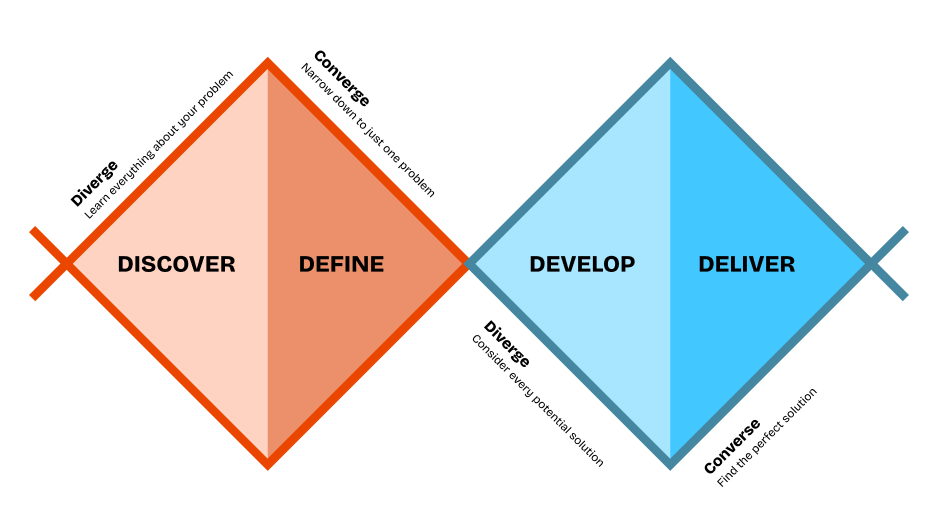
The Double Diamond is a design framework that visualizes the journey from problem to solution using two connected phases.
Each phase follows a pattern of divergent thinking to explore options and convergent thinking to refine decisions.
This structure ensures teams first define the right problem before building solutions.
What are The Two Diamonds in Process?
The Double Diamond framework uses two distinct diamonds because design thinking naturally splits into two fundamental challenges: understanding the problem and creating the solution.
The first diamond represents the problem space. It begins with divergent thinking during the Discover phase, where designers gather wide-ranging insights through research, user interviews, and observation. This broadens understanding before converging in the Define phase to identify the core problem worth solving.
The second diamond represents the solution space. It starts with divergent thinking in the development phase, where designers generate multiple potential solutions and concepts. Then it narrows through convergent thinking in the Deliver phase, where ideas are tested, refined, and implemented.
This two-diamond structure is powerful because it prevents the common design mistake of rushing to solutions before fully understanding the problem. By explicitly separating problem exploration from solution creation, the framework ensures designers solve the right problem with the right solution, rather than creating perfect solutions to the wrong problems.
Each diamond's diverge-converge pattern also acknowledges that creativity requires both expansive exploration and focused refinement at different stages of the design process.
4 Phases of the Double Diamond Design Process
1. Discover (Divergent Thinking)
The Discover phase focuses on gathering insights through research, interviews, and observation.
The goal is to explore the problem space broadly without filtering ideas too early.
This ensures a deeper understanding of user needs and context.
2. Define (Convergent Thinking)
The Define phase narrows insights into a clear problem statement.
Teams identify patterns, prioritize user needs, and align on what needs to be solved.
This creates a focused direction for solution development.
3. Develop (Divergent Thinking)
The Develop phase focuses on generating multiple solution ideas.
Teams explore concepts, create prototypes, and experiment with different approaches.
This phase encourages creativity without immediate evaluation.
4. Deliver (Convergent Thinking)
The Deliver phase refines and validates solutions through testing and feedback.
Teams evaluate usability, improve designs, and prepare for implementation.
This ensures the final solution meets user and business requirements.
Tools and Techniques for Each Phase
Discovery Phase Tools
- User Interviews: Conduct in-depth conversations with target users to understand their needs, pain points, and behaviours
- Contextual Inquiry: Observe users in their natural environment as they interact with products or services
- Competitive Analysis: Evaluate similar solutions in the market to identify gaps and opportunities
- Surveys and Questionnaires: Gather quantitative data from larger user groups
- Journey Mapping: Document the user's current experience step by step
- Trend Analysis: Research emerging patterns in the industry or user behaviour
Definition Phase Tools
- Affinity Diagrams: Organize large amounts of research data and insights into related groups to reveal patterns and connections
- Persona Development: Create representative user archetypes based on research
- Problem Framing: Craft clear "How Might We" statements to define the challenge
- Prioritization Matrices: Evaluate problems based on impact and feasibility
- User Need Statements: Articulate specific user needs in a structured format
- Stakeholder Mapping: Identify key players and their interests in the problem space
Turn Ideas Into Designs That Sell
Work with our team to create UI that wows investors and converts customers.
Development Phase Tools
- Brainstorming Sessions: Generate a wide range of solution ideas
- Sketching Workshops: Quickly visualize potential solutions
- Crazy Eights: Draw eight distinct ideas in eight minutes to encourage divergent thinking
- Card Sorting: Organize information architecture with user input
- Storyboarding: Illustrate user scenarios and solution concepts
- Co-creation Workshops: Involve users in generating solution ideas
Delivery Phase Tools
- Prototyping: Create low to high-fidelity representations of solutions
- Usability Testing: Evaluate prototypes with real users
- A/B Testing: Compare different solution versions to identify the most effective
- Heuristic Evaluation: Assess usability against established principles
- Implementation Planning: Create roadmaps for development
- Feedback Collection Systems: Establish methods to gather ongoing input after launch
Each phase's tools support either divergent thinking (expanding possibilities) or convergent thinking (narrowing focus), depending on where they fall in the diamond. The most effective design processes use a combination of these tools, adapting them to the specific project context and available resources.
How to use the Double Diamond Design Process
Start with a Clear Challenge
Begin by formulating an initial challenge statement—though expect it to evolve as you progress through the process. Define the scope, timeline, and team members who will participate in each phase.
Assemble the Right Team
Form a diverse, cross-functional team with different perspectives and expertise. Include stakeholders, subject matter experts, and when possible, end users in appropriate phases.
Plan Your Activities for Each Phase
For Discover: Schedule research activities like interviews, surveys, and observation sessions. Allocate time for team members to share findings regularly.
For Define: Organize workshops to analyze research data, identify patterns, and craft a precise problem statement. Plan sessions for prioritizing insights and reaching consensus.
For Develop: Arrange ideation sessions with clear techniques and formats. Schedule time for individual ideation followed by collaborative development.
For Deliver: Plan testing sessions with users, create a feedback collection system and develop an implementation roadmap.
Document Everything
Maintain thorough documentation throughout the process. Create visual representations of your progress, such as journey maps, insight boards, and prototype iterations.
Embrace Iteration
Don't treat the Double Diamond as a rigid, linear process. Be prepared to revisit earlier phases if new insights emerge that challenge your understanding.
Time Management
Allocate appropriate time to each phase based on project complexity. Avoid rushing through the problem space (first diamond) to get to solutions—this is a common pitfall.
Involve Users Throughout
Incorporate user input in every phase, not just during initial research. Continuous user involvement ensures solutions remain grounded in real needs.
Communicate Progress
Regularly share progress, insights, and direction with stakeholders to maintain alignment and gather additional perspectives.
By following these practical steps, design teams can effectively implement the Double Diamond process to create solutions that genuinely address user needs while meeting business objectives.
Common Misconceptions About the Double Diamond

"It's a Linear, One-Way Process"
Many mistakenly view the Double Diamond as a rigid, sequential process that moves in only one direction. In reality, it's highly iterative. Teams often cycle back to previous phases as new insights emerge. You might return to Discovery after defining your problem, or revisit Development after testing reveals issues during Delivery.
"Each Phase Takes Equal Time"
There's no rule that each diamond or phase must receive equal time allocation. The appropriate duration depends entirely on project complexity, team familiarity with the problem space, and available resources. Some projects might benefit from an extended Discovery phase, while others may require more iteration during Development.
"It's Only for Major Design Projects"
While the Double Diamond works excellently for large-scale initiatives, it's equally valuable for smaller projects. The framework can be scaled up or down, with simpler projects potentially completing a diamond in days rather than weeks or months.
"The Goal is Perfect Execution of Each Phase"
The Double Diamond isn't about perfection but about making informed decisions with available information. Each phase doesn't need to be exhaustively completed before moving forward—it's about reaching sufficient understanding to progress effectively.
"It's Only for Designers"
Though originating in design, the Double Diamond is fundamentally a problem-solving framework applicable to various disciplines. Business strategists, product managers, engineers, and marketers can all benefit from its structured approach to understanding problems before developing solutions. Data-driven design methodologies can complement this framework by providing quantitative insights during each phase.
"Divergent Thinking Means Including Every Possible Idea"
While divergent phases encourage broad exploration, they should still maintain strategic focus. Not every idea or insight deserves equal attention—the key is gathering diverse perspectives while remaining relevant to the core challenge.
Understanding these misconceptions helps teams implement the Double Diamond more effectively, adapting it to their specific needs rather than following a perceived "correct" application of the framework.
Double Diamond on a Budget
Low-Cost Research Techniques
Conduct guerrilla research using coffee shop interviews instead of formal user testing facilities. Utilize free survey tools like Google Forms rather than premium research platforms. Leverage your personal network for initial user testing—friends and family can provide valuable early feedback if you guide them properly.
DIY Workshop Materials
Create your own workshop materials using basic office supplies instead of specialized design thinking kits. Use sticky notes, markers, and large sheets of paper from office supply stores. Digital alternatives like Miro offer free plans that work well for small teams.
Turn Ideas Into Designs That Sell
Work with our team to create UI that wows investors and converts customers.
Prioritize Your Spending
Invest resources strategically in phases that matter most for your specific project. For example, allocate more budget to Discovery for unfamiliar problem areas, or to Delivery for complex implementation challenges.
Time-Boxed Activities
Set strict time limits for each phase to prevent scope creep. A tightly time-boxed process forces prioritization and focus, making better use of limited resources.
Leverage Existing Data
Before conducting new research, thoroughly mine existing sources—customer service logs, analytics, and previous research can provide substantial insights at zero additional cost.
Remote Collaboration Tools
Use free tiers of digital collaboration tools like Mural, Figma, or Google Jamboard for distributed teamwork instead of in-person workshops requiring travel and venue costs.
Paper Prototyping
Create low-fidelity prototypes using paper and basic materials before investing in digital prototyping tools or high-fidelity mockups.
Community Testing
Tap into online communities, local meetups, or social media groups for user testing and feedback rather than paying for professional testing participants.
FAQ
1. What is the Double Diamond process?
A framework for problem-solving using four design phases.
2. What are the four stages?
Discover, Define, Develop, and Deliver.
3. Why is Double Diamond important?
It ensures solving the right problem before building solutions.
4. Is Double Diamond only for designers?
No, it applies to multiple industries and roles.
5. What is divergent vs convergent thinking?
Divergent explores ideas, convergent refines decisions.
6. Can Double Diamond be used in startups?
Yes, it works for both small and large projects.
7. Is Double Diamond a linear process?
No, it is iterative and flexible.
8. What is the goal of Double Diamond?
To create validated, user-centered solutions.
Conclusion
The Double Diamond process provides a powerful framework for tackling design challenges with structure and flexibility, complementing the iterative design process for comprehensive problem-solving. Separating problem understanding from solution creation, helps teams avoid the common mistake of solving the wrong problems.
This approach balances creativity with focus, ensuring solutions address genuine user needs. Whether applied to large projects or small initiatives, with substantial budgets or limited resources, the Double Diamond methodology remains an effective approach to user-centered design and problem-solving.

Syed Nazia
I’m a UI/UX designer creating user-friendly and visually appealing interfaces. I focus on improving user experience in digital products.