Why Do React Native & Flutter Outperform Kotlin & Swift?
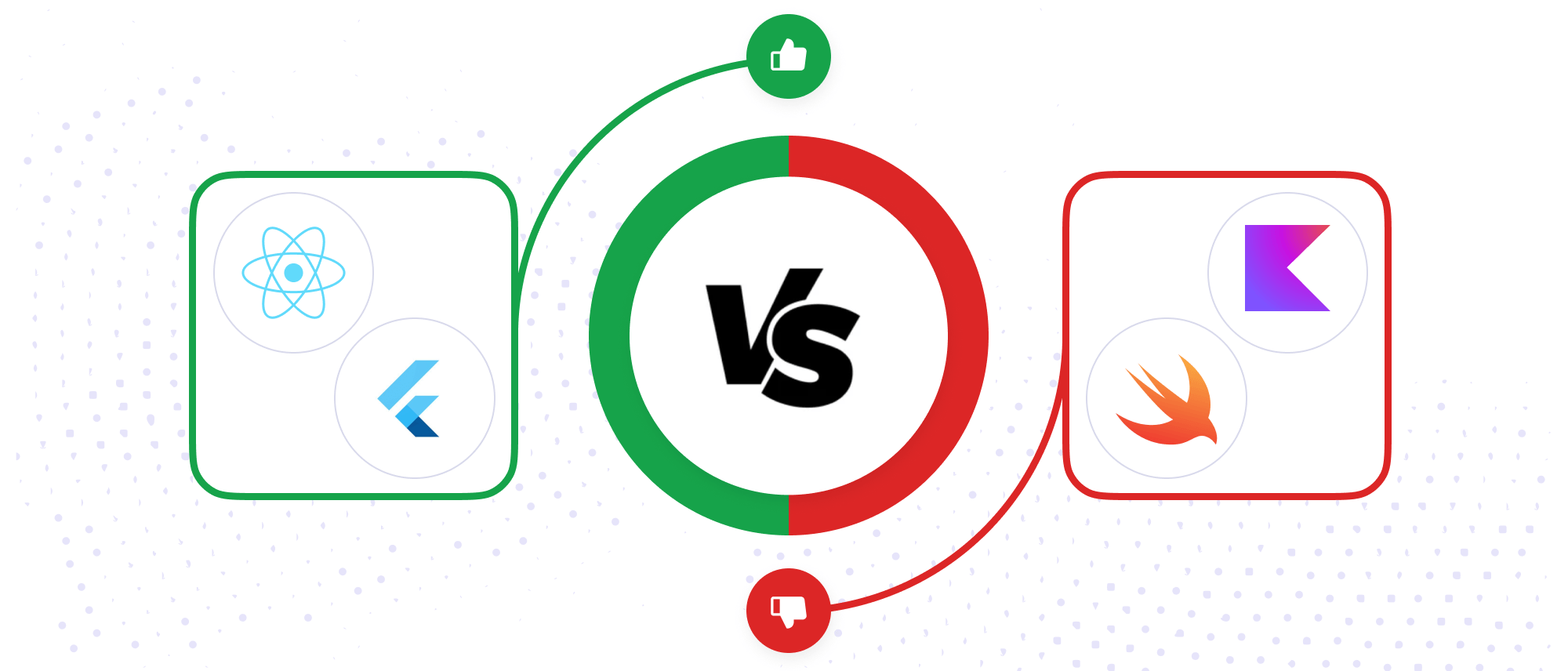
Choosing between native development (Kotlin, Swift) and cross-platform frameworks like React Native and Flutter affects far more than just the codebase. It influences how quickly you can ship, how easily you maintain the product, and how efficiently your team scales.
A few years ago, native was the default for performance-heavy apps. Today, that gap has narrowed. Frameworks like React Native and Flutter are powering production features inside companies like Walmart and Instagram, not as experiments, but as deliberate engineering choices to improve velocity and maintainability.
In this article, I’ll break down where React Native and Flutter actually outperform native development, across cost, development speed, technical architecture, and long-term maintenance and where native still makes sense. The goal isn’t to push hybrid as a trend, but to help you choose based on trade-offs that matter in real product environments.
1. Reduced Development Time and Cost
React Native and Flutter let teams build a single shared codebase for both Android and iOS. This removes duplicate feature development and reduces parallel testing efforts.
Faster Development:
Features are implemented once and deployed to both platforms, speeding up initial builds and future iterations.
Lower Long-Term Cost:
With fewer platform-specific dependencies and simplified maintenance, updates and bug fixes require less engineering effort over time.
2. Easier Maintenance and Updates
With a shared codebase, teams avoid maintaining parallel feature branches, duplicate QA workflows, and platform-specific bug tracking.
Unified Release Management:
Updates, patches, and version upgrades are coordinated from a single codebase, reducing fragmentation between Android and iOS builds.
Lower Risk of Platform Drift:
Native teams often implement features slightly differently over time. A shared architecture helps maintain feature parity and UI consistency across platforms.
This becomes especially valuable as the product scales and update cycles become more frequent.
3. Faster Time-to-Market
Cross-platform frameworks reduce initial build time by eliminating parallel platform development.
Let’s Build Your React Native App Together!
We build powerful React Native apps that run smoothly on iOS and Android — fast, reliable, and ready to scale.
Rapid Prototyping:
Pre-built UI components, shared business logic, and hot reload capabilities allow teams to iterate quickly during early product validation.
Simultaneous Deployment:
Launching on Android and iOS at the same time avoids staggered releases and shortens the feedback loop from real users.
This is especially useful for startups and product teams validating features under tight timelines.
4. Flexibility in Hiring
React Native and Flutter leverage widely adopted ecosystems (JavaScript and Dart), expanding the available talent pool compared to strictly native development.
Broader Developer Base:
Teams can recruit from web and cross-platform backgrounds rather than hiring separate Android and iOS specialists.
Team Versatility:
Engineers can contribute across both platforms within a single codebase, reducing dependency on platform-specific silos.
This flexibility is particularly valuable for growing teams that need to scale without doubling platform-specific resources.
Technical Advantages of Hybrid Apps
Modern cross-platform frameworks have significantly narrowed the performance gap with native development by improving architecture, rendering pipelines, and runtime efficiency.
Shared Business Logic
Core application logic can be reused across Android and iOS, reducing duplication while preserving platform-specific capabilities when needed.
Hot Reload & Fast Refresh
Developers can see UI and logic changes instantly without full rebuilds, accelerating debugging and iteration cycles.
Direct Access to Native APIs
Both React Native and Flutter allow integration with native modules, enabling access to device features such as camera, GPS, sensors, and background services.
Improved Rendering Performance
Flutter compiles ahead-of-time (AOT) to native code and uses its own rendering engine, while React Native optimizes communication between JavaScript and native layers through improved bridge architecture.
Near-Native User Experience
With optimized rendering pipelines and platform-specific UI components, hybrid apps can deliver smooth animations and responsive interfaces for most business applications.
Let’s Build Your React Native App Together!
We build powerful React Native apps that run smoothly on iOS and Android — fast, reliable, and ready to scale.
Each framework has architectural differences, but both are now capable of supporting production-scale apps without the historical performance limitations of early hybrid tools.
When Hybrid Apps Aren't a Good Fit
While hybrid apps offer many benefits, they may not be suitable for every project. Here are some scenarios where native languages like Kotlin and Swift may be a better choice:
- High-Performance Requirements: If your app requires extreme performance, such as gaming or video editing, native languages may be a better choice.
- Complex Native Integration: If your app requires complex native integration, such as accessing native hardware or APIs, native languages may be a better choice.
- Custom UI Requirements: If your app requires a highly customized UI, native languages may be a better choice.
- Real-Time Features and Advanced Animations: If your app requires real-time features, such as live streaming or highly advanced animations, native development might be a better choice.
Frequently Asked Questions?
1. Are hybrid apps slower than native apps?
While this may have been true in the past, hybrid apps have made significant improvements in performance. Just-in-Time (JIT) compilation and optimized bridge implementations in frameworks like React Native have drastically reduced the performance gap.
2. Are hybrid apps less secure than native apps?
Both React Native and Flutter provide robust security features, including encryption and secure storage.
3. Can hybrid apps access native functionality?
Both React Native and Flutter provide native modules, which allow developers to access native functionality and APIs. React Native and Flutter both offer direct bindings to native components, allowing access to camera, GPS, and other device-specific features.
4. Do hybrid apps provide a native look and feel?
Modern hybrid frameworks can closely mimic native UI components and behaviors. Flutter uses its own rendering engine to create pixel-perfect UI components that look native on both platforms. React Native uses platform-specific UI components under the hood.
5. Is it harder to get hybrid apps approved in app stores?
App store approval processes don't discriminate against hybrid apps. As long as your app meets the store guidelines and provides a good user experience, the underlying technology doesn't matter to app store reviewers.
Conclusion
React Native and Flutter are no longer experimental alternatives to native development; they are mature frameworks capable of supporting production-scale applications across industries. For many products, the operational advantages of shared architecture, faster iteration cycles, and simplified maintenance outweigh the marginal performance benefits of fully native builds.
That said, native development still has a place in performance-intensive or deeply system-level applications. The right choice depends on product complexity, scalability requirements, and long-term maintenance strategy, not just on technical preference.
If you're evaluating the right approach for your next mobile product, the decision should be based on trade-offs that impact cost, velocity, and engineering structure over time.
At F22 Labs, we help teams make that decision with clarity, whether it leads to Flutter, React Native, or native development, and execute it with a focus on performance, scalability, and business alignment.

Murtuza Kutub
A product development and growth expert, helping founders and startups build and grow their products at lightning speed with a track record of success. Apart from work, I love to Network & Travel.