In-House vs Outsourced Project Management: Which Model Fits?
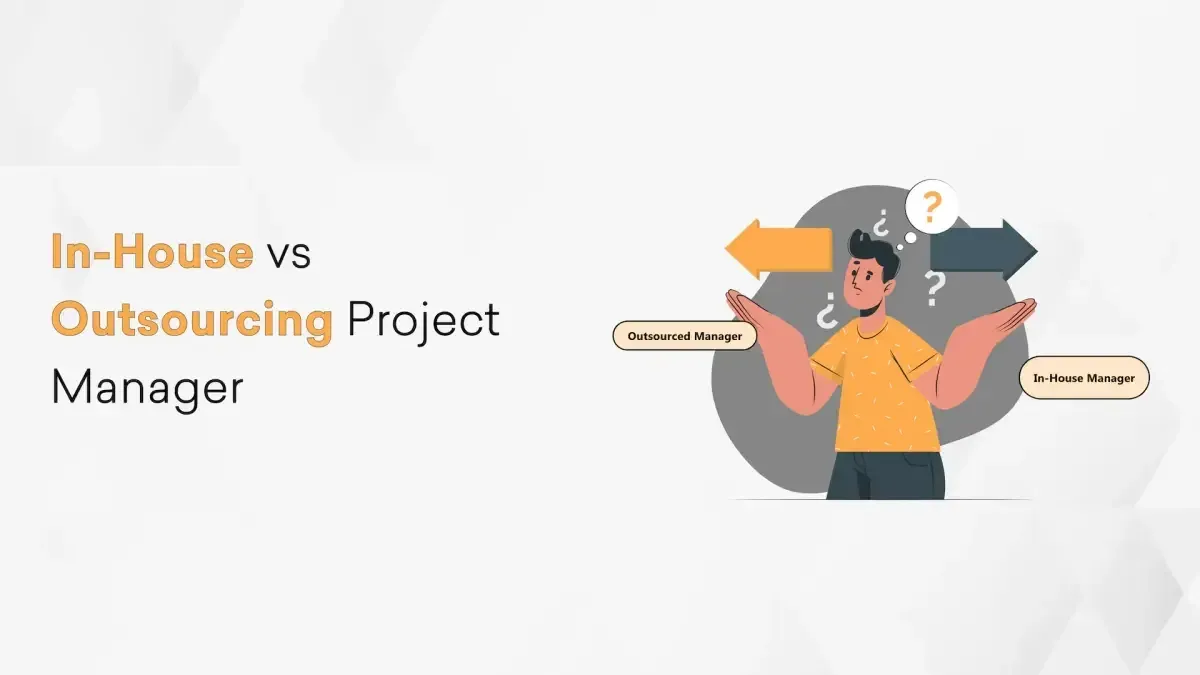
According to the Project Management Institute, organizations waste an average of $97 million for every $1 billion invested due to poor project performance. The model you use to manage projects, in-house, outsourced, or a hybrid, directly affects whether your projects land on time and on budget.
Project management outsourcing has grown significantly as companies look for ways to access specialized expertise without the fixed overhead of a permanent PMO (Project Management Office).
But it's not the right fit for every organization. This guide breaks down both models honestly, including a third option most comparisons skip: the hybrid approach.
What Is Outsourcing in Project Management?
Outsourcing in project management means engaging an external firm or individual to plan, coordinate, and oversee project delivery on your behalf.
The outsourced project manager operates with the same responsibilities as an internal hire, scope management, timelines, budgets, stakeholder communication, and risk, but without being a full-time employee on your payroll.
This is different from hiring a freelance consultant for advice. An outsourced project manager takes ownership of delivery outcomes, not just recommendations.
What is In-House Project Management?
An in-house project manager is a full-time employee embedded in your organization. They know the internal processes, the team dynamics, and the organizational priorities that don't get documented anywhere.
In-House Project Management Advantages:
Deep institutional knowledge. An internal PM understands the history behind decisions, the informal power structures, and the internal dependencies that external managers take months to learn. This reduces miscommunication and speeds up decision-making on complex internal projects.
Direct control and accountability. You set priorities, processes, and standards. The PM works within your management chain with no competing external obligations.
Cultural alignment. Long-term team cohesion is easier when project leadership is part of the culture, not visiting it.
In-House Project Management Disadvantages:
High fixed cost. According to Glassdoor, the average project manager salary in the US is $95,000–$130,000 per year, before benefits, training, certifications, and tools. This cost is fixed whether or not there are active projects.
Limited cross-industry exposure. Internal PMs build deep expertise in your domain. The trade-off is narrower exposure to methodologies and solutions from other industries that could solve problems faster.
Hiring and retention difficulty. Qualified PMs with the right certifications (PMP, CSM, PRINCE2) are in high demand. Recruiting, onboarding, and retaining them adds significant time and cost.
Scalability constraints. When project volume spikes, internal teams hit capacity limits. Scaling up means hiring, a process that takes months, not weeks.
What is Outsourced Project Management?
Project management outsourcing brings in an external team or individual to manage delivery. They typically integrate into your workflows, use your tools, and report to your leadership, but come from outside the organization.
Partner with Us for Success
Experience seamless collaboration and exceptional results.
Advantages of Outsourced Project Management:
Immediate access to specialized expertise. Outsourced project management firms work across multiple industries and project types. They bring established frameworks, risk playbooks, and cross-sector experience that an internal hire from a single industry won't have.
Lower total cost. You pay for the engagement, not the overhead. No benefits, no PTO accrual, no certification reimbursement, no idle time between projects. Deloitte's Global Outsourcing Survey consistently finds cost reduction as the primary driver for outsourcing decisions.
Flexibility and scalability. You scale up for large or complex projects and scale down when delivery is complete. No structural headcount decisions required.
Objective perspective. External PMs are not subject to internal politics, personal relationships, or organizational bias. They can flag risks and inefficiencies that internal teams have normalized.
Faster deployment. An experienced outsourced PM can be operational within days. Hiring and onboarding an in-house PM typically takes 6–12 weeks from job posting to productive contribution.
Disadvantages of Outsourced Project Management:
Less organizational context. An external PM starts without institutional knowledge. There is a ramp-up period to understand internal dynamics, team capabilities, and legacy decisions.
Reduced direct control. The PM works within a contract and a defined scope. Reprioritizing outside that scope requires renegotiation.
Communication overhead. Remote coordination across time zones or different working practices introduces friction if not structured properly from the start.
Dependency risk. If a key outsourced PM leaves the engagement, continuity depends on how well the provider manages transitions, which varies significantly between firms.
The Hybrid Model
Many organizations land between both extremes. A hybrid model keeps a small in-house PM function for strategic, ongoing work, the projects tied directly to the core product or long-term roadmap, while using outsourced project management for short-term, specialist, or high-volume bursts.
This is particularly effective for:
- Organizations in growth phases with unpredictable project volume
- Teams that have a stable internal PM for BAU (business as usual) but need surge capacity for a major implementation or launch
- Companies building internal PM maturity by having an outsourced firm establish frameworks, tooling, and documentation before handing off to an internal team
The challenge with a hybrid model is coordination. Two PM functions operating with different tools, methodologies, or reporting cadences create confusion. Clear ownership boundaries and a single source of truth for project status are non-negotiable.
Cost Comparison of In-House and Outsourced Project Management
| In-House PM | Outsourced PM | Hybrid | |
Annual cost (US) | $120K–$180K (salary + benefits) | $60K–$120K (engagement fee, varies) | $80K–$150K |
Setup time | 6–12 weeks | 1–2 weeks | Varies |
Scalability | Low (headcount-dependent) | High | Medium |
Ideal project volume | Continuous, high volume | Specific projects or bursts | Mixed |
Knowledge retention | High | Low–Medium | Medium |
Cost figures are approximate and vary significantly based on region, seniority, and project complexity.
How to Decide: A Practical Framework?
Choose in-house project management when:
- You have a consistent, high volume of projects running year-round
- Your projects are deeply tied to proprietary systems, processes, or sensitive data where external access creates risk
- Cultural continuity and long-term team ownership are critical to delivery quality
- You are at a scale where the fixed cost of an internal PM is lower than the aggregate cost of repeated outsourcing
Outsource project management when:
- You need to deliver a specific project or program without adding permanent headcount
- Your projects require cross-industry expertise or a methodology your internal team doesn't have
- You need delivery to begin immediately, and you can't absorb a 3-month hiring timeline
- Project volume is inconsistent, with high demand during certain periods and low demand between them
Partner with Us for Success
Experience seamless collaboration and exceptional results.
Consider a hybrid when:
- You have ongoing internal projects AND periodic specialist or high-complexity initiatives
- You want to build internal PM capability over time while maintaining delivery momentum now
- You've outgrown freelance PM support but aren't ready to build a full in-house PMO
Frequently Asked Questions
What is outsourced project management?
It's hiring an external firm or individual to manage project delivery, scope, timelines, budget, risks, and stakeholder communication, without adding a full-time employee.
Is project management outsourcing cheaper than hiring in-house?
Usually, yes, for specific or short-term projects. For continuous, high-volume project work, in-house becomes more cost-effective over time.
What are the risks of outsourcing in project management?
The main risks are loss of institutional context, communication overhead, and dependency on the provider's consistency. Mitigate with clear contracts, a defined scope, and structured onboarding.
When does a hybrid PM model make sense?
When project volume is mixed, stable ongoing work suits an internal PM, while complex or specialist projects benefit from external expertise brought in as needed.
How long does it take to get an outsourced project manager operational?
Most experienced outsourced PM teams are operational within 1–2 weeks. In-house hiring, by comparison, typically takes 6–12 weeks from posting to productive contribution.
Final Thoughts
The right model isn't universal; it depends on your project volume, budget structure, and how critical institutional knowledge is to your delivery outcomes. Most organizations benefit from starting with outsourced project management to establish processes, then evaluating whether the volume justifies building in-house.
If you're evaluating how to structure project management for your next development initiative, F22 Labs provides dedicated teams with embedded project management. Book a free consultation to discuss what fits your stage.